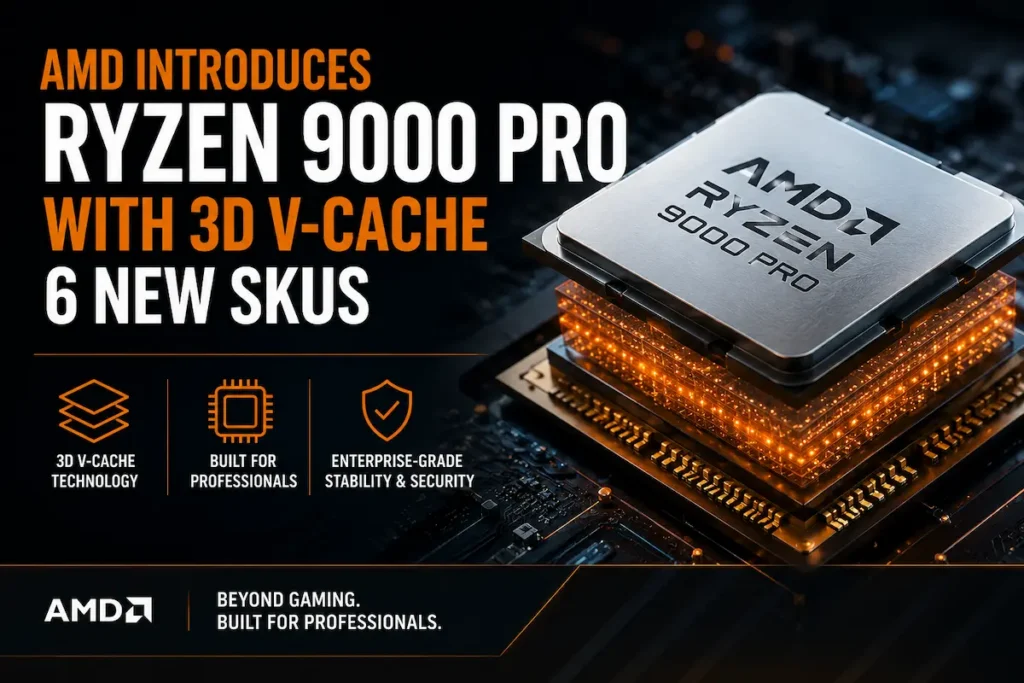
AMD Disrupts the Workstation Market: Ryzen 9000 PRO Meets 3D V-Cache
AMD is once again shifting the goalposts for professional computing. In a move that brings its most celebrated consumer-grade innovation to the enterprise sector, the company has announced an expansion of its Ryzen 9000 PRO lineup. This launch introduces six new SKUs, headlined by the first-ever integration of 3D V-Cache technology within the PRO series.
By marrying the security and stability of the PRO platform with the massive L3 cache capacities of the “X3D” line, AMD is targeting a specific breed of professional: those whose workloads are hampered by memory latency rather than just raw clock speed.
The X3D Advantage: Beyond Gaming
While 3D V-Cache (the vertical stacking of L3 cache) became a household name among gamers, its utility in the workstation market is arguably more profound. For engineers, developers, and data scientists, the increased on-chip memory can significantly accelerate tasks that are “cache-sensitive.”
- CAD/CAM Simulations: Reduced data “round-trips” to system RAM allows for smoother manipulation of complex assemblies.
- Software Compilation: Larger caches can house more of the codebase during the build process, slashing compile times.
- Computational Fluid Dynamics (CFD): Scientific workloads that rely on frequent data access see massive uplift from the 96MB+ of L3 cache found on X3D chips.
Power and Thermal Dynamics
The new lineup doesn’t shy away from power. With Thermal Design Power (TDP) ratings reaching up to 170W for the flagship models, these processors are designed for high-end workstation environments with robust cooling solutions. This increased power envelope ensures that the Zen 5 architecture can maintain higher sustained boost clocks under heavy multi-threaded loads, such as 8K video rendering or local AI model fine-tuning.
For IT departments, this means a shift in hardware requirements. These aren’t “drop-in” replacements for low-profile office PCs; they are the engines for dedicated workstation towers that require premium thermal management.
Challenging the Xeon Status Quo
AMD’s strategy here is clear: bridge the gap between the standard desktop and the ultra-expensive threadripper/Xeon platforms. By offering PRO-level features—such as AMD Memory Guard, enhanced manageability, and long-term software stability—alongside 3D V-Cache, AMD is providing a compelling alternative to Intel’s Xeon W-series.
The Ryzen 9000 PRO series offers a “sweet spot” for firms that need enterprise-grade security and ECC memory support without the massive overhead and platform costs associated with server-class sockets.
Availability and Deployment
Following AMD’s traditional enterprise rollout, these six new SKUs will be available through OEM partners (such as HP, Lenovo, and Dell) later this year. While individual “boxed” versions for DIY workstation builders are less common for the PRO line, the inclusion of these chips in pre-built professional systems signals a major push into the corporate hardware refresh cycle for 2026.
The Verdict: By bringing 3D V-Cache to the PRO ecosystem, AMD isn’t just adding more cores—it’s adding more efficiency to the most demanding professional workflows on the planet.
AMD’s workstation push is not happening in isolation. The company is also widening its professional and enthusiast strategy through high-memory AI-focused platforms and a reshaped RDNA 4 graphics lineup. For more context on where AMD may be heading next, read: