AMD and Microsoft have expanded their long-running cloud infrastructure partnership, confirming that Microsoft Azure will deploy AMD’s next-generation Helios rack-scale AI systems built around Instinct MI455X accelerators, 6th Gen EPYC “Venice” processors, Pensando networking, and the ROCm software platform.
The July 20 announcement provides one of the clearest examples yet of how AMD intends to introduce its next generation of computing technology. Zen 6 CPU cores, TSMC’s advanced 2nm manufacturing process, HBM4-equipped accelerators, and high-bandwidth rack-scale networking are heading into hyperscale artificial intelligence infrastructure before equivalent advances become broadly available to desktop PC buyers.
That does not mean AMD is abandoning the consumer market. The company has extended support for its Socket AM5 desktop platform through 2029 and introduced additional processors for both AM5 and the older AM4 ecosystem. However, the contrast is becoming difficult to ignore: AMD’s most advanced silicon is being deployed first where AI demand, power efficiency, and enterprise margins can justify its cost.
Microsoft Azure Will Deploy AMD Helios AI Systems
Microsoft and AMD announced an expanded strategic partnership covering processors, accelerators, networking technology, and software for Azure’s artificial intelligence and high-performance computing infrastructure.
The centerpiece is AMD’s Helios rack-scale AI platform. Helios combines several upcoming AMD technologies into a complete infrastructure design rather than selling the accelerator as an isolated component.
The planned configuration includes:
- AMD Instinct MI455X accelerators using HBM4 memory and advanced chiplet packaging.
- 6th Gen AMD EPYC processors, codenamed “Venice,” based on the Zen 6 architecture.
- AMD Pensando networking technology for high-speed communication within and between AI racks.
- AMD ROCm software for deploying and managing AI training and inference workloads.
Microsoft said the systems will support frontier-model inference, Azure AI services, and customer workloads requiring large amounts of compute and memory capacity. The agreement broadens Microsoft’s access to AI infrastructure beyond Nvidia systems and Microsoft’s internally developed accelerators, while giving AMD a major hyperscale customer for its complete rack-level platform.
AMD expects volume deployments of Helios-based systems to begin during the second half of 2026. The companies did not disclose the financial value of the agreement or the total number of systems Microsoft intends to deploy.
Venice Brings Zen 6 and TSMC 2nm to the Data Center
The 6th Gen EPYC “Venice” processor family will mark the commercial debut of AMD’s Zen 6 CPU architecture and its first high-performance computing product manufactured using TSMC’s N2 process technology.
AMD announced in May 2026 that Venice had entered its production ramp, following the successful bring-up of initial 2nm silicon in 2025. That milestone gives AMD time to validate yields, platform stability, firmware, and customer systems before wider Helios deployments begin.
AMD says the highest-density Venice configurations will provide:
- Up to 256 CPU cores.
- As much as 1.7 times the performance of the previous generation in selected workloads.
- Up to 1.6TB/s of memory bandwidth.
- Support for a substantially expanded memory subsystem.
- PCI Express 6.0 connectivity for high-speed accelerator, networking, and storage devices.
The processors are expected to use AMD’s new SP7 server platform. Reported platform details include support for 16 memory channels, although exact capabilities may vary between processor and server configurations when the complete product family is released.
These specifications are designed around dense data centers where CPUs must keep large accelerator clusters supplied with data. In an AI rack, the processor is responsible for orchestration, data preparation, storage access, networking, security, and workloads that cannot run efficiently on accelerators alone.
Why AMD Is Introducing 2nm in Servers First
Leading-edge semiconductor manufacturing is expensive. New process nodes initially offer limited capacity, higher wafer costs, and less mature yields than established production technologies.
Server processors are a natural starting point because enterprise customers are more willing to pay for improvements in performance, density, and energy efficiency. A hyperscale operator can justify an expensive processor when it allows more work to be completed within the same rack space or power envelope.
The economics are especially important for artificial intelligence infrastructure. Power delivery and cooling are becoming major constraints, making performance per watt nearly as valuable as absolute performance. Even a modest efficiency improvement can create significant savings when multiplied across thousands of servers operating continuously.
Consumer desktop processors compete under very different conditions. They must be produced in much larger volumes, hit stricter retail price targets, and work across a broad range of motherboards and system configurations. Allowing a manufacturing process to mature in high-margin server products before expanding it into consumer markets can reduce risk and improve production economics.
Desktop Zen 6 Is Still Waiting in the Wings
AMD has not announced a firm retail launch date for Zen 6 Ryzen desktop processors. Industry reporting commonly associates the next desktop family with the codename “Olympic Ridge” and points toward a possible 2027 introduction, but those details remain unofficial until AMD publishes a consumer roadmap or product announcement.
That distinction matters. The confirmed arrival of Zen 6 in EPYC servers does not automatically establish when an equivalent Ryzen processor will reach store shelves. AMD can use different chip designs, manufacturing nodes, packaging arrangements, and launch schedules across its server, mobile, and desktop families.
A 2027 desktop launch would nevertheless fit AMD’s current strategy. The company can continue selling and expanding its established Zen 5 and Zen 4 product lines while allowing N2 production to mature through higher-margin server deployments.
For most desktop buyers, this means the next several quarters are more likely to revolve around pricing changes, additional X3D models, firmware updates, and product-line extensions than an immediate replacement for the current Ryzen architecture.
AMD Extends Socket AM5 Support Through 2029
At Computex 2026, AMD formally extended its commitment to the Socket AM5 platform through 2029. The previous public commitment had covered 2027 and beyond.
This gives AM5 owners a longer potential upgrade path and reinforces one of AMD’s most effective competitive advantages: allowing users to replace a processor without automatically replacing the motherboard and memory.
However, platform support should not be interpreted as an unconditional guarantee that every AM5 motherboard will support every processor released through 2029. Individual compatibility can still depend on motherboard firmware, BIOS storage capacity, power delivery, chipset features, and the support policies of each board manufacturer.
The commitment does indicate that AMD does not currently plan to force desktop users onto an entirely new socket simply to introduce its next processor generation.
AMD Adds New Options to AM5 and AM4
AMD is filling the space between major architectural launches with additional processors and platform features.
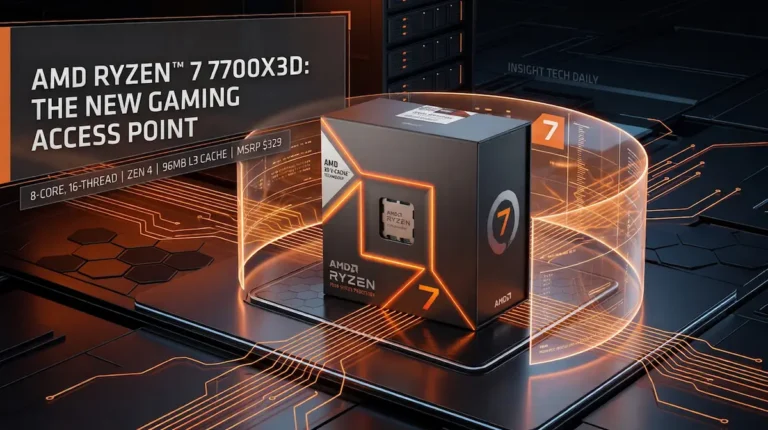
The company introduced the Ryzen 7 7700X3D, bringing its 3D V-Cache technology to another eight-core Zen 4 desktop processor. AMD also marked the tenth anniversary of Socket AM4 with a special-edition Ryzen 7 5800X3D, extending attention to a platform that first arrived in 2016.
Alongside those processors, AMD announced EXPO Ultra Low Latency memory profiles for certified DDR5 kits. The profiles are intended to improve memory latency and system responsiveness without requiring a new processor socket.
These additions do not replace a full next-generation Ryzen launch, but they give AMD new products to sell while preserving the value of its existing platforms.
RDNA 4 Remains AMD’s Current Gaming Architecture
AMD’s current discrete gaming graphics lineup remains based on RDNA 4. The Radeon RX 9000 family targets mainstream and performance-focused gaming systems, with products such as the Radeon RX 9070 and RX 9070 XT competing primarily in the 1440p and entry-level 4K markets.
AMD has also expanded the architecture through regional and lower-tier products, allowing the company to address more price points without introducing an entirely new graphics architecture.
This strategy resembles AMD’s approach on the processor side: extend the current platform while the next generation remains under development.
RDNA 5 and UDNA Timelines Remain Unconfirmed
Reports from graphics card manufacturers and other industry sources suggest that AMD’s next major gaming GPU generation may not arrive until the second half of 2027, with some estimates allowing for a delay into early 2028.
Those reports should not be treated as a confirmed AMD launch schedule. The company has not formally announced a retail release date, final architecture name, product stack, or manufacturing process for its next consumer graphics family.
The terminology is also unsettled. The next architecture is frequently described as RDNA 5, while AMD has separately discussed longer-term efforts to unify aspects of its consumer and data-center graphics development. The informal “UDNA” label is often used to describe that direction, but AMD has not confirmed that its next Radeon generation will be marketed under that name.
Memory pricing, advanced-node wafer availability, product positioning, and competition from Nvidia and Intel could all influence the final schedule. For now, RDNA 4 remains the only next-step Radeon architecture consumers can evaluate based on shipping hardware rather than leaks and projections.
What the Roadmap Means for PC Builders
AMD’s current direction creates different conclusions depending on the buyer.
- Existing AM5 owners: There is little reason to replace a capable AM5 motherboard solely out of concern that the platform is nearing its end. AMD’s support commitment now extends through 2029, although individual CPU compatibility will still need to be verified.
- New PC builders: AM5 remains one of the safer current platforms for buyers who value future processor upgrades. Waiting indefinitely for Zen 6 may not make sense when its desktop timing and pricing remain unconfirmed.
- Ryzen 7000 and Ryzen 9000 users: Owners should judge upgrades by workload and performance requirements rather than architecture names. A future Zen 6 chip may be compatible with the same platform, reducing the cost of waiting.
- Radeon buyers: Anyone needing a graphics card now should evaluate RDNA 4 against current Nvidia and Intel alternatives. A rumored late-2027 product is too distant and uncertain to serve as a practical purchasing plan.
What the Microsoft Agreement Means for AMD
The Microsoft deployment is strategically important because AMD is trying to compete with Nvidia at the platform level rather than only through individual accelerators.
Modern AI customers increasingly purchase complete systems incorporating CPUs, GPUs, networking, memory, software, and rack-level management. Nvidia has built a powerful position by controlling much of that stack through products including its GPUs, NVLink interconnects, networking hardware, rack systems, and CUDA software platform.
Helios gives AMD a more direct answer. It combines Instinct accelerators, EPYC processors, Pensando networking, and ROCm software within a coordinated reference architecture that cloud providers and server manufacturers can deploy at scale.
Microsoft’s participation does not guarantee that AMD will displace Nvidia across Azure. Microsoft is building a diverse infrastructure fleet that includes Nvidia hardware, AMD products, and its own internally designed processors and accelerators. The Helios agreement does, however, validate AMD as a supplier capable of delivering more than a standalone GPU.
AI Is Changing the Order of Semiconductor Rollouts
The most revealing part of AMD’s roadmap is not simply that EPYC receives Zen 6 before Ryzen. Server-first architectural launches are not new. What has changed is the scale of the economic pull coming from artificial intelligence infrastructure.
Hyperscale customers can reserve enormous quantities of advanced processors, high-bandwidth memory, networking components, and leading-edge wafer capacity. Their demand can justify products and manufacturing investments well before those technologies become economical for mainstream consumer devices.
That dynamic is likely to shape more semiconductor launches during the remainder of the decade. The newest manufacturing nodes, packaging technologies, and memory systems will increasingly appear first in AI accelerators and server platforms, followed later by desktop, laptop, and gaming products.
InsightTechDaily Editorial Analysis
AMD’s expanded partnership with Microsoft provides a useful snapshot of the modern semiconductor market. The company’s first production-ramping 2nm processor is not a Ryzen gaming chip. It is a 256-core-capable EPYC processor designed to keep a rack of AI accelerators supplied with data.
That decision is economically rational. Data centers can pay for leading-edge silicon, benefit directly from better performance per watt, and place large orders before consumer manufacturing volumes become practical.
For desktop users, the tradeoff is a longer wait for the newest architecture—but potentially less disruption when it arrives. Extending AM5 through 2029 means AMD can delay a consumer Zen 6 launch without forcing existing users to assume their current platform is already obsolete.
The same reassurance does not yet exist for Radeon buyers. Reports of a late-2027 or early-2028 successor to RDNA 4 remain unofficial, and AMD has not explained how or when its consumer and data-center graphics architectures may converge.
The confirmed story is therefore more nuanced than a single roadmap date. AMD is moving its most advanced technology into AI infrastructure first, preserving AM5 as a long-lived consumer platform, and asking desktop and gaming buyers to get more life from the hardware already available.