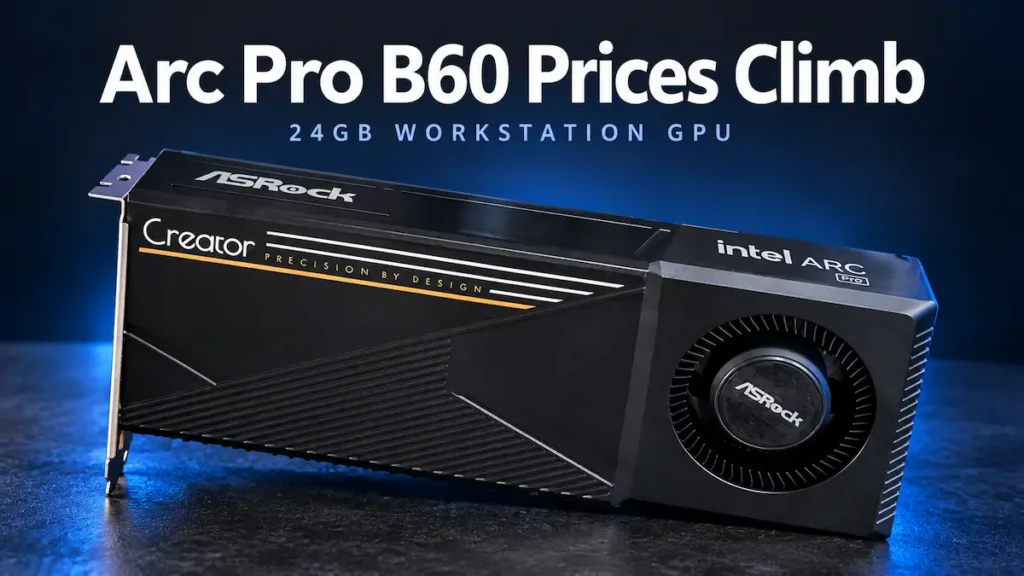
The ASRock Intel Arc Pro B60 24GB has taken a sharp step up in price at Newegg, weakening the affordability advantage that made it attractive for local AI workstation builds. After monitoring the card for a planned purchase, we noticed its asking price rise to $999.99. PCPartPicker’s price history now provides a clearer picture of that change: months of pricing near $650, followed by a sudden jump in late October.
The timing distinguishes this development from the earlier increase affecting the 32GB ASRock Arc Pro B70. The 32GB Arc Pro B65 also appears at a higher current asking price than its earlier retail listing, although the available history does not establish precisely when that change occurred.
Our interpretation is that demand may finally be catching up with available supply of the relatively affordable ASRock B60. The evidence establishes a retail price change; it does not establish an Intel-directed increase or confirm the underlying cause.
ASRock’s B60 Shows a Sharp Increase After Months Near $650
PCPartPicker’s tracked history shows Newegg’s tracked ASRock B60 price holding near $650 for much of the displayed summer and autumn period. There is a gap in the recorded history during August, but the visible pricing returns to approximately the same level afterward.
Near the end of the chart, just after the October 19 marker, the tracked price rises sharply to $999.99. Against a $649.99 baseline, that is a $350 increase, or approximately 53.8%.
The chart supports a sudden change in the tracked offer rather than a gradual increase spread across several months. Without a dated tooltip or the underlying daily records, however, it would be premature to assign the change an exact day or describe it as an overnight increase.
Our October 22 check of the ASRock Arc Pro B60 product page confirmed a $999.99 offer sold and shipped by Newegg. The page also displayed a separate $799.99 offer from marketplace seller Halfmoon Tech Store. The higher figure therefore describes Newegg’s own offer, rather than the lowest advertised price from every seller.
Earlier reporting provides additional context. VideoCardz recorded the ASRock B60 at $659.99 on Newegg in June. The later price history helps explain why buyers monitoring the card more recently would instead recognize approximately $650 as its familiar price.
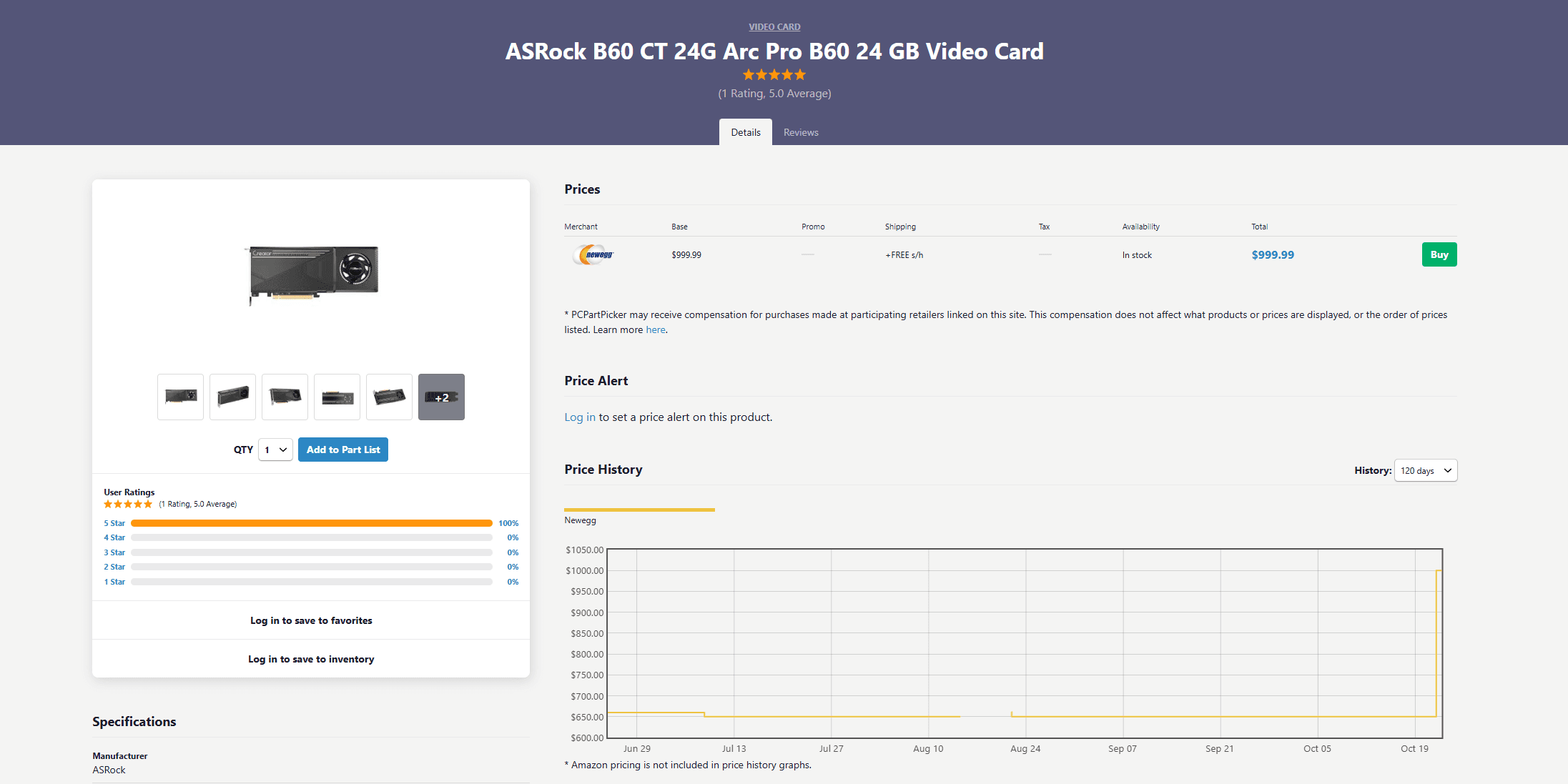
Source: PCPartPicker, Newegg price history.
The 32GB B70 Became More Expensive Earlier
The ASRock Arc Pro B70’s Newegg history shows a different timeline. Its tracked price sits near $1,000 through July before moving to approximately $1,300 in early August. The screenshot displays a current Newegg offer of $1,299.99.
That earlier increase is consistent with Tom’s Hardware’s August 17 reporting, which documented a roughly 30% U.S. increase for the ASRock B70.
The B65 requires a more qualified comparison. The price history we reviewed shows an earlier Newegg price near $910, while the current offer displayed above the chart is $1,199.99 through Amazon. PCPartPicker explicitly notes that Amazon pricing is excluded from its historical graphs. Comparing those figures shows a higher current asking price at a different retailer, but it cannot establish the date or shape of an Amazon price increase.
The strongest documented sequence is therefore straightforward: the ASRock B70’s Newegg price rose in early August, while the ASRock B60’s tracked Newegg offer remained substantially lower until its sharp late-October increase.
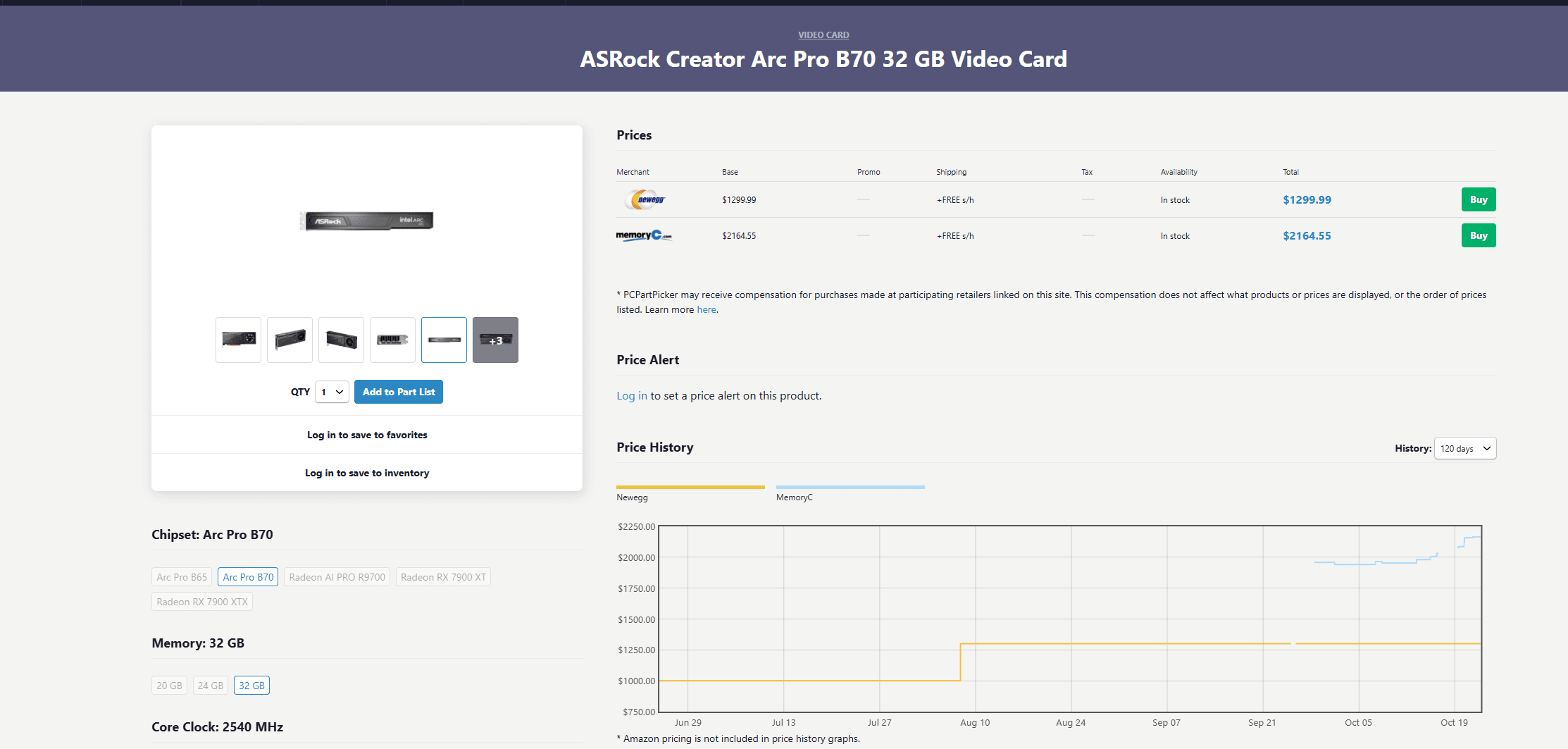
Source: PCPartPicker. Historical prices and timing are approximate.
Not Every B60 Followed the Same Pricing Path
The Sparkle Arc Pro B60 price history we reviewed shows that MemoryC’s tracked offer was already around $1,000 in early August. It subsequently fluctuated, with a $1,220.04 offer displayed when captured.
That history prevents us from describing the latest change as a synchronized increase across every B60 model. Different board partners and retailers have followed different pricing paths. What stands out now is the loss of the roughly $650 Newegg offer for ASRock’s card.
The Intel-branded B70 also has its own price history and substantial differences between retailers. Those offers should be evaluated separately from ASRock’s B70 rather than combined into a single continuous price trend.
Why the 24GB and 32GB Cards Appeal to Different Buyers
The memory distinction is central to this story. The B60 carries 24GB of GDDR6, while the B65 and B70 each carry 32GB. Intel’s specifications also show differences in bandwidth and compute resources:
| Graphics card | VRAM GDDR6 | Memory bus | Memory bandwidth | Xe cores |
|---|---|---|---|---|
| Arc Pro B60 | 24GB | 192-bit | 456 GB/s | 20 |
| Arc Pro B65 | 32GB | 256-bit | 608 GB/s | 20 |
| Arc Pro B70 | 32GB | 256-bit | 608 GB/s | 32 |
The 32GB cards offer one-third more memory capacity than the B60, together with higher bandwidth. The B65 retains the B60’s 20 Xe cores, while the B70 increases that count to 32.
For local AI workloads, additional memory can influence purchasing decisions independently of compute performance. Whether a workload fits depends on the model, quantization, context length and software overhead. Buyers who need more than 24GB per card have a clear reason to consider the higher-capacity models.
That makes stronger early interest in the 32GB cards plausible. However, neither hardware specifications nor retail price charts establish actual demand or sales volumes.
Has Demand Finally Caught Up With the Affordable B60?
Our reading of the sequence is that the relatively inexpensive ASRock B60 may have taken longer to encounter the pricing pressure already visible in the B70.
At roughly $650, the B60 provided a lower-cost option for buyers who wanted substantial dedicated memory but could work within a 24GB limit. As 32GB options became more expensive, the B60 could have attracted buyers looking to keep workstation costs under control. If available supply failed to keep pace with that interest, a higher asking price would be a plausible result.
This is an interpretation, not a confirmed explanation. Price trackers record advertised offers. They do not disclose sales volumes, inventory replenishment rates, distributor costs or the reasoning behind a retailer’s pricing decision. A sharp change in a graph also does not prove that a restock triggered the increase.
Likewise, the larger memory capacity of the B65 and B70 does not establish that rising GDDR6 costs caused their pricing changes. More memory may help attract demand, while memory component costs are a separate question. The evidence reviewed does not isolate either factor as the cause.
At $999.99, the B60 Faces a Tougher Value Comparison
The higher B60 price brings it much closer to the 32GB alternatives. PCPartPicker listings captured for this article show the ASRock B65 advertised at $1,199.99 through Amazon and the ASRock B70 at $1,299.99 through Newegg.
Against Newegg’s $999.99 B60 offer, those are premiums of $200 and $300 respectively. Both provide another 8GB of memory and higher memory bandwidth, while the B70 also adds more Xe cores. These comparisons concern displayed offers; seller identity, warranty terms, shipping and availability still need to be checked.
The change also adds up quickly in a multi-card build. Buying two B60 cards at $999.99 instead of $649.99 would add $700 to the graphics hardware bill before tax. A lower available offer could materially alter that calculation.
Software compatibility becomes more important as the purchase price rises. Buyers should verify support for their intended applications, operating system and AI frameworks before choosing a card. Workflows built around CUDA may require alternative software or configuration on Intel hardware, and additional VRAM does not resolve application compatibility.
For buyers whose workloads already run well on Intel, the B60 may still be a practical option. At nearly $1,000, however, its price advantage over the displayed 32GB alternatives is considerably smaller.
What Buyers Should Watch Next
The most useful next indicator will be whether other competitively priced ASRock B60 offers remain available, disappear or move upward. That would help show whether Newegg’s increase remains isolated or becomes part of a broader change in accessible retail pricing.
For now, the evidence supports a specific and significant development: an ASRock B60 offer that stayed near $650 for months has jumped to $999.99 at Newegg, following the ASRock B70’s earlier August increase. The B65’s higher current asking price provides additional context, but its timing is less certain.
For those of us monitoring the B60 for a workstation purchase, the concern is the shrinking availability of its former price advantage. Supply and demand offer a plausible explanation for that change, without assuming that Intel has announced or directed it.
Pricing reflects the PCPartPicker pricing history reviewed for this article and retailer checks on October 22, 2026. Chart dates and historical values are approximate where no tooltip is available. All amounts are in U.S. dollars before applicable tax. Advertised prices, sellers and availability can change; gaps in tracked history do not by themselves establish that a product was out of stock.