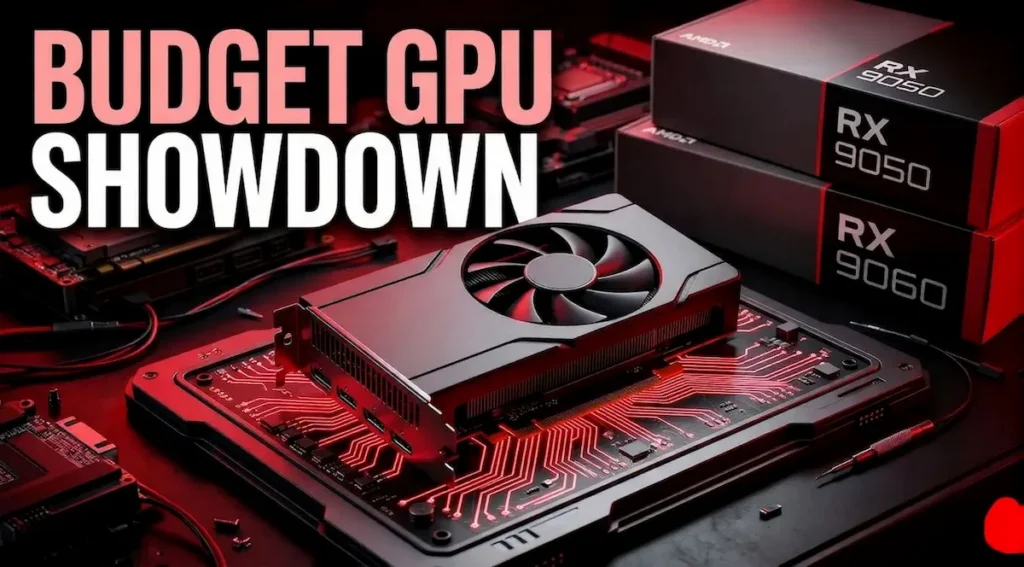
AMD may be preparing one of the strangest budget GPU launches of the RDNA 4 generation.
A new leak suggests the rumored Radeon RX 9050 could ship with more stream processors than the already-listed Radeon RX 9060, despite carrying a lower model number. On paper, that sounds backwards. In practice, it may reveal how AMD is trying to compete in the most sensitive part of the graphics card market: affordable 1080p gaming.
The short version is this: the RX 9050 may not be “better” in every way, but if the leak is accurate, it could be a more interesting card than the name suggests.
The Strange Part: The RX 9050 May Have More Cores Than the RX 9060
The rumored Radeon RX 9050 is reportedly based on AMD’s Navi 44 silicon and may feature 2,048 stream processors. That would put it above the official Radeon RX 9060’s listed 1,792 stream processors.
That is the detail causing the confusion. Normally, a higher number in the product stack suggests a stronger card. The RX 9060 should logically sit above the RX 9050. But if AMD is using a fuller version of the Navi 44 die in the RX 9050 while lowering clocks and keeping memory conservative, the naming starts to look less like a clean performance ladder and more like a segmentation puzzle.
This does not automatically mean the RX 9050 will beat the RX 9060 in games. GPU performance is not just core count. Clocks, power limits, memory bandwidth, drivers, cache behavior, and board design all matter. But if the leak is accurate, AMD may be using the RX 9050 as a value-focused “spoiler” card rather than a traditional lowest-tier GPU.
RX 9050 vs RX 9060: Rumored and Official Specs
| Specification | Radeon RX 9050 | Radeon RX 9060 |
|---|---|---|
| Status | Rumored / leaked | Officially listed by AMD |
| Architecture | RDNA 4 | RDNA 4 |
| GPU | Navi 44, reportedly fuller configuration | Navi 44 |
| Stream Processors | 2,048 rumored | 1,792 official |
| VRAM | 8GB GDDR6 rumored | 8GB GDDR6 official |
| Memory Bus | 128-bit rumored | 128-bit official |
| Memory Speed | 18Gbps rumored | Up to 18Gbps official |
| Boost Clock | Up to 2.6GHz rumored | Up to roughly 3.0GHz official |
| Target Market | Entry-level / budget 1080p | OEM and mainstream 1080p |
The basic tradeoff appears simple: the rumored RX 9050 may have more cores, while the RX 9060 has higher clocks. That creates a fascinating performance question.
In games that scale well with frequency and are not shader-bound, the RX 9060 may still hold an advantage. In workloads that benefit from more active compute units, the RX 9050 could be surprisingly competitive. That could make benchmark results more varied than the names imply.
Why Would AMD Do This?
There are a few possible explanations.
First, AMD may be trying to use more Navi 44 silicon efficiently. A chip that does not fit neatly into one product bin can still be sold as another card if clocks, power limits, and memory are adjusted. That is common across the GPU industry.
Second, AMD may be positioning the RX 9050 as a direct value weapon against Nvidia’s lower-end RTX 50-series cards. Nvidia’s desktop GeForce RTX 5050 officially uses 8GB of GDDR6 on a 128-bit bus, while separate reports have pointed to a possible 9GB GDDR7 variant. Either way, the entry-level GPU market is becoming a fight over memory, AI upscaling, ray tracing features, and price as much as raw raster performance.
Third, AMD may be trying to make the RX 9050 more attractive to system builders and budget gamers who care less about the product name and more about the frame rate per dollar.
The 8GB VRAM Problem Is Still Here
The biggest weakness in the rumored RX 9050 spec sheet is not the name. It is the memory capacity.
An 8GB card can still make sense for budget 1080p gaming, especially if the price is low enough. But the industry has already reached the point where 8GB feels like the minimum rather than a comfortable amount. Modern games can push VRAM hard with high-resolution textures, ray tracing, large open worlds, and less-than-perfect PC ports.
That puts AMD in a familiar position. If the RX 9050 launches cheaply enough, 8GB may be acceptable. If it lands too close to stronger cards with more memory, the value argument becomes harder.
The RX 9050’s success may depend less on whether it beats the RX 9060 and more on whether AMD prices it like a true budget card. A confusing name can be forgiven. A weak value proposition cannot.
RDNA 4 Makes This More Interesting Than a Basic Budget GPU
The RX 9050 rumor matters because RDNA 4 is not just another small refresh. AMD’s RX 9000-series cards bring a redesigned focus around ray tracing, AI acceleration, and upscaling features.
AMD’s official RDNA 4 positioning emphasizes 3rd-generation ray tracing accelerators, 2nd-generation AI accelerators, and improved visual features across the Radeon RX 9000 family. AMD has also moved FSR further into machine-learning-powered territory on RDNA 4 hardware.
For budget buyers, that matters. Entry-level cards are no longer judged only by native 1080p performance. Upscaling quality, frame generation support, ray tracing behavior, driver maturity, and game support can all change how useful a GPU feels over time.
Could the RX 9050 Be an Overclocking Sleeper?
This is where the rumor becomes especially interesting.
If the RX 9050 really uses a fuller Navi 44 configuration with lower clocks, some buyers will immediately wonder whether the card has manual tuning potential. A lower-clocked GPU with more cores can sometimes become a hidden gem if board power, cooling, BIOS limits, and silicon quality leave room for tuning.
That said, budget GPUs often come with strict power limits and simpler cooler designs. AMD and board partners could also lock the card down enough that the extra cores do not translate into much real-world headroom.
In other words, the RX 9050 could become a budget enthusiast favorite — or it could simply be a carefully limited entry-level card that looks more exciting on a spec table than it feels in benchmarks.
What Buyers Should Watch For
If the Radeon RX 9050 becomes official, the most important details will be:
- Actual MSRP: The card needs aggressive pricing to make 8GB feel acceptable.
- Board power: A low power limit could prevent the extra cores from stretching their legs.
- Real game benchmarks: Core count alone will not decide the RX 9050 vs RX 9060 matchup.
- PCIe configuration: Budget cards can be more sensitive to PCIe lane limitations, especially on older systems.
- FSR 4 support and game adoption: AMD’s software ecosystem will matter more than ever at the low end.
- Retail availability: A great budget GPU only matters if it is actually available near its intended price.
So, Is the RX 9050 Actually Better Than the RX 9060?
Not necessarily. But it may be more interesting.
The RX 9060 still has the advantage of being an official product with known specifications. It also appears to run at much higher clocks, which could help it maintain a lead in many games. The rumored RX 9050, meanwhile, appears to trade clock speed for a fuller core configuration.
That makes the RX 9050 a strange card on paper. It may not sit cleanly beneath the RX 9060 in every scenario. Instead, it could behave like a low-clocked, value-tuned version of a stronger Navi 44 configuration.
For shoppers, the final verdict will come down to price and benchmarks. If AMD launches the RX 9050 at a genuinely budget-friendly price, it could become one of the most talked-about low-end GPUs of the RDNA 4 generation. If the price lands too close to the RX 9060 or RX 9060 XT, the naming confusion may turn into buying confusion.
The Bottom Line
The rumored Radeon RX 9050 is exactly the kind of leak that makes the budget GPU market fun again. It is confusing, slightly backward, and potentially very compelling.
If the leak is accurate, AMD may be preparing a card that challenges the usual assumption that lower model numbers always mean weaker hardware. The RX 9050 may not be a straight upgrade over the RX 9060, but it could offer enough raw silicon to become a serious value play for 1080p gamers.
Until AMD confirms the card, this should be treated as a rumor. But if the RX 9050 arrives with 2,048 stream processors, 8GB of GDDR6, and a properly aggressive price, it could become one of the more surprising budget GPU launches of 2026.