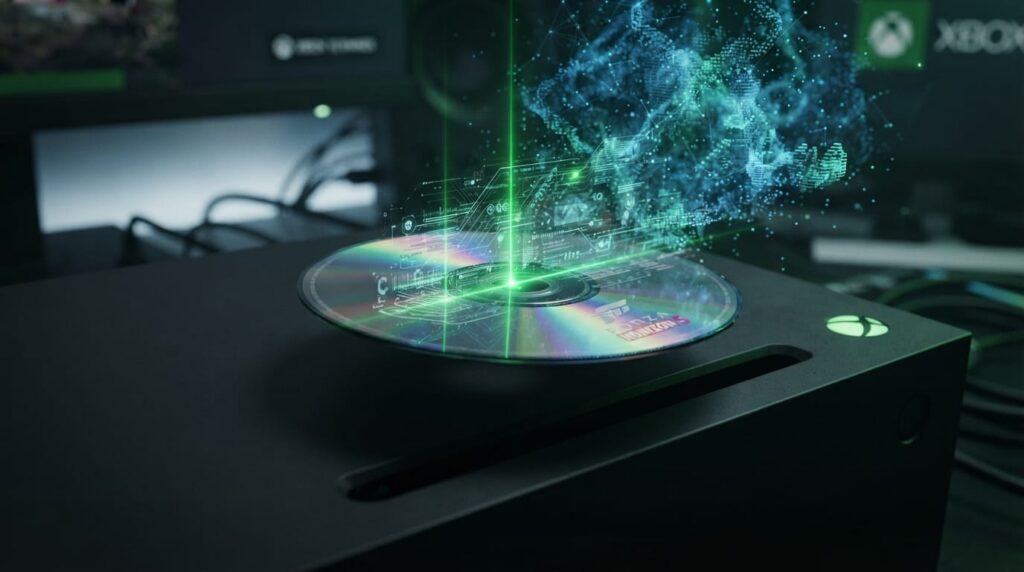
Xbox’s new disc-to-digital program could give players digital convenience without destroying the used-game market. Whether it becomes a genuine ownership solution—or simply makes an all-digital future easier to accept—remains to be seen.
The battle over physical video games is often presented as a choice between progress and nostalgia.
On one side are players who prefer subscriptions and digital libraries. They want immediate access to a large catalog, the ability to move between devices, and no shelf full of plastic cases. On the other are players who want to own something tangible—something they can lend, collect, trade, or sell when they are finished with it.
Microsoft’s new Xbox disc-to-digital program attempts to occupy the increasingly narrow space between those two camps.
Announced on August 26 and opening to Xbox Insiders on August 31, the program lets players insert a supported Xbox One or Xbox Series X game disc into a console and claim a digital entitlement for it. That entitlement can provide digital benefits such as playing without the disc inserted, Xbox Play Anywhere support, and Xbox Cloud Gaming access where those features are available.
The original disc continues to function, and the digital entitlement reportedly follows the disc if it is sold or lent to someone else. In theory, that gives players the convenience of a digital game without eliminating the transferability that makes physical ownership valuable.
It is an unusually clever compromise. Whether it proves to be a good one will depend on details Microsoft has not yet fully answered.
The Disc Becomes More Than a Disc
Microsoft’s system is not simply giving every physical owner a permanent second copy.
According to Microsoft, players claim an entitlement by inserting an eligible disc into an Xbox One or Xbox Series X and launching the game. The entitlement then gives that account access to supported digital features. Microsoft says the test will begin with thousands of titles and eventually cover “most” Xbox One and Xbox Series X disc-based games.
The important limitation is that there is only one revocable digital entitlement for each individual disc.
If the disc is sold, traded, or lent to another person and claimed under a different account, reporting indicates that the digital entitlement can move to the new player. The previous account then loses its disc-free access.
That arrangement is less generous than receiving a permanent digital copy, but it is also what prevents the system from producing unlimited licenses from a single game. More importantly, it allows the physical disc to retain one of its greatest consumer advantages: transferability.
A player can still finish a game and sell it to recover some of the purchase price. A family member can borrow it. A used-game store can resell it. The digital convenience travels with the physical object instead of permanently locking the game to the first account that claims it.
That is where Microsoft’s approach becomes more interesting than a conventional digital upgrade program.
Two Very Different Ideas of Value
The program also acknowledges that players do not all want the same relationship with their libraries.
For subscription-oriented players, ownership may be less important than access. A service such as Game Pass offers hundreds of games without requiring individual purchases, and digital libraries are easier to use across consoles, PCs, handheld devices, and cloud services.
For physical buyers, the value is different. A disc can be collected, given away, traded, or sold. It may remain useful after a game disappears from a storefront. It also provides at least some protection against an account problem or a title being removed from a subscription catalog.
Microsoft’s program tries to offer something to both groups.
A physical buyer can retain the disc while gaining some of the flexibility normally associated with a digital purchase. Someone with a large Xbox collection may be able to carry supported games onto newer devices without buying them again. Depending on the title, a disc purchase could also open access on PC through Xbox Play Anywhere or through cloud streaming.
At the same time, the disc does not become worthless once its digital entitlement is claimed. That distinction matters because a physical game’s resale value can reduce the real cost of buying it. Digital games and subscriptions rarely provide an equivalent way to recover that money.
If the system performs as advertised, it could make physical Xbox games more useful rather than merely helping Microsoft phase them out.
This Is Access Preservation, Not Complete Preservation
Microsoft describes the program as part of its broader commitment to game preservation. There is merit to that claim, but it should not be accepted without qualification.
Giving an existing disc access to newer Xbox devices could help older libraries survive hardware changes. It is certainly more consumer-friendly than requiring players to purchase the same games again simply because a future console lacks an optical drive.
The feature also appears to have been in development before the latest backlash over physical media. References to disc-to-digital functionality were reportedly discovered in Xbox software before Sony’s July announcement that it will stop producing physical discs for new PlayStation games in January 2028. Microsoft’s program therefore does not look like something assembled during a few weeks of favorable publicity.
That deserves some credit. Microsoft appears to have recognized the approaching divide between physical libraries and digital hardware and started building a bridge before the argument reached its current intensity.
But a digital entitlement is still dependent on Microsoft’s infrastructure. It must be issued, associated with an account, and potentially transferred or revoked. Support also will not be universal at launch, and Microsoft has only promised that more titles will be added over time.
There are still important questions about unsupported and delisted games, publisher participation, offline use, account problems, and the eventual fate of these licenses if Microsoft changes the service years from now. Original Xbox and Xbox 360 discs are not part of the initial announcement either, limiting the program’s value as a complete preservation strategy.
The physical disc may remain usable under its existing conditions, but the additional digital access exists because Microsoft’s servers recognize it. That makes the program a useful form of access preservation—not an assurance that every game will remain playable indefinitely.
A Quieter Return to Microsoft’s Original Xbox One Idea
There is some historical irony here.
In 2013, Microsoft proposed an Xbox One licensing system that would install disc games into a cloud-connected library and let players access them without carrying the disc. The idea offered digital convenience, but Microsoft surrounded it with internet requirements and restrictions on lending and resale.
Players revolted, and Microsoft abandoned the plan before the console launched.
The new disc-to-digital program revisits part of that original vision without treating the physical disc as disposable. Instead of permanently separating the license from the object, the entitlement can follow the disc to its next owner.
That seemingly small difference may be what makes the concept workable. Microsoft is not asking players to surrender the familiar used-game system in exchange for digital convenience. It is attempting to place a digital layer on top of that system.
Thirteen years later, the company may have found a better way to present—and implement—the idea.
The Real Test Comes After the Announcement
On paper, Microsoft’s approach is one of the more thoughtful responses to the decline of physical media.
It recognizes that digital access is convenient while physical transferability still has real financial and personal value. It could help players move established libraries onto new hardware without repurchasing games, and it avoids immediately destroying the resale and lending rights that physical buyers care about.
But the program is still a test, not a settled ownership model.
Its success will depend on how many games are supported, how reliably entitlements transfer, what happens in unusual lending or resale situations, and whether Microsoft continues supporting the system for the lifespan of future Xbox hardware. It will also depend on whether the program remains an addition to physical media or eventually becomes the justification for removing disc drives altogether.
Microsoft deserves credit for attempting a bridge rather than simply declaring physical games obsolete. The company may have created a workable middle ground between digital convenience and physical ownership.
For now, however, it has only shown us the bridge’s design. We will have to wait and see whether players can trust it to carry their libraries into the future.