AMD Expands Its AM5 Gaming Lineup with the Ryzen 7 7700X3D
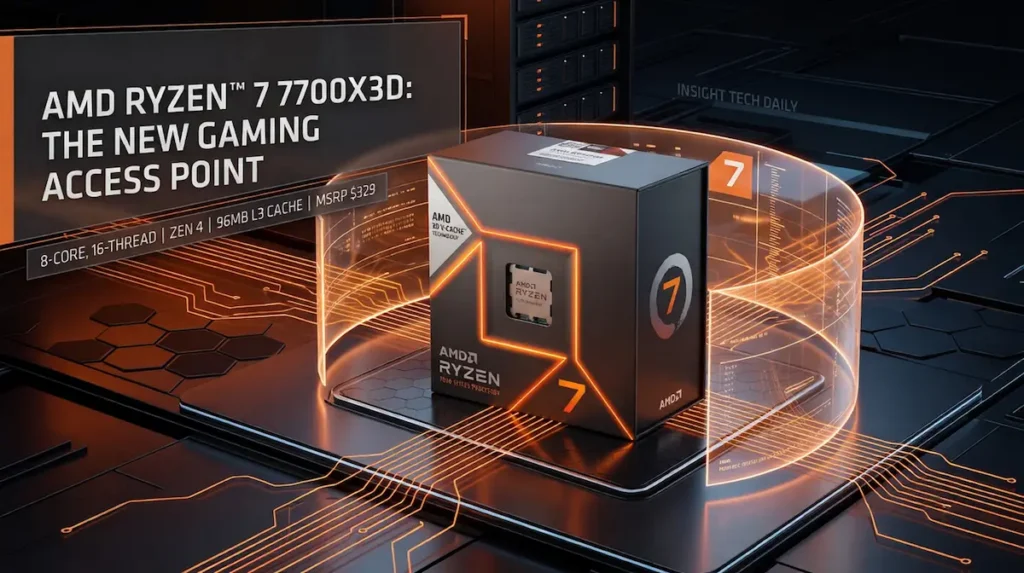
AMD is giving AM5 builders another way to access its gaming-focused 3D V-Cache technology. The new Ryzen 7 7700X3D is an 8-core, 16-thread desktop processor based on the Zen 4 architecture, positioned below the Ryzen 7 7800X3D as a potentially more affordable option for gaming-focused systems.
The processor officially launches on July 16, 2026, with a suggested price of $329. It combines 96MB of L3 cache with 8MB of L2 cache for 104MB of total cache, matching the overall cache capacity of the Ryzen 7 7800X3D.
Where the two processors differ is clock speed. The Ryzen 7 7700X3D operates at a 4.0GHz base clock and can boost up to 4.5GHz, compared with 4.2GHz and up to 5.0GHz for the 7800X3D. Both chips carry a 120W default TDP, although the 7700X3D’s lower operating frequencies may help keep real-world power consumption and temperatures under control.
A New Zen 4 Option Arriving Late in the AM5 Cycle
The Ryzen 7 7700X3D is an unusual release because it arrives nearly four years after AMD introduced the first Zen 4 desktop processors. Instead of replacing the Ryzen 7 7800X3D with a newer architecture, AMD is extending the life of an established design and offering another price point within its increasingly broad AM5 lineup.
That strategy reflects the current PC hardware market. Newer processors, DDR5 memory, graphics cards, and other components have become increasingly expensive, making older but still capable architectures more attractive to cost-conscious builders. AMD already has a supply chain and manufacturing base for Zen 4 products, allowing the company to introduce another gaming processor without requiring an entirely new platform.
AMD has also committed to supporting the AM5 socket through 2029, which gives the 7700X3D some value as an entry point into a platform that should still offer future CPU upgrades. Someone building around the chip today could potentially move to a later Zen 6 or Zen 7 processor without replacing the motherboard, provided the board manufacturer supplies the necessary BIOS support.
Newegg Handles the Initial North American Launch
In North America, the Ryzen 7 7700X3D is launching through Newegg at its $329 suggested retail price. The limited retail availability may make the processor easier for AMD to position and distribute during its initial rollout, but it also reduces the opportunity for immediate price competition between major stores.
That matters because the 7700X3D’s value depends heavily on the prices of neighboring processors. Discounts on the Ryzen 7 7800X3D, Ryzen 5 7600X3D, or newer Intel alternatives could quickly make the new chip less appealing at its launch price.
Availability may expand after the initial launch period, but buyers should compare current prices rather than assuming the 7700X3D is automatically the least expensive route to an eight-core AM5 X3D system.
Strong Gaming Hardware with Deliberate Clock-Speed Limits
Like AMD’s other X3D processors, the Ryzen 7 7700X3D is designed primarily for gaming. Its large L3 cache keeps more frequently accessed game data close to the CPU cores, reducing the number of times the processor must retrieve information from slower system memory.
This can improve average frame rates, minimum frame rates, and frame-time consistency in games that respond well to additional cache. The benefit varies considerably by title, resolution, graphics card, and game engine, however. The extra cache does not eliminate the value of a properly configured dual-channel DDR5 memory kit, and buyers should not treat it as a substitute for adequate system memory.
The processor supports AMD Precision Boost Overdrive and Curve Optimizer, although its maximum advertised boost clock remains 4.5GHz. Tuning may improve efficiency, temperatures, and sustained boost behavior, but it should not be expected to turn the 7700X3D into a fully clock-matched 7800X3D.
The lower frequency also creates a more visible disadvantage outside gaming. Applications such as rendering, video encoding, software compilation, and other heavily threaded workloads may perform better on newer or higher-clocked processors at similar prices. The 7700X3D is best viewed as a specialized gaming CPU rather than the strongest all-purpose processor available for $329.
Early Testing Raises Questions About the Launch Price
Initial independent reviews indicate that the Ryzen 7 7700X3D remains a capable and efficient gaming processor, but its value is highly dependent on retail pricing. The chip generally trails the 7800X3D, while some testing places its gaming performance closer to lower-cost Zen 4 X3D options than its name and core count might suggest.
That does not make it a poor processor. Eight Zen 4 cores, 16 threads, and 96MB of L3 cache are still enough to support a high-end gaming system. The concern is that AMD is asking $329 for an older architecture in a market where remaining 7800X3D stock may occasionally sell near the same price.
A reduction into the roughly $250 to $280 range would give the 7700X3D a clearer role as a value-focused eight-core gaming chip. At its full launch price, buyers will need to compare it carefully against both discounted Zen 4 processors and newer mid-range CPUs with stronger productivity performance.
What the Ryzen 7 7700X3D Means for PC Builders
For someone who already owns an AM5 motherboard, the Ryzen 7 7700X3D could provide a straightforward gaming upgrade without requiring a platform replacement. However, builders should check the motherboard manufacturer’s CPU support list and install the required BIOS version before swapping processors. Physical socket compatibility does not guarantee that every older BIOS will recognize a newly released CPU.
For a completely new build, the decision is more complicated. The 7700X3D offers the gaming advantages associated with AMD’s 3D V-Cache technology, but the processor must be evaluated as part of the entire platform cost, including the motherboard, DDR5 memory, cooling, and graphics card.
The Ryzen 7 7700X3D makes the most sense for a buyer who wants eight cores, prioritizes gaming over heavy productivity work, and finds it meaningfully cheaper than the 7800X3D. It becomes harder to recommend when the price gap between the two processors narrows or when a six-core X3D model delivers similar gaming results for considerably less money.
AMD has added another capable gaming processor to the AM5 lineup, but it has not created an automatic value winner. The Ryzen 7 7700X3D’s long-term appeal will depend less on its specifications—which are already well suited to modern gaming—and more on how quickly retail pricing settles below its $329 launch point.