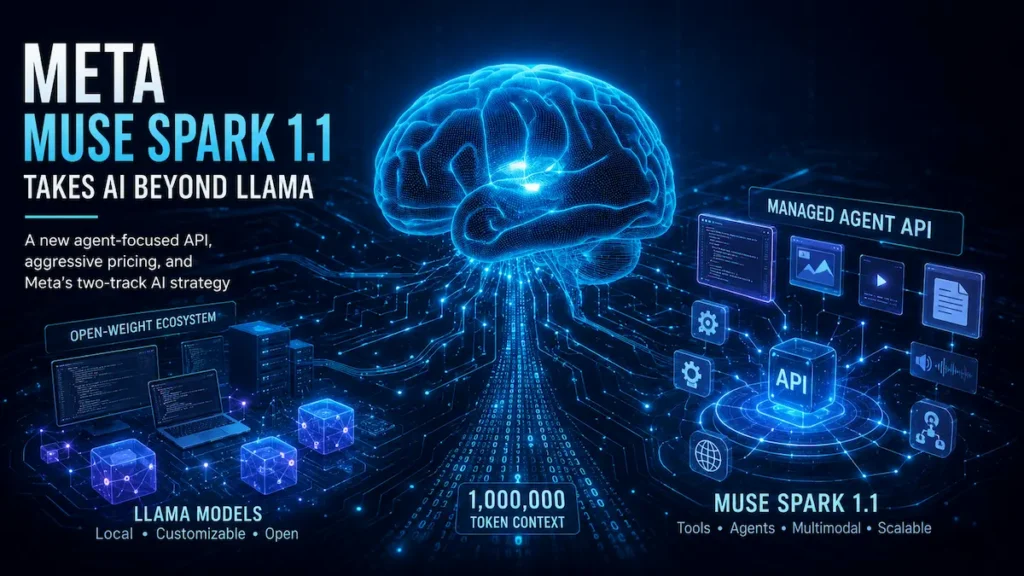
Meta built much of its influence in generative AI by distributing Llama models as downloadable open weights. Muse Spark 1.1 introduces a different strategy: a proprietary frontier model delivered through a paid developer API and designed for agents, coding, computer use, and multimodal workflows.
Meta released Muse Spark 1.1 on July 9, 2026, alongside the public preview of the new Meta Model API. The launch gives developers their first direct API access to a model from Meta Superintelligence Labs and marks a significant expansion beyond the company’s familiar Llama distribution model.
This does not necessarily mean Meta is abandoning open-weight AI. Llama remains an important part of its developer ecosystem. However, Muse Spark 1.1 shows that Meta also wants to compete directly in the commercial model market currently led by OpenAI, Anthropic, and Google.
The immediate attraction is not simply another chatbot. Meta has built Muse Spark 1.1 around the workloads becoming increasingly important to businesses and developers: coordinating tools, operating software, working across large projects, delegating tasks to subagents, and retaining context throughout long-running workflows.
ITD Take: Muse Spark 1.1 is less about Meta replacing Llama than Meta building a second AI business beside it. Llama gives Meta reach across local and self-hosted AI. The Meta Model API gives it a path toward recurring developer revenue.
Muse Spark 1.1 Is Built for Agentic Work
Muse Spark 1.1 succeeds the original Muse Spark model introduced in April 2026. Meta says the updated model delivers substantial improvements in tool use, computer control, coding, multimodal understanding, and long-running agent tasks.
The distinction matters because an agentic model is expected to do more than answer a prompt. It may need to inspect files, choose among available tools, operate software, recover from failed actions, update a plan, and complete a task across dozens or hundreds of steps.
Meta is positioning Muse Spark 1.1 as both a primary agent and a supporting subagent. As the primary agent, it can gather information, create a plan, and delegate work across parallel processes. As a subagent, it is trained to complete a narrower assignment and return control when it encounters something outside its role.
That approach could improve both speed and cost. A capable orchestrator does not need to perform every part of a project sequentially. It can send independent tasks to specialized agents and combine the results when they finish.
A One-Million-Token Context Window With Active Compaction
Muse Spark 1.1 supports a context window of up to one million tokens. More importantly, Meta says the model can actively manage that context during extended workflows.
Long context alone does not guarantee reliable long-term memory. As an agent accumulates tool results, documents, messages, screenshots, and intermediate decisions, relevant details can become buried beneath thousands of less important tokens.
Meta says Muse Spark 1.1 can compact earlier work while retaining the actions and information needed later. In practical terms, this is intended to help an agent continue working without repeatedly carrying every previous interaction at full length.
That could be valuable for repository-scale coding, extended research, enterprise document analysis, and workflows that span multiple applications. It should not, however, be interpreted as perfect memory. Context compaction is still a form of summarization, and important details can be lost if the model decides they are no longer relevant.
Multimodal Reasoning Meets Computer Use
Muse Spark 1.1 can process text, images, video, audio, PDFs, and other document-based inputs as part of a broader workflow. Meta’s emphasis is on combining perception with action rather than treating image analysis as a separate feature.
For example, Meta demonstrated a workflow in which the model analyzes a smartphone video of an item, selects useful images, extracts product details, and operates a browser to prepare a Facebook Marketplace listing.
Another demonstration showed the model building and debugging a web application. It generated the application, captured screenshots, identified visible problems, traced those problems back to the relevant code, implemented corrections, and then checked the result.
These examples point toward the larger goal: an agent that can observe what is happening inside software, reason about the state of a task, and take the next appropriate action without requiring the user to spell out every click.
The Meta Model API Opens a New Commercial Path
The Meta Model API is currently available as a public preview for developers in the United States. It gives outside developers direct access to Muse Spark 1.1 and introduces a usage-based commercial model that differs substantially from downloading and self-hosting Llama weights.
Meta and its early partners say the API supports several features important to production agent systems, including:
- Structured output for returning information in predictable formats.
- Parallel tool calling for requesting several independent actions during the same turn.
- Long-context operation for projects involving large repositories, document collections, or extended histories.
- Multimodal inputs spanning images, video, audio, and documents.
- Agentic coding workflows involving planning, tool use, debugging, and subagent delegation.
Meta is also emphasizing compatibility with familiar developer tooling. Early partners have described the service as OpenAI-compatible, which could reduce the amount of work needed to test Muse Spark inside applications already designed around common chat-completion and tool-calling patterns.
Because the platform remains in public preview, developers should still confirm endpoint behavior, model identifiers, rate limits, data handling rules, regional availability, and feature support in Meta’s current documentation before treating it as a drop-in production replacement.
Benchmark Results Show a Strong Agent Model, Not an Unquestioned Overall Leader
Meta compared Muse Spark 1.1 against OpenAI’s GPT-5.5, Anthropic’s Claude Opus 4.8, Google’s Gemini 3.1 Pro, and the original Muse Spark across reasoning, agents, coding, health, and multimodal evaluations.
The results suggest that Muse Spark 1.1 is particularly competitive in tool-heavy and professional agent workflows. It does not lead every category, and Meta’s own evaluation report acknowledges that third-party models may not have been tested inside environments optimized for their individual strengths.
MCP Atlas: Strong Performance Across Real Tool Servers
Muse Spark 1.1 scored 88.1 on MCP Atlas, ahead of the comparison models included in Meta’s published results.
MCP Atlas evaluates agents across 1,000 human-authored tasks involving 36 real Model Context Protocol servers and 220 tools. Tasks generally require the model to identify the correct tools and coordinate between three and six calls without receiving explicit step-by-step instructions.
This makes the benchmark more representative of real agent systems than a basic function-calling test. A successful model must discover tools, provide valid parameters, interpret results, and recover when an operation does not behave as expected.
JobBench: A Major Improvement in Professional Workflows
Muse Spark 1.1 recorded a score of 54.7 on the JobBench evaluation reported by Meta. That placed it above Claude Opus 4.8 at 48.4, GPT-5.5 at 38.3, Gemini 3.1 Pro at 15.9, and the original Muse Spark at 17.0 in Meta’s comparison table.
JobBench is designed around work that professionals actually want to delegate. Its tasks span occupations and require models to work through realistic reference files, procedural requirements, and detailed grading criteria.
That makes the result especially relevant to enterprise adoption. Businesses do not simply need models that answer difficult questions. They need systems that follow instructions, produce usable deliverables, and respect the structural requirements of a real workflow.
Coding Performance Is Competitive but Uneven
Muse Spark 1.1 improved substantially over the original model in coding, but it did not dominate every software benchmark.
| Benchmark | Muse Spark 1.1 | Leading Result in Meta’s Table |
|---|---|---|
| Terminal-Bench 2.1 | 80.0 | GPT-5.5 — 83.4 |
| SWE-Bench Pro | 61.5 | Claude Opus 4.8 — 69.2 |
| DeepSWE 1.1 | 53.3 | GPT-5.5 — 67.0 |
Those results support a more nuanced conclusion. Muse Spark 1.1 appears to be a strong general agent with credible coding ability, rather than the undisputed leader for every repository or terminal task.
Meta’s Own Benchmark Methodology Needs Context
Benchmark tables are useful, but readers should not treat them as a final ranking of the entire AI market.
Meta says it used high or maximum reasoning settings for the models in its comparison. Depending on the benchmark, it combined self-reported competitor results with internal reproductions and best-effort evaluations performed through third-party APIs.
The company also notes that its agent tools and system prompts may not have been specifically tuned for competing models. That could affect results because agent performance depends heavily on the surrounding harness, available tools, prompts, retry behavior, and context-management strategy.
Independent testing will therefore be important, particularly around reliability, latency, rate limits, tool-call accuracy, coding quality, and actual cost per completed task.
Aggressive Pricing Could Be Meta’s Biggest Advantage
Meta priced Muse Spark 1.1 at $1.25 per million input tokens and $4.25 per million output tokens. New API users are also being offered $20 in launch credits.
| Model | Input per 1M Tokens | Output per 1M Tokens | Introductory Credit |
|---|---|---|---|
| Muse Spark 1.1 | $1.25 | $4.25 | $20 |
The low headline price could matter most for agent systems because they often consume far more tokens than a conventional chatbot. Planning, tool outputs, retries, subagent conversations, context summaries, and verification steps can all increase usage.
However, token price is only one component of the total cost. A cheaper model can become expensive if it requires more attempts, produces invalid tool calls, or takes longer to finish. The meaningful metric is not simply cost per million tokens. It is cost per successfully completed task.
What Does Muse Spark 1.1 Mean for Llama?
The largest strategic question is whether Meta’s paid API signals a retreat from open-weight models.
For now, it is more accurate to view Muse Spark and Llama as two complementary parts of Meta’s AI strategy.
Llama gives developers greater control over deployment, fine-tuning, privacy, and local or private-cloud operation. Muse Spark gives Meta tighter control over its most advanced model, the ability to update it centrally, and a direct way to charge for inference.
This resembles a two-tier approach:
- Llama serves developers who value downloadable weights, customization, and self-hosting.
- Muse Spark serves developers who want Meta’s strongest managed model without operating the underlying infrastructure.
The tension will become more important if Meta begins reserving its most capable models exclusively for the API. That could gradually shift Llama from the center of Meta’s frontier strategy toward a broader ecosystem and adoption role.
Who Should Consider Testing Muse Spark 1.1?
Muse Spark 1.1 looks most relevant to developers building:
- Multi-agent orchestration platforms.
- AI coding and repository-management tools.
- Document-heavy enterprise workflows.
- Computer-use agents that operate browsers or desktop applications.
- Research systems that combine search, files, tools, and long context.
- High-volume agent services where inference cost is a major constraint.
It is less compelling for users whose primary requirement is local operation, downloadable weights, offline privacy, or unrestricted model customization. Those users will remain better served by Llama and other open-weight alternatives.
The Verdict: Meta Is Building a Second AI Business
Muse Spark 1.1 does not prove that Meta is leaving open-weight AI behind. It does show that the company no longer intends to compete through open distribution alone.
The model combines a one-million-token context window, multimodal perception, computer use, coding, tool orchestration, and subagent delegation with pricing designed to encourage large-scale experimentation.
Its strongest reported results are in exactly the areas becoming more important to the next generation of AI software: tools, professional workflows, long-running tasks, and agent coordination. Its coding scores are competitive rather than universally dominant, and Meta’s own comparison methodology makes independent evaluation essential.
Still, the launch is strategically important. Meta now has an open-weight ecosystem through Llama and a commercial frontier API through Muse Spark. If it can maintain both without weakening either one, it will be competing with OpenAI, Anthropic, and Google from a position none of them currently match in quite the same way.
For developers, Muse Spark 1.1 is worth testing—but the deciding question will not be whether it wins the most benchmark rows. It will be whether it can complete real agent workloads more reliably and at a lower total cost than the alternatives.
 |
Google Gemini and the AI Agent Ecosystem AdvantageWhy deep ecosystem integration is giving Google a massive leg up in the race to build truly autonomous, production-ready AI agents. |
 |
Local AI Hardware Demands Surge as Chinese MoE Models Challenge U.S. Open-Weight StandardsEfficient MoE models are changing the local AI hardware conversation. For everyday users, VRAM and unified memory are becoming more important than raw benchmark speed alone. |