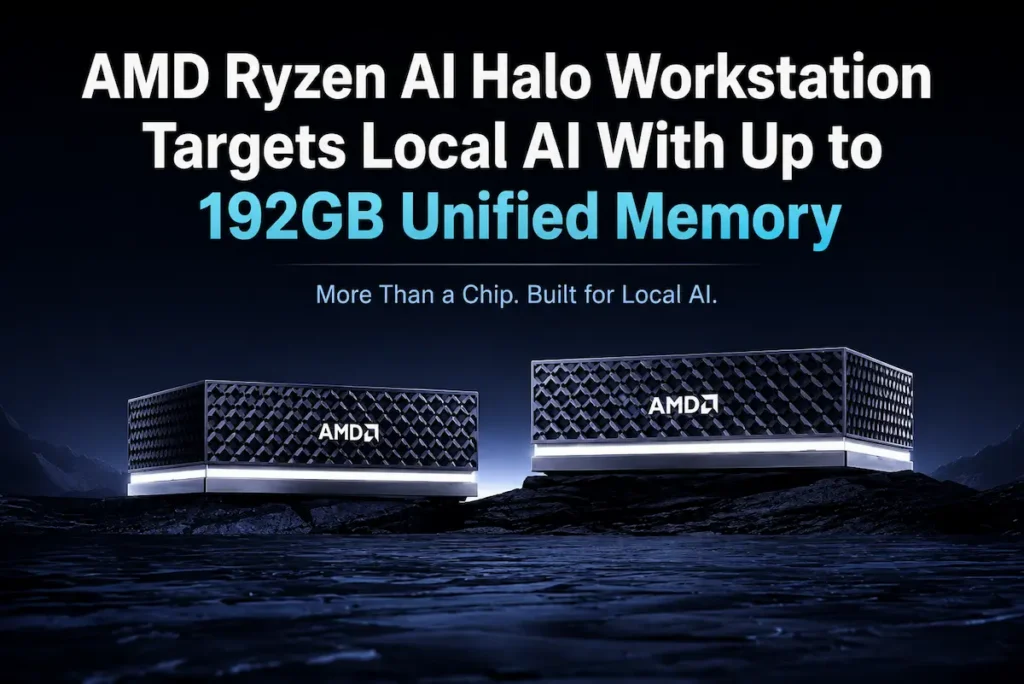
AMD is turning Ryzen AI Halo into more than a chip story. With a first-party compact workstation starting at $3,999, the company is making a direct pitch to developers and small teams that want to run large AI models locally instead of renting every token from the cloud.
The new Ryzen AI Halo developer system starts with AMD’s Ryzen AI Max+ 395 platform, 128GB of unified memory, and 2TB of storage, with pre-orders expected to open in June. AMD’s own product page says the system is designed to run intensive AI workloads locally, with support for up to 200B-parameter models in a compact, power-efficient 120W form factor.
The bigger strategic move is what comes next. AMD has also detailed Ryzen AI Max PRO 400, the “Gorgon Halo” refresh of its Strix Halo-class silicon, with configurations supporting up to 192GB of unified memory and up to 160GB available as GPU memory. The flagship Ryzen AI Max+ PRO 495 keeps the same broad Zen 5 and RDNA 3.5 foundation while adding a 5.2GHz boost clock, 55 TOPS NPU, Radeon 8065S graphics, and a much larger memory ceiling.
That distinction matters: the $3,999 starting price applies to the 128GB Ryzen AI Max+ 395 system, not necessarily the future 192GB model. AMD and reporting around the launch point to Ryzen AI Max PRO 400 systems arriving later, with partner systems expected from Q3, but final pricing for the highest-memory workstation configurations remains one of the biggest unanswered questions.
AMD’s Local AI Pitch Is Really About Token Economics
AMD is not framing Ryzen AI Halo as a mainstream mini PC. This is a developer workstation for teams that are already spending real money on AI inference, coding agents, image generation, model testing, or private local workflows.
The company’s commercial argument is straightforward, if a developer or engineering team is spending hundreds or thousands of dollars a month on cloud AI usage, a dedicated local system can start to look less like a luxury box and more like a capital expense. AMD highlights the example of a user spending about $773 per month for 6 million daily AI tokens, a scenario in which a $3,999 Halo system could theoretically pay for itself in roughly six months.
The math is plausible, but only under the right workload. A simple hardware-cost calculation puts $3,999 divided by $773 at just over five months before taxes, support, electricity, storage, software time, and the opportunity cost of managing local infrastructure. AMD’s six-month framing is therefore not outrageous, but it assumes the system is used heavily enough to displace paid cloud usage rather than merely supplement it.
That is the important buyer test. A developer who occasionally experiments with local models will not save money quickly. A small team running daily coding-agent experiments, private document workflows, model evaluation, or offline inference may have a stronger case, especially if cloud bills are unpredictable or data privacy is a practical constraint.
ITD Insight
AMD is trying to shift the local AI workstation conversation from raw benchmark bragging to utilization economics. The real question is not whether Ryzen AI Halo can run large models, but whether a team’s workload is steady enough that owning the hardware beats renting tokens.
Why Unified Memory Is the Center of the Story
For local large language models, memory capacity often matters as much as peak compute. Large models need enough memory to hold weights, context, and runtime overhead, and systems with constrained VRAM can quickly run into bottlenecks even when their GPU compute looks strong on paper.
That is why AMD’s move from 128GB on Ryzen AI Max 300-class systems to up to 192GB on Ryzen AI Max PRO 400 is significant. Reports indicate that up to 160GB of that unified memory can function as GPU memory, with 32GB reserved for the system, allowing the platform to target 300B-plus parameter local LLM use cases.
AMD’s underlying Strix Halo architecture already showed why this class of product is different from a normal laptop chip. The architecture combines up to 16 Zen 5 CPU cores with a large RDNA 3.5 integrated GPU and a wide 256-bit LPDDR5X-8533 memory setup, plus 32MB of memory-side cache (MALL / Infinity Cache).
That architecture is not the same as a discrete Nvidia workstation GPU with dedicated high-bandwidth VRAM, and it is not the same as Apple’s tightly integrated Mac platform. But it gives AMD a credible technical wedge: a large x86 APU with unified memory, a capable integrated Radeon GPU, a dedicated NPU, and enough RAM capacity to make local AI workflows practical for more than toy models.
AMD Versus Nvidia DGX Spark and Apple Mac Studio
AMD is clearly aiming Ryzen AI Halo at two very different competitors: Nvidia’s CUDA-centered AI ecosystem and Apple’s high-memory desktop systems.
Against Nvidia, AMD’s biggest challenge remains software gravity. CUDA remains deeply embedded in AI tooling, research workflows, and developer muscle memory. But AMD is leaning into two counterpoints: price-performance and operating system flexibility. AMD undercuts Nvidia’s $4,699 DGX Spark entry point by roughly $700 while supporting both Windows and Linux, whereas the competing Nvidia configuration targets Linux workflows. AMD also emphasizes the inclusion of its 50 to 55 TOPS hardware NPU, providing dedicated, low-power processing overhead.
That Windows support could matter more than it sounds. Many small engineering teams, creators, and enterprise developers still operate in mixed Windows/Linux environments. A local AI box that can sit in either workflow lowers friction, even if the highest-performance AI stacks still tend to mature first on Linux.
Against Apple, AMD’s argument is different. Apple has made unified memory a major strength of the Mac Studio and MacBook Pro lines, and Apple Silicon remains attractive for quiet, efficient local inference and creator workflows. AMD’s answer is x86 compatibility, Windows/Linux flexibility, and an unlocked memory ceiling of up to 192GB that sidesteps Apple’s highly rigid, non-upgradable tier steps.
However, AMD still has to prove the full experience. Apple controls silicon, operating system, developer frameworks, and hardware design. Nvidia controls the most entrenched AI software ecosystem. AMD’s workstation will need strong drivers, reliable ROCm support, clear model documentation, and repeatable performance across popular inference stacks to turn a compelling spec sheet into a dependable tool.
What the Panther Lake and Strix Halo Context Adds
The Strix Halo versus Panther Lake performance discussion is useful because it shows how unusual AMD’s approach is in the client market. Intel’s Panther Lake chips may compete strongly in standard mobile/desktop CPU performance and daily power efficiency, but AMD’s Halo-class products are intentionally built around a much larger integrated GPU and an expansive memory subsystem optimized specifically for parallel, high-bandwidth compute.
That does not automatically make Ryzen AI Halo the better general-purpose PC platform. For many mainstream workloads, Intel’s next-generation client architectures may prove more practical. But for a compact AI workstation, AMD’s advantage is not simply raw clock speed. It is the architectural alignment of processing resources, massive unified capacity, and an evolving software stack aimed squarely at local inference execution.
This is also where the 192GB Ryzen AI Max PRO 400 configuration becomes strategically important. A modest CPU clock bump is not the headline. The memory expansion is. For local AI buyers, the ability to load larger models, keep more context, or avoid offloading penalties can matter more than a small benchmark gain.
Why This Matters
Local AI is moving from hobbyist tinkering into a practical infrastructure decision. Companies are increasingly asking which workloads should stay in the cloud, which can run on employee devices, and which should live on a local workstation for privacy, latency, cost, or experimentation reasons.
AMD’s Ryzen AI Halo system gives that discussion a more concrete hardware option. It is not a cloud replacement for every team, and it is not a magic box for training frontier models. But it could be attractive for local inference, coding assistants, retrieval-augmented generation, model testing, image workflows, and private internal AI experiments where recurring cloud costs or data movement are pain points.
The broader signal is that AI PCs are splitting into tiers. Most consumer AI PCs will handle lightweight features, camera effects, background assistance, and small local models. Ryzen AI Halo is aimed at a higher tier: developers and technical teams that want workstation-class local memory and enough compute to run serious models without buying a rack server or committing every experiment to an API bill.
What Remains Unclear
The first uncertainty is price. The $3,999 starting point is clear for the 128GB Ryzen AI Max+ 395 configuration, but the most interesting 192GB Ryzen AI Max PRO 400 systems may cost more. Given ongoing memory-market supply pressures, high-capacity unified-memory configurations could face steep pricing premiums.
The second uncertainty is software maturity. AMD can compete on hardware value, but local AI buyers will judge the system by how easily it runs the models and frameworks they already use. Compatibility with popular inference engines, PyTorch workflows, quantized models, and developer tools will matter as much as AMD’s own benchmark slides.
The third uncertainty is whether AMD can make this a category, not a one-off. A first-party workstation can establish the reference experience, but broader adoption will depend on OEM systems, pricing variety, documentation, and long-term driver support.
Bottom Line
AMD’s Ryzen AI Halo workstation is a serious attempt to make local AI hardware feel financially and technically viable for developers, not just enthusiasts. The $3,999 128GB system gives AMD a clear entry point against Nvidia’s DGX Spark and Apple’s high-memory Macs, while the upcoming Ryzen AI Max PRO 400 platform pushes the memory story further with up to 192GB unified memory.
The commercial case is strongest for teams already spending heavily on cloud AI tokens and running repeatable local inference workloads. For everyone else, Ryzen AI Halo is less about immediate savings and more about where the market is heading: AI hardware that sits on a desk, runs large models privately, and challenges the assumption that every serious AI workflow has to live in the cloud.
RELATED READING:
 |
DGX-Class Desktops Arrive: Comparing NVIDIA GB10 AI WorkstationsA comprehensive architectural comparison of the new Blackwell-based GB10 desktop hardware configurations and their local tensor execution pipelines. |
 |
AMD’s Strix Halo AI Workstations: Large Language Models to the DesktopEvaluating how AMD’s high-bandwidth APU footprint handles massive parameter models locally without enterprise discrete hardware overhead. |