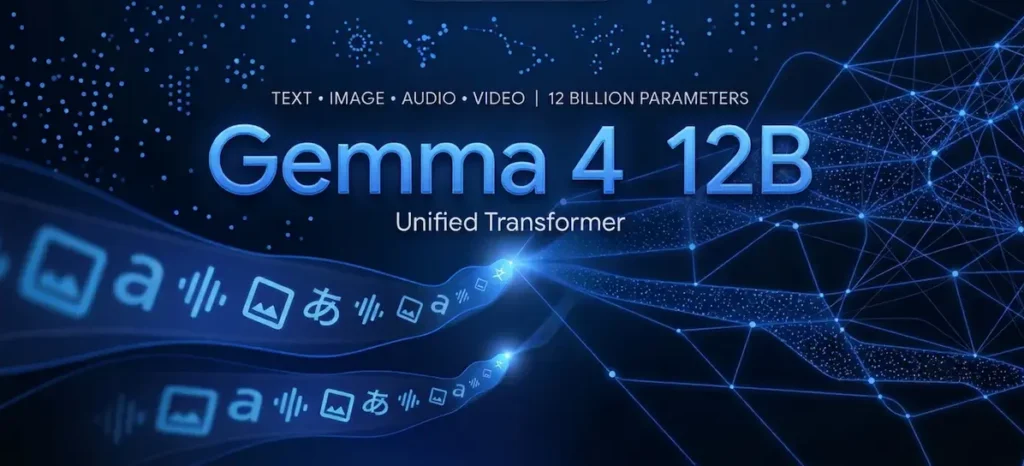
Google DeepMind’s Gemma 4 12B is not just another open-weight model update. Its most interesting feature is the architectural shift underneath it: a move toward encoder-free multimodal AI that treats local hardware as a serious deployment target.
Gemma 4 12B Changes the Multimodal Playbook
For the last few years, many open multimodal models have followed a familiar recipe. Start with a language model, attach a vision encoder, use a projection layer to translate image features into something the language model can understand, and then tune the system until the pieces cooperate.
That approach worked. It helped power models such as LLaVA, PaliGemma, and other “LLM with eyes” systems. But it also came with trade-offs. The language model and vision system were often separate components stitched together with an alignment layer in the middle.
Gemma 4 12B points in a cleaner direction.
Google describes the model as a unified, encoder-free multimodal model. In plain English, that means Gemma 4 12B is designed to handle multimodal inputs without relying on the same kind of large, separate vision or audio encoder stack that many earlier systems used.
That does not mean images or audio are magically treated exactly like plain text from the first pixel onward. Google still uses lightweight input processing to turn visual and audio data into something the model can work with. But the important shift is that the heavy multimodal encoder bottleneck is reduced, and the model is built around a more unified transformer-based design.
Why Encoder-Free Matters
The easiest way to understand this shift is to think about where the “understanding” happens.
In many older multimodal pipelines, a separate vision model looks at the image first. That vision model produces embeddings, and those embeddings are passed into the language model. The LLM is reasoning over a processed representation of the image, not the image structure as directly as possible.
With Gemma 4 12B, Google is pushing more of that multimodal work into the shared model backbone. The goal is not just to bolt vision onto language. The goal is to make text, images, and audio part of a more unified reasoning flow.
That matters for several reasons:
- Lower architectural complexity: Fewer large separate components can make the model easier to deploy and optimize.
- Better local-AI potential: A 12B-class model is still large, but it is much closer to the world of high-end consumer GPUs and unified-memory laptops than frontier-scale cloud models.
- Cleaner multimodal context handling: A unified architecture may be better suited for long documents, screenshots, code windows, diagrams, and multi-step visual reasoning.
- More realistic agent workflows: Local agents need to read screens, interpret documents, follow UI state, and combine text with visual context. Gemma 4 12B is aimed directly at that kind of future.
The Local Hardware Angle Is the Real Story
The architecture is interesting on its own, but the hardware target may be just as important.
Google is positioning Gemma 4 12B as a model that brings multimodal intelligence closer to laptops and workstations. That makes this release especially relevant for developers, researchers, homelab users, and AI PC enthusiasts who want useful local models without handing every document, screenshot, or audio sample to a cloud service.
This is where the model fits into a larger consumer technology trend. The AI PC conversation has often focused on NPUs, TOPS ratings, and marketing labels. Gemma 4 12B is a more practical reminder that local AI adoption depends on models that are actually usable on real hardware.
A 12B model is still not tiny. Users should not expect effortless performance on every laptop or budget GPU. But compared with much larger frontier-class systems, Gemma 4 12B sits in a more realistic zone for local experimentation, quantized inference, and workstation deployment.
Gemma 4 12B matters because it connects two stories that are often treated separately: model architecture and local hardware. Encoder-free multimodal AI is not just a research curiosity if it can run on machines people actually own. That is what makes this release worth watching.
What Gemma 4 12B Can Handle
Gemma 4 models support multimodal input, and the 12B version is especially notable because it brings text, image, and audio capabilities into a mid-sized open-weight model. That makes it a candidate for several practical workflows:
- Document understanding: Reading PDFs, screenshots, diagrams, forms, and mixed-layout content.
- Developer workflows: Interpreting code screenshots, UI states, logs, and technical diagrams alongside normal text prompts.
- Local assistants: Running private multimodal tasks on a workstation instead of sending everything to a cloud API.
- Research and fine-tuning: Giving developers an open-weight base for experiments around multimodal agents and domain-specific visual tasks.
The model’s large context window also matters here. Long-context multimodal systems are especially useful when the input is not just one image and one question. Real workflows often involve a messy PDF, a spreadsheet screenshot, a browser window, a code block, and several rounds of follow-up questions.
That is the kind of use case where a unified multimodal model becomes more interesting than a simple image-captioning system.
The Reality Check: Encoder-Free Does Not Mean Perfect
There is a reason many successful multimodal systems have relied on strong vision encoders. Dedicated vision models have years of training behind them, and they can be very good at fine-grained perception tasks.
That means Gemma 4 12B should not automatically be treated as a replacement for every SigLIP-backed, ViT-backed, or specialized OCR system. Encoder-free is an architectural direction, not a magic performance guarantee.
For some tasks, especially pure perception, fine-grained classification, or production OCR, models with dedicated vision encoders may still hold advantages. For broader reasoning over mixed text, images, audio, and long context, Gemma 4 12B’s unified design could be more compelling.
That distinction matters. The question is not whether every multimodal model should immediately abandon encoders. The better question is whether unified multimodal models will scale better as hardware, context length, and training methods improve.
Why Developers Should Pay Attention
For developers, the appeal of Gemma 4 12B is not just benchmark chasing. It is the possibility of building local tools that understand more of the working environment.
A useful local AI assistant should be able to read a screenshot, understand a chart, summarize a PDF, interpret an error message, and reason through a UI flow. That requires more than text completion. It requires multimodal context that feels native rather than bolted on.
That is why Gemma 4 12B is important even if it does not dominate every benchmark category. It gives developers a serious open-weight model to test the next generation of local multimodal workflows.
For homelab users and AI PC builders, this also makes hardware choices more interesting. GPU memory, unified memory, inference engines, quantization quality, and context-window management will all matter. The best local AI machine will not just be the one with the biggest NPU number on the box. It will be the one that can actually run useful models smoothly.
The Open-Weight Advantage
Google releasing Gemma 4 12B as an open-weight model gives the community room to experiment. That matters because multimodal AI is still moving fast, and many of the best use cases will not come from polished demos.
They will come from developers testing the model on weird PDFs, small-business workflows, UI automation, coding tools, accessibility experiments, classroom materials, and private document collections.
That is where open-weight releases have an advantage. They let the community find the edges.
Some users will push Gemma 4 12B into local coding assistants. Others will test it against document parsing. Some will try multimodal agents that can inspect a desktop environment. Others will simply want a private assistant that can read images and text without sending everything off-device.
Not all of those experiments will work perfectly. But they are exactly the kinds of experiments that move local AI from a hobbyist demo into a practical computing category.
Bottom Line
Gemma 4 12B is not just another model release with a larger context window and a fresh benchmark table. Its real importance is architectural.
Google is pushing a mid-sized open-weight model toward encoder-free multimodal reasoning, and that shift lines up directly with where local AI needs to go. If AI PCs, high-memory laptops, and consumer GPU workstations are going to matter, they need models that can do more than answer text prompts. They need models that can understand documents, screenshots, diagrams, audio, and messy real-world context.
Gemma 4 12B does not make every older multimodal approach obsolete. Dedicated vision encoders and specialized OCR models still have a place. But it does make the next phase of local AI feel more concrete.
The old model was “an LLM with eyes.” Gemma 4 12B is closer to something different: a local model built to reason across modalities from the start. For developers, AI PC builders, and anyone watching the future of private on-device intelligence, that is the part worth paying attention to.
RELATED READING:
 |
Google Gemini and the AI Agent Ecosystem AdvantageWhy deep ecosystem integration is giving Google a massive leg up in the race to build truly autonomous, production-ready AI agents. |
 |
ZAYA1 8B Shows Why AMD’s Local AI Ecosystem Could Matter in 2026A smaller local model angle that connects well with the rise of practical open-weight AI. |
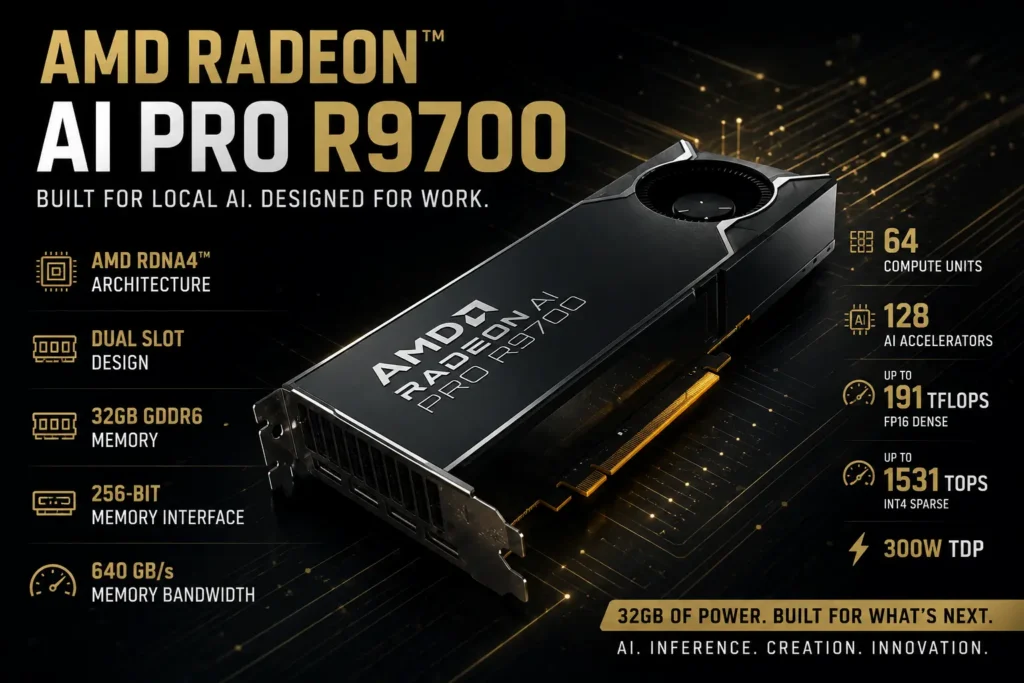 |
AMD’s Radeon AI Pro R9700 and R9600 Put 32GB Local AI Workstations in FocusA good hardware-side companion for the local multimodal AI discussion. |
Source links: Google’s Gemma 4 12B announcement, Google developer guide, and Gemma 4 12B on Hugging Face.