Google’s Gemini platform is moving beyond the chatbot model, but the bigger story may be simpler: Google has more places to put AI than almost anyone else.
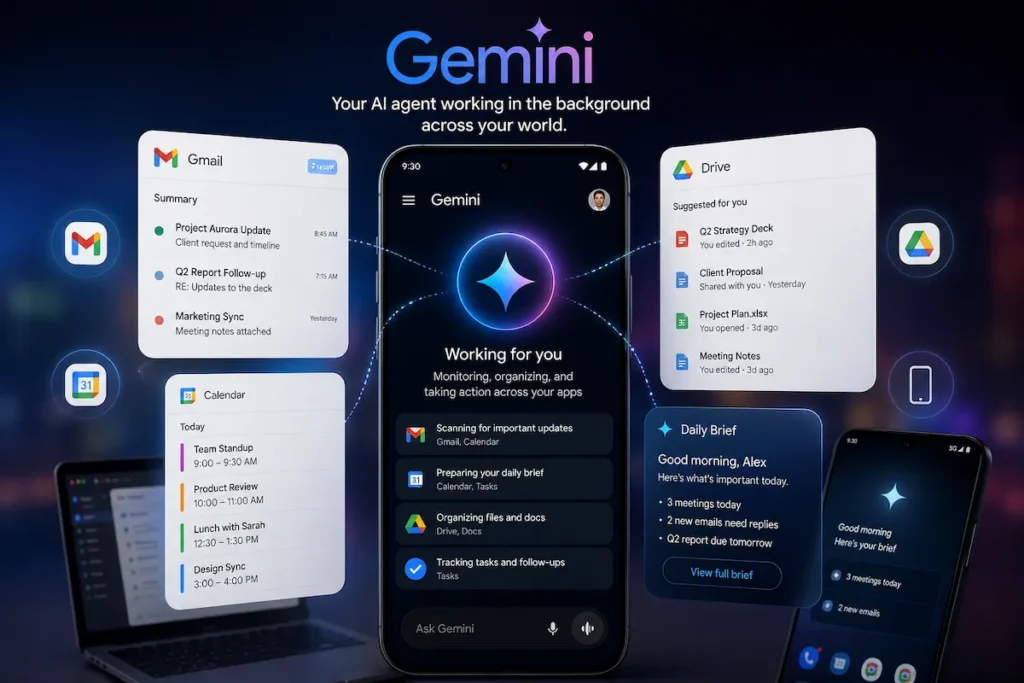
At Google I/O 2026, the company pushed Gemini into a new phase of consumer AI. The headline features include Gemini Spark, a 24/7 personal AI agent designed to take action on a user’s behalf, and Daily Brief, a background agent that can turn connected app activity into a personalized morning summary.
That sounds like another entry in the increasingly crowded “agentic AI” race. But Google’s advantage is not only model performance. It is distribution. Gmail, Calendar, Drive, Docs, Sheets, Slides, YouTube, Maps, Android, Chrome, Search and Workspace already sit inside the daily routines of billions of users. If AI agents are going to become useful in ordinary life, Google has more everyday surfaces to connect than almost any other AI company.
That gives Gemini a very different path from a standalone chatbot. Instead of asking users to build a new habit around an AI app, Google can insert Gemini into the habits users already have: reading email, checking a calendar, searching the web, writing a document, planning a route, summarizing a meeting, organizing files or following up on a task.
ITD Insight
Google’s real AI advantage may not be that Gemini answers questions better than everyone else. It is that Google can turn Gemini into connective tissue across the consumer internet: inbox, calendar, search, documents, maps, mobile devices and cloud services all feeding into one assistant layer.
Gemini Is Becoming an Ecosystem Layer, Not Just a Chatbot
Traditional AI chatbots are reactive. A user opens a chat box, types a prompt, receives an answer and then leaves. That model is useful, but it is also limited. It asks consumers to interrupt what they are doing and move into an AI interface.
Google’s newer Gemini direction points toward something more ambient. Gemini Spark and Daily Brief suggest a future where AI is not only waiting inside a prompt window. It can monitor permitted surfaces, organize information, track priorities and prepare useful next steps before the user asks.
That is where Google’s ecosystem becomes a strategic weapon. A background agent is only as useful as the data and tools it can access. Google already controls many of the consumer and productivity surfaces where daily context lives: Gmail for communication, Calendar for scheduling, Drive for files, Docs and Sheets for work, YouTube for media, Maps for location, Android for mobile context and Search for discovery.
In other words, Google does not have to invent a consumer operating environment for AI. It already has one. Gemini’s job is to correlate it all together.
The Google Advantage: AI Where Consumers Already Live
The most important part of Google’s Gemini strategy is not one app. It is the number of places Gemini can appear without feeling foreign.
A user may not think of Gmail, Calendar, Docs, YouTube, Maps and Android as one unified platform. But for AI, those are all context surfaces. An agent that can understand an email thread, connect it to a meeting, find the relevant document, summarize the next steps and remind the user before they leave for the appointment is far more useful than a chatbot that only sees what the user manually pastes into a prompt box.
That is the consumer AI prize Google is chasing. Gemini can become the assistant that lives between services rather than a destination users have to visit.
This matters because most consumers do not want to “use AI” as a separate job. They want fewer missed details, faster follow-ups, better organization and less digital housekeeping. Google’s ecosystem gives Gemini a way to deliver those benefits inside tools people already understand.
That also explains why the company is pushing agentic infrastructure such as Antigravity alongside consumer-facing Gemini features. The goal is not simply to make Gemini smarter. It is to build the framework that lets Gemini move across tasks, apps and workflows with enough structure to be useful and enough guardrails to be trusted.
How Gemini Compares With Claude and OpenAI
The contrast with other major AI companies is important.
Anthropic’s Claude has built a strong reputation among developers, especially around coding, long-context work and careful reasoning. Claude Code and Anthropic’s broader agentic coding push make Claude feel like a model that grew up inside professional software workflows first and is now expanding toward a wider audience.
That is not a weakness. It gives Claude credibility with developers, technical teams and businesses that care about reliability, reasoning quality and controlled workflows. But Claude does not have Google’s consumer distribution layer. It does not own the inbox, calendar, phone operating system, search engine, maps app and document suite for a massive share of everyday users.
OpenAI faces a different transition. ChatGPT helped define the modern consumer AI category, and OpenAI built enormous developer gravity through its API ecosystem. But the company is increasingly moving toward a larger corporate and enterprise structure, with products such as ChatGPT Enterprise, Codex and deployment-focused services aimed at putting frontier AI into business operations.
That gives OpenAI strength in brand recognition, developer adoption and enterprise momentum. But it also means OpenAI has to partner, integrate or build its way into many of the consumer surfaces Google already controls.
Google’s advantage is that Gemini can be both the model and the distribution layer. That does not guarantee success, but it gives Google a cleaner path to making AI feel native instead of bolted on.
Why Background Agents Change the Infrastructure Story
The shift from chatbot to background agent also changes the infrastructure math.
A chatbot interaction is relatively contained. A user sends a prompt, the model responds and the session may end. A 24/7 agent is different. It needs persistent state, identity controls, permissions, retrieval, scheduling, tool access, logging, model routing and safety checks. It may need to watch for new information, decide whether something matters and prepare an action without the user actively prompting it.
That is a much heavier platform requirement. It also ties directly into the broader question of whether the AI boom can scale without overwhelming energy, data center and infrastructure planning. As we covered in our analysis of AI data centers, energy demand and infrastructure pressure, the next phase of AI is not just about better models. It is about whether the physical systems behind those models can keep up.
Consumer agents raise that pressure because they imply more frequent, persistent and personalized AI workloads. A search query is one thing. A cloud-based assistant that monitors permitted user context, summarizes activity, checks schedules and prepares actions throughout the day is a different class of demand.
The Privacy Tradeoff Is the Product
Google’s ecosystem advantage also creates its biggest challenge: trust.
The more surfaces Gemini can connect, the more useful it becomes. But every useful connection also raises the stakes. Email, calendar events, private documents, location history, work files and task lists are not abstract data streams. They are the raw material of a person’s life.
That makes permission design central to the product. Users will need clear controls over which apps Gemini can access, what it can remember, what it can summarize, what it can act on and when approval is required. The interface cannot bury those decisions under vague toggles and legal fog. If background agents are going to become mainstream, users need to understand what the agent is doing when they are not watching.
This is also where the broader AI safety debate moves from theory into ordinary consumer software. The question is no longer only whether powerful models should be released, limited or held back in the abstract. It is whether agentic systems should be allowed to operate across sensitive personal surfaces before the permission, auditing and failure-recovery models are mature enough. That concern echoes the wider debate we examined in our analysis of powerful AI models, Claude Mythos and the security debate.
Agentic AI Has to Be Useful Without Becoming Annoying
The product challenge is just as difficult as the technical challenge.
If Gemini asks for approval constantly, it becomes another notification layer. If it acts too freely, it risks making mistakes in sensitive situations. If it summarizes too aggressively, it may hide details the user actually needed. If it is too cautious, it becomes a dressed-up inbox filter with better branding.
That balance will define whether consumer AI agents work.
The ideal Gemini agent would know when to stay quiet, when to summarize, when to suggest and when to ask for approval. That is much harder than generating a polished answer in a chat window. It requires judgment, context awareness and user-specific preference learning. It also requires Google to make the system transparent enough that people do not feel like they are being quietly managed by software they only half understand.
Google’s Opportunity Is Bigger Than the Chatbot Race
The AI market is often framed as a model-vs-model contest: Gemini versus ChatGPT, Claude versus Gemini, OpenAI versus Google, and so on. That comparison still matters, but it misses the larger platform shift.
The next consumer AI winner may not be the company with the best isolated chatbot. It may be the company that can make AI useful across the most real-world tasks with the least friction.
That is why Google’s position is so interesting. Gemini does not need to win every benchmark to become deeply embedded in everyday life. If it can reliably summarize Gmail, prepare Calendar briefings, organize Drive files, support Docs and Sheets, connect with Android and improve Search, it can become useful in a way that pure chatbot competitors may struggle to match.
Google has spent years building the consumer surfaces. Gemini is now the attempt to stitch them together with AI.
Bottom Line
Google’s Gemini update is not just another chatbot upgrade. It is a move toward persistent, ecosystem-level AI.
That is where Google has a real advantage. Claude has strong developer credibility. OpenAI has massive consumer mindshare and enterprise momentum. But Google has Gmail, Calendar, Drive, Docs, YouTube, Maps, Android, Chrome, Search and Workspace. That gives Gemini more ways to become part of everyday consumer behavior without asking users to start from scratch.
The tradeoff is that deeper integration also means deeper trust requirements. A background AI agent that can monitor connected apps and prepare actions may be genuinely useful, but only if users understand what it can see, what it can do and how to stop or audit it when needed.
The next phase of AI will not be defined only by smarter answers. It will be defined by which company can safely turn AI into a practical layer across daily life. Google may have the strongest map of that territory — now it has to prove Gemini can navigate it without making users feel like passengers.