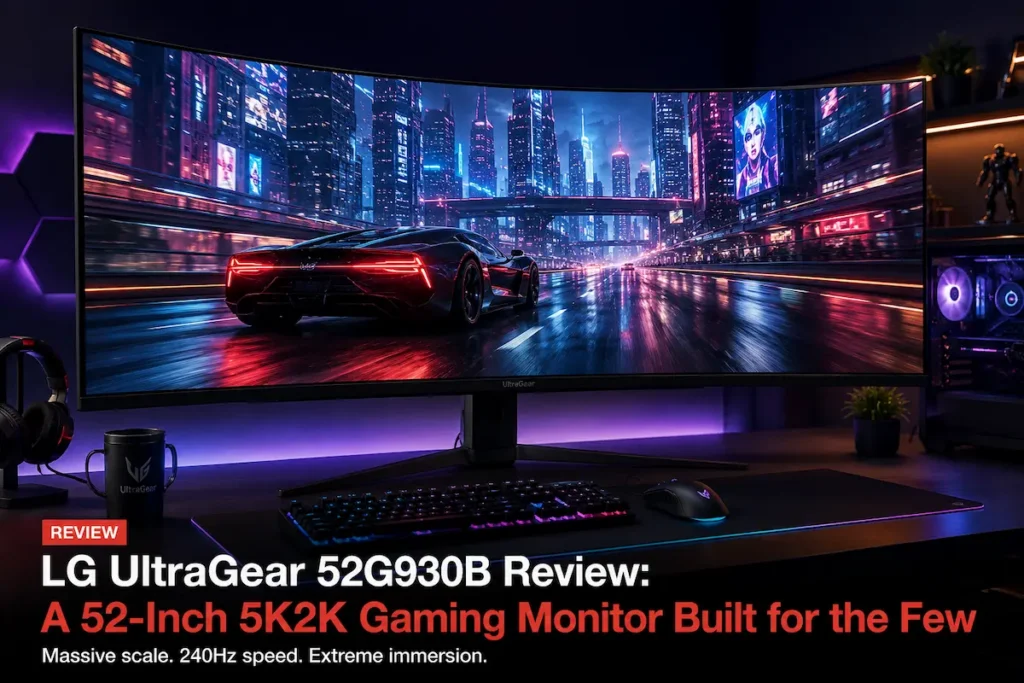
The desktop monitor market has spent years chasing two different dreams at once: sharper resolution and deeper immersion. The LG UltraGear 52G930B tries to brute-force both ideas into one outrageous display.
This is a 52-inch, 5120 x 2160, 21:9 ultrawide gaming monitor with a 1000R curve, 240Hz refresh rate, DisplayHDR 600, and a scale that makes even many premium ultrawides look restrained. It is not an OLED panel, and it is not designed for the average desk. Instead, the 52G930B is LG’s attempt to build a true big-screen PC gaming display for sim enthusiasts, high-end battlestations, and buyers who want immersion without moving to a living-room TV setup.
The LG UltraGear 52G930B is less about “bigger monitor, better monitor” and more about a new category forming between traditional ultrawides and gaming TVs. It is aimed at people who want a cockpit-like field of view, desktop-grade refresh rates, and PC-focused connectivity in one enormous display.
The Core Idea: A 52-Inch Desktop Display That Refuses to Be Normal
LG calls the 52G930B the world’s largest 5K2K gaming monitor, and the raw numbers explain why it immediately stands out. The panel measures 51.6 inches diagonally and runs at 5120 x 2160, creating an ultrawide canvas with roughly 11.1 million pixels on screen.
That is about 33% more pixels than 4K UHD, which means this monitor is not merely large — it is also extremely demanding. A graphics card that feels comfortable at standard 4K may have a much harder time maintaining high frame rates at 5K2K, especially if the goal is to take advantage of the monitor’s 240Hz ceiling.
The display uses a 21:9 aspect ratio, but its unusually large physical height changes the experience compared with a typical 34-inch or 39-inch ultrawide. LG says its vertical size is comparable to a 42-inch 16:9 4K screen, which helps explain why this monitor feels less like a stretched productivity panel and more like a panoramic gaming wall.
A VA Panel, Not OLED — and That Changes the Story
One of the most important points to get right is that the LG UltraGear 52G930B uses a VA panel, not OLED. That distinction matters. OLED remains the favorite for perfect blacks and per-pixel contrast, but VA technology can still produce excellent native contrast, and LG rates this panel at 4,000:1.
The 52G930B is also certified for VESA DisplayHDR 600 and rated for up to 95% DCI-P3 color coverage. In testing, Tom’s Hardware found the monitor unusually accurate out of the box, noting that its default picture mode was already so well tuned that calibration made little practical difference. That is a meaningful strength for a display at this price, especially because giant gaming panels are often sold more on spectacle than precision.
This is where the 52G930B becomes more interesting than its headline size suggests. LG is not simply stretching a low-tier panel to absurd dimensions. It is trying to make a very large monitor that still behaves like a premium enthusiast display, with strong color performance, high refresh capability, and more disciplined image processing than the “giant screen” concept might imply.
240Hz at 5K2K: The Feature That Turns This Into a Hardware Flex
The most technically aggressive part of the 52G930B is its combination of 5120 x 2160 resolution and 240Hz refresh rate. That pairing is what turns the monitor from a strange luxury display into a serious performance statement.
LG includes DisplayPort 2.1, HDMI 2.1, and USB-C with up to 90W power delivery, giving the monitor a modern input stack that makes sense for both high-end desktop rigs and laptop workflows. It also supports FreeSync Premium, VESA Adaptive Sync, and VRR, helping maintain smoother output when frame rates fluctuate.
But the unavoidable reality is that a monitor like this can easily outrun the rest of the system. Rendering modern AAA games at 5K2K is already difficult. Doing so at frame rates high enough to fully exploit 240Hz is another level entirely. For many buyers, the 52G930B will likely be used somewhere between two modes:
- Maximum visual fidelity at 5K2K with demanding graphics settings
- Higher refresh competitive play in lighter or better-optimized titles
That flexibility is part of the appeal, but it also reinforces the monitor’s niche position. This is not a display that “future-proofs” a midrange build. It is a display that exposes exactly how much power the rest of your PC does — or does not — have.
The 52G930B is one of those products where the screen itself becomes a benchmark for the whole system. At 5K2K, it is not enough to ask whether a GPU can run a game well. The better question is whether the PC can feed this much display without leaving a large part of the monitor’s headline capability unused.
The 1000R Curve Is Not Cosmetic Here
Curved monitors can sometimes feel like a marketing checkbox, especially at smaller sizes. On a 52-inch ultrawide, the 1000R curvature is much easier to justify. LG says the curve is designed to pull more of the image into the user’s natural field of view, and that logic makes sense at this width.
For sim racing, flight simulation, open-world games, and first-person titles where peripheral awareness adds to the experience, the curve helps the display feel less like a flat billboard and more like a wraparound environment. This is likely the 52G930B’s strongest experiential advantage over a large 16:9 TV placed on a desk.
It is not simply “more screen.” It is more screen arranged in a way that is intended to be used from a close, seated desktop position.
Gaming Performance Looks Strong, but the Use Case Is Specialized
LG rates the panel at 1ms GtG, and Tom’s Hardware praised the monitor’s video processing, smooth motion, and low input lag in testing. That matters because displays this large can easily drift into TV-like behavior, where the scale impresses but gaming responsiveness becomes secondary.
The 52G930B appears to avoid that trap. It is large enough to feel theatrical, but its refresh rate, adaptive sync support, and motion handling keep it anchored in the gaming monitor category rather than the television category.
That said, this remains a product built for specific kinds of players. Competitive esports users who want ultra-fast eye travel and minimal screen distance will likely prefer smaller high-refresh displays. The 52G930B makes far more sense for:
- Sim racing and flight simulation
- Single-player cinematic PC gaming
- Immersive RPGs and open-world titles
- Premium multitasking setups where one giant screen replaces multiple displays
Audio and Everyday Features Are Better Than Expected
One pleasant surprise is that LG did not treat the built-in speakers as an afterthought. The 52G930B includes stereo speakers, and Tom’s Hardware specifically called out the audio quality as a strength. LG also includes DTS Headphone:X, which adds some extra appeal for users who want spatial audio support without immediately leaning on external software.
Feature-wise, the monitor includes Picture-in-Picture and Picture-by-Picture, Auto Input Switch, Dual Controller, factory calibration support, and a configurable gaming feature set that includes tools like a crosshair, FPS counter, and Black Stabilizer.
There is no need to oversell these extras. They do not define the product. But on a display this large — one that may serve as both a gaming station and a full desktop workspace — they help it feel like a monitor designed for real daily use rather than a one-note showcase piece.
The Physical Reality: This Thing Is Enormous
Specifications can make the 52G930B sound like a dream, but the physical footprint is part of the review. With the stand attached, LG lists the monitor at roughly 46.24 inches wide, 28.07 inches tall at its highest position, and 13.7 inches deep. It weighs about 37 pounds with the stand.
That means desk planning is not optional. A shallow desk could make the monitor feel overwhelming, and buyers will want to think seriously about seating distance before treating it like a normal ultrawide upgrade. LG does support height, swivel, and tilt adjustment, and the display uses a 100 x 100 VESA mount, but any arm or mounting solution needs to be rated appropriately for the size and weight.
This is a monitor that may force the room to adapt around it.
Price and Positioning: A Luxury Monitor for Luxury Systems
The LG UltraGear 52G930B launched as a premium product, with early preorder coverage placing it at roughly $2,000. Retail pricing has already shown some movement, with recent listings and review references pointing closer to $1,700 in some channels, but that still keeps it firmly in enthusiast territory.
The important point is not merely that it is expensive. It is that the true cost of using it properly extends beyond the panel itself. A display like this invites a high-end GPU, a large enough desk, and potentially a redesigned gaming setup. That makes the 52G930B feel less like a monitor purchase and more like a commitment to a particular style of PC gaming.
Verdict: Excessive, Impressive, and More Thoughtful Than It First Appears
The LG UltraGear 52G930B is an easy product to dismiss as absurd. It is enormous. It is expensive. It asks for more desk space and more GPU power than most players can reasonably justify.
But it is also more serious than the spectacle suggests. The combination of 52-inch scale, 5K2K resolution, 240Hz refresh rate, 1000R curvature, strong factory color accuracy, and modern high-bandwidth connectivity gives it a coherent purpose. This is not simply a television masquerading as a monitor. It is a high-end gaming display built around the idea that immersion can be a premium performance feature in its own right.
For most buyers, the 52G930B will be impractical. For the smaller group with the hardware, the space, and a real appetite for panoramic desktop gaming, LG has built one of the most extreme monitor experiences currently available.