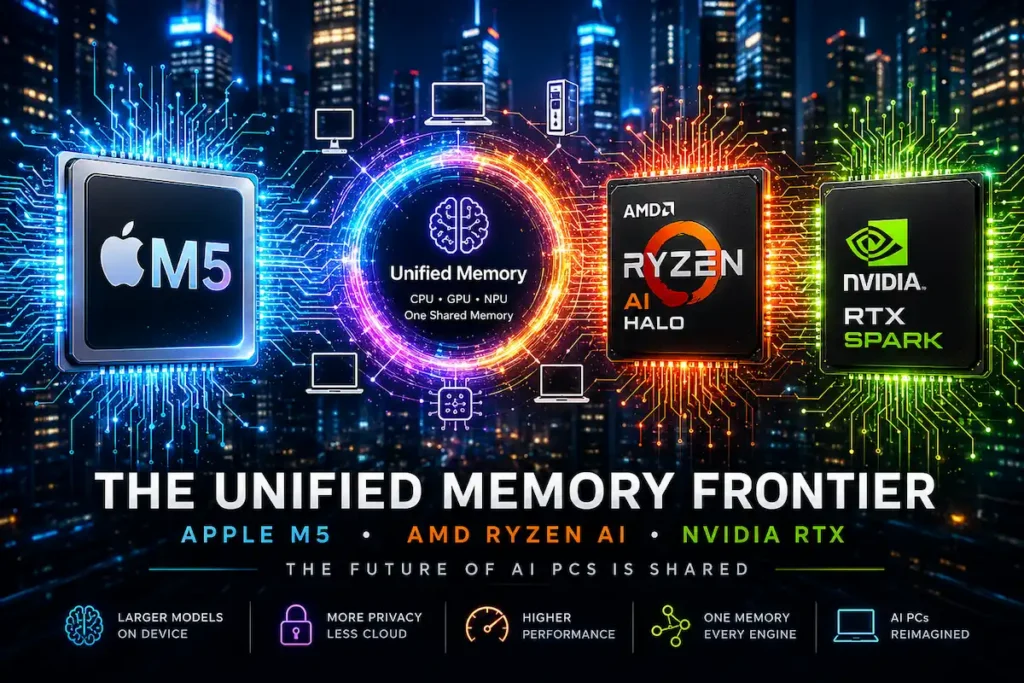
Unified memory architecture is starting to look like the next major frontier for PC computing. Apple has already made it feel normal inside the Mac ecosystem, AMD is pushing it into more open Windows and Linux local-AI systems, and NVIDIA’s entrance into unified-memory Windows laptops suggests the broader PC market is now taking the idea seriously.
When we looked at Apple vs. AMD in the unified memory AI PC race, the debate still felt like a two-sided question. Apple had the mature consumer ecosystem, while AMD was making the case that large shared memory pools could matter outside of macOS, especially for developers, creators, and local AI users.
Now the conversation is expanding. NVIDIA’s RTX Spark platform brings unified memory into a new class of Windows AI laptops and compact PCs, with NVIDIA and Microsoft positioning the design around local agents, CUDA, RTX acceleration, and on-device AI workflows. NVIDIA says RTX Spark combines a Blackwell GPU, Arm-based CPU design, up to 128GB of unified memory, and support from major PC makers including Dell, HP, Lenovo, ASUS, MSI, and Microsoft Surface. NVIDIA’s announcement makes the timing hard to ignore.
But the bigger story is not NVIDIA alone. The bigger story is that unified memory architecture is moving from a Mac talking point into one of the most important questions facing the future of AI PCs.
Unified Memory Is Becoming Bigger Than One Company
For decades, PC buyers were trained to think in separate buckets. System RAM belonged to the CPU. VRAM belonged to the GPU. Storage was where everything lived when it was not actively being used. That model worked beautifully for traditional computing, especially for gaming desktops, modular workstations, and upgrade-friendly PCs.
Unified memory challenges that layout. Instead of separating memory into different pools, unified memory architecture allows the CPU, GPU, and other accelerators to access a shared memory resource. Apple describes Apple Silicon Macs as using a unified memory architecture for CPU and GPU tasks, with performance benefits tied to its system-on-chip design and tuned frameworks like Metal and Accelerate. Apple’s developer documentation has framed this as a core advantage since the Apple Silicon transition.
The reason this matters more now is simple: AI workloads are memory hungry.
A traditional laptop may have 32GB of system RAM and 8GB of dedicated GPU memory. That can be perfectly fine for gaming, office work, browsing, and many creative tasks. But local AI workloads often care about how much memory the accelerator can actually use. If the model does not fit inside the available GPU memory, the system may slow down, offload work, or fail to run the workload cleanly.
That is where unified memory starts to look less like a spec-sheet detail and more like a platform decision.
The Promised Land: What Unified Memory Could Solve
The dream version of unified memory is easy to understand. A laptop or compact desktop with a large shared memory pool could run heavier local AI models, handle creator workloads more efficiently, and avoid the awkward situation where a system has plenty of system RAM but not enough GPU memory for the task at hand.
For AI PCs, that could be a major step forward.
Local AI is not just about chatbots. It includes image generation, coding assistants, background agents, transcription, video tools, private document search, local automation, and future operating system features that may run continuously in the background. Those workloads do not just need faster chips. They need fast access to enough memory.
That is why unified memory feels like a frontier. It is not just about making one benchmark faster. It is about changing how the entire system shares resources.
In the best version of this future, consumers do not need to think about whether an app is running on the CPU, GPU, NPU, or another accelerator. The system simply has a large enough shared memory pool to let the right engine handle the right task.
That sounds like the promised land for AI PCs. But every promised land has a border crossing.
Apple’s Approach: Make Unified Memory Invisible
Apple is still the cleanest example of unified memory becoming mainstream. The company did not position unified memory as a niche workstation feature. It made unified memory part of the basic Apple Silicon Mac design.
That matters because a MacBook Air buyer does not need to understand the architecture to benefit from it. They do not have to decide how much VRAM the GPU needs. They do not have to ask whether the system RAM and graphics memory are balanced correctly. They simply choose a memory configuration, and the system is built around that shared pool.
That is Apple’s greatest strength: unified memory becomes invisible.
Apple controls the silicon, operating system, developer frameworks, hardware design, and product segmentation. That lets the company turn unified memory into an everyday experience rather than a technical argument. A student, creator, developer, or office user may never say “unified memory architecture,” but they are already living inside that model.
The trade-off is familiar. Apple’s version of the future is polished, efficient, and deeply integrated, but it is also expensive to configure and difficult to upgrade later. Memory decisions must usually be made at purchase. Once the machine is built, the buyer is largely locked into that configuration.
That is the Apple version of the promised land: beautiful, efficient, and surrounded by walls.
AMD’s Approach: Bring the Frontier to the Open PC World
AMD’s unified memory push is compelling because it tries to bring some of the same architectural benefits into a more familiar PC world. Instead of asking users to leave Windows, Linux, or x86 compatibility behind, AMD is trying to make large shared memory pools useful inside the systems developers, creators, and local AI users already understand.
That is why AMD’s Ryzen AI Max and Ryzen AI Halo positioning matters. In our earlier look at AMD’s Ryzen AI Halo workstation strategy for local AI, the bigger point was not just raw performance. It was that AMD was trying to make high-capacity unified memory feel practical for local AI workstations, small teams, creators, and developers who may not want to rely entirely on cloud services.
AMD says Ryzen AI Halo systems support up to 128GB of unified system memory, ROCm software optimization, Windows and Linux support, and local AI workloads with models up to 200 billion parameters. AMD’s own announcement makes the local-agent angle explicit.
This gives AMD a different lane from Apple and NVIDIA. Apple has already made unified memory mainstream inside its own tightly controlled ecosystem. NVIDIA brings enormous AI software gravity, but it is entering this specific unified-memory PC conversation later. AMD’s potential advantage is the broader PC space itself: Windows, Linux, x86 compatibility, OEM flexibility, and users who still want a more open path into local AI computing.
That matters because not every user wants to be inside macOS. Not every workflow fits inside Apple’s platform. Some users need Windows. Some need Linux. Some need x86 compatibility. Some want a compact workstation that can sit on a desk and run local models without depending on cloud APIs. For those users, AMD’s pitch may feel less like a walled garden and more like an extension of the PC ecosystem they already know.
AMD’s challenge is that the broader software story is still developing. Apple has years of consumer-facing polish. NVIDIA has CUDA, RTX, and deep AI developer mindshare. AMD has openness and strong hardware potential, but it still needs the ecosystem around local AI tools, drivers, frameworks, and OEM systems to mature.
Still, AMD may be the most important bridge in this entire discussion. If unified memory architecture is going to move beyond Apple’s ecosystem and become a serious part of the wider PC market, AMD is one of the companies best positioned to prove it can work there.
NVIDIA’s Approach: Turn Unified Memory Into an AI Software Platform
NVIDIA’s entrance matters because it adds software gravity to the unified memory discussion. Apple has integration. AMD has openness. NVIDIA has the AI developer ecosystem.
That is why RTX Spark should be viewed as a catalyst, not the whole story. NVIDIA is not just saying, “Here is a laptop with a large memory pool.” It is trying to connect unified memory to CUDA, RTX acceleration, local AI agents, creator workflows, and Microsoft’s Windows AI PC ambitions.
NVIDIA says RTX Spark is designed around a 1-petaflop AI platform, the CUDA and RTX ecosystem, and Windows-native agents. The company is also positioning these systems as personal AI computers that can run more capable workloads locally rather than relying entirely on the cloud. That framing is important because it shows NVIDIA treating unified memory as part of a broader AI platform, not just a hardware feature.
This may be NVIDIA’s strongest argument. Developers already build around NVIDIA’s AI tooling. Many creative and AI workflows already expect NVIDIA acceleration. If unified memory makes those workloads easier to run locally on thinner Windows laptops, NVIDIA could give the broader PC market a reason to care about the architecture.
There are still unanswered questions. Pricing, battery life, thermals, real-world performance, software compatibility, and Windows-on-Arm maturity will all matter. NVIDIA’s first wave of RTX Spark systems may also live firmly in the premium laptop segment. That means this is not automatically a mainstream transition on day one.
But NVIDIA’s entrance changes the tone of the conversation. Unified memory is no longer just Apple’s polished architecture or AMD’s local-AI workstation strategy. It is now part of the Windows AI laptop roadmap too.
The Old PC Model Is Not Broken
This is where the excitement needs a reality check.
Traditional PC architecture is not going away just because unified memory is gaining momentum. Separate system RAM and dedicated GPU memory still make a lot of sense for many users.
Gamers still benefit from discrete GPUs with fast dedicated VRAM. Desktop builders still value upgradeable RAM. Workstation buyers may want to replace a graphics card, add more memory, or choose components from multiple vendors. Budget systems need cost control. Enterprise buyers care about repairability, lifecycle planning, and predictable deployment.
Unified memory systems often ask buyers to make the memory decision upfront. That can be efficient, but it can also be limiting. If a user buys too little memory, there may be no simple upgrade path. If they buy more than they need, they may pay a premium for capacity they never fully use.
That is the real tension. Unified memory may be cleaner, but traditional PCs are still more flexible.
This is especially true in the desktop market. A gaming desktop with a replaceable GPU, standard DIMM slots, and a clear upgrade path still has an obvious place. A budget office PC does not necessarily need a massive shared memory pool. A high-end enthusiast system may still prefer the brute-force path of a powerful CPU, large system RAM, and a discrete GPU with dedicated VRAM.
So the question is not whether unified memory is “better.” The question is where it becomes the better trade-off.
Will Unified Memory Become Mainstream?
The most likely future is not a total replacement of traditional PC architecture. It is a split market.
Unified memory will probably become increasingly common in premium AI laptops, compact workstations, creator machines, and systems designed around local AI. These are the places where large shared memory pools solve obvious problems. A thin laptop running local agents, a compact desktop handling AI workloads, or a creator system juggling media and AI tools can all benefit from a more integrated memory design.
Traditional x86 systems with separate RAM and VRAM will remain strong in gaming desktops, budget PCs, modular workstations, and upgrade-friendly machines. Those systems offer flexibility unified memory designs often cannot match.
That means the future may not have one winner. It may have two strong paths.
One path is the integrated unified-memory AI system: efficient, compact, tightly coordinated, and designed for local intelligence.
The other path is the traditional modular PC: flexible, upgradeable, component-driven, and still extremely powerful.
Both can survive. Both can improve. Both can serve different users.
The Real Frontier Is Local AI
Unified memory architecture matters because local AI is changing what personal computers are expected to do.
For years, the cloud carried the heaviest AI workloads. That will not disappear. The largest models, enterprise training systems, and massive-scale inference workloads will still live in data centers. But a growing number of useful AI tasks can happen locally, especially when privacy, latency, cost, or offline access matters.
That is where memory becomes strategic.
A local AI PC does not just need a fast processor. It needs enough accessible memory to keep models, context, tools, and user data close to the compute engines that need them. Unified memory is one answer to that challenge.
Apple is proving that unified memory can be normal for everyday users. AMD is trying to prove it can power open local-AI systems. NVIDIA is trying to prove it can become the foundation for Windows AI laptops tied to the world’s most established AI acceleration ecosystem.
None of those approaches is automatically the final answer. But together, they show where the frontier is moving.
Final Take: The Frontier Is Real, But It Has Not Been Settled
Unified memory architecture is starting to look like the next great frontier for AI PCs, but that does not mean every machine needs to cross it at the same speed.
Apple has already shown what the promised land can look like when the entire platform is built around shared memory. AMD is trying to make that future more open and more familiar to Windows and Linux users. NVIDIA is trying to tie unified memory to the AI software stack developers already trust.
The question now is not whether unified memory matters. It clearly does. The question is whether it becomes the default shape of future PCs, or remains the premium path for users who need local AI, compact power, and tightly integrated performance.
The answer is probably somewhere in the middle. Unified memory may become the architecture of premium AI computing, while traditional x86 systems continue to dominate where flexibility, upgrades, discrete graphics, and pricing matter most.
That does not make unified memory less important. It makes it more interesting.
The PC is not moving toward one promised land. It is opening a new frontier.
RELATED READING:
 |
Apple vs. AMD: Unified Memory and the Future of AI PCsA head-to-head architectural analysis of unified memory designs and why high-bandwidth bus routing dictates modern on-device LLM loading speeds. |
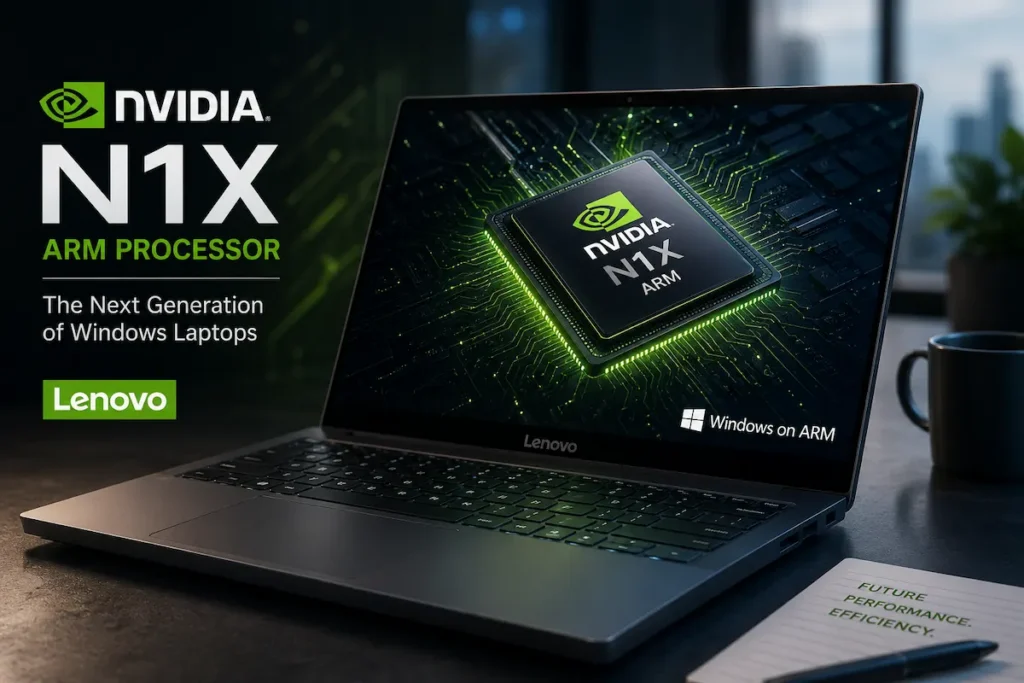 |
Lenovo NVIDIA N1X ARM Laptop Leak Points to a New Windows AI PC PushUnpacking the leaked hardware manifests behind Lenovo’s upcoming custom ARM clamshell and its implications for desktop-tier AI power limits. |