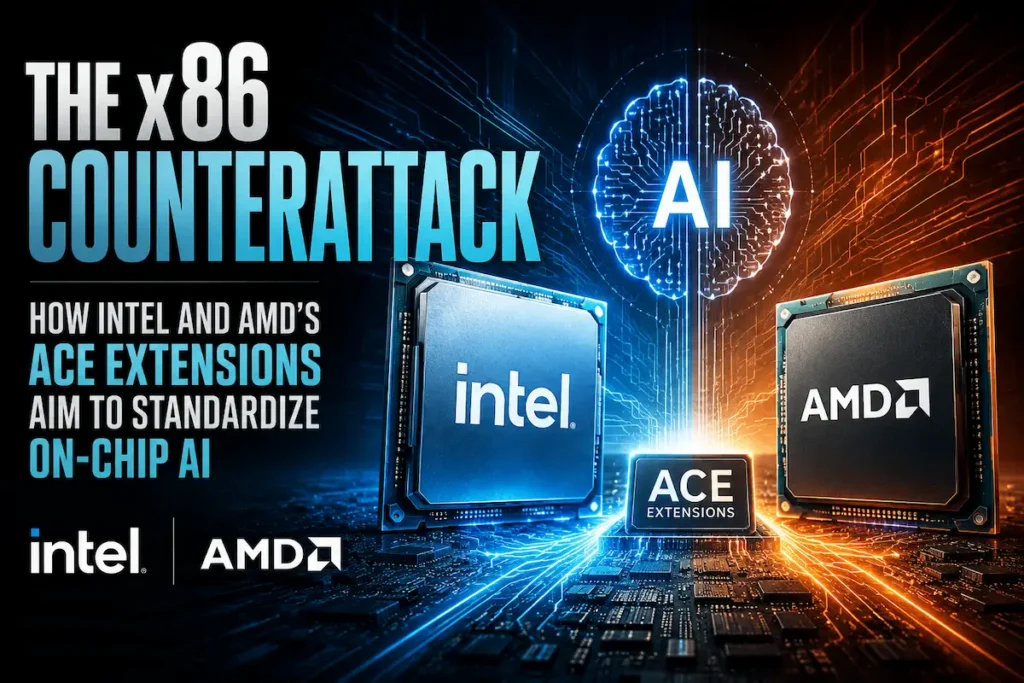
Intel and AMD do not agree on much. That is exactly why their shared push behind ACE Extensions matters. As AI moves deeper into everyday PCs, the two x86 giants are trying to make sure the CPU still has a major role to play.
The x86 Counterattack Begins Inside the CPU
For the last few years, the AI hardware conversation has mostly belonged to GPUs, NPUs, and custom accelerators. NVIDIA owns the datacenter narrative. Apple has its own tightly integrated silicon. Qualcomm is pushing Arm-based AI PCs. Microsoft is building more AI features directly into Windows. In that environment, the traditional x86 CPU could easily start looking like the traffic cop instead of the star of the show.
That is what makes the new ACE Extensions interesting. Short for AI Compute Extensions, ACE is a joint Intel and AMD effort to give future x86 processors a more consistent way to handle matrix-heavy AI workloads directly on the CPU.
This does not mean your next desktop processor is going to replace a high-end GPU for large model training or heavy creative AI workloads. That is not the point. The more practical goal is to make the CPU better at the smaller, constant, low-latency AI jobs that are starting to show up across modern operating systems and applications.
Think background agents, semantic search, image classification, local transcription, small language models, privacy-focused inference, and app-level AI features that do not always need to wake up a discrete GPU or rely on the cloud.
Why Matrix Math Matters for AI
Most modern AI workloads depend heavily on matrix multiplication. That sounds abstract, but it is basically the math engine behind neural networks. GPUs became dominant in AI because they are extremely good at running many of these operations in parallel.
Traditional CPUs can perform this kind of work too, especially with vector instruction sets like AVX. The problem is that CPUs were not originally designed around AI-style matrix operations as their main job. They are general-purpose processors. They run the operating system, applications, browser tabs, game logic, background services, drivers, security tools, and everything else that keeps a PC alive.
ACE attempts to improve that balance. Instead of treating matrix math as an awkward workload that has to be broken into many smaller vector operations, ACE gives future x86 CPUs a more direct path for AI-oriented computation. That should reduce instruction overhead, improve efficiency, and give software developers a more predictable target across both Intel and AMD hardware.
The important part for everyday users is simple: the CPU may become better at handling useful AI tasks without needing to hand every job to a separate accelerator.
Intel and AMD Working Together Is the Real Story
The technical side of ACE is important, but the bigger story is strategic. Intel and AMD are fierce competitors. They battle over desktop CPUs, laptop chips, servers, workstations, gaming performance, power efficiency, and platform roadmaps. When those two companies move in the same direction, it usually means the pressure is coming from somewhere larger than their own rivalry.
That pressure is the changing shape of computing.
Apple has shown what can happen when hardware, software, memory, and AI acceleration are designed as one connected platform. Qualcomm and other Arm players are trying to push that model into Windows PCs. NVIDIA is expanding beyond graphics into full AI systems. Cloud providers are building their own custom silicon. Meanwhile, Microsoft is trying to turn Windows into an AI-aware platform where local agents, search, and background intelligence become normal parts of the user experience.
For x86 to remain central in that world, it cannot afford a fragmented AI instruction landscape where one path works best on Intel, another works best on AMD, and developers are left deciding which implementation to prioritize.
That is where ACE becomes more than just another instruction set update. It is a signal that Intel and AMD understand the software ecosystem needs a common foundation.
The Problem ACE Is Trying to Avoid
PC history is full of powerful hardware features that took too long to matter because software support was fragmented, inconsistent, or confusing. Developers do not want to maintain endless special-case paths for every chip vendor, every accelerator, and every precision format.
That problem gets worse with AI. A modern developer may already have to think about NVIDIA CUDA, AMD ROCm, Intel acceleration libraries, Apple’s Neural Engine, Qualcomm’s Hexagon NPU, Microsoft’s DirectML layer, ONNX Runtime, browser-based AI, cloud APIs, and local inference frameworks.
If x86 CPU AI acceleration becomes another vendor-specific maze, it will slow adoption. If ACE gives developers one common target across future Intel and AMD processors, it could make x86 a cleaner platform for local AI software.
That does not guarantee instant success. Hardware support will need to arrive in real products. Compilers, libraries, drivers, and machine learning frameworks will need time to mature. Developers will need a reason to use ACE instead of simply targeting a GPU, NPU, or cloud service. But the standardization effort matters because it reduces one of the biggest barriers before the hardware even reaches most users.
This Is Not About Replacing the GPU
One of the easiest ways to misunderstand ACE is to frame it as a CPU-versus-GPU fight. That is not the right lens.
GPUs and dedicated AI accelerators will remain the better choice for many heavy AI workloads. If you are training large models, running massive batch inference, generating images, or pushing a large language model at high throughput, a GPU or specialized accelerator will still be the main engine.
ACE is more interesting in the middle ground.
There are many AI tasks where waking up a discrete GPU may be inefficient, unnecessary, or too power-hungry. On a laptop, battery life matters. In a business desktop, cost matters. In an edge device, simplicity matters. In a mainstream PC, not every user has a strong GPU or a modern NPU.
If the CPU can handle smaller AI tasks quickly and efficiently, the whole system becomes more flexible. The GPU can still do the heavy lifting. The NPU can still handle specialized low-power AI features. But the CPU gains a stronger role as the universal fallback and coordination layer for local intelligence.
That could become especially important as AI features move from special apps into ordinary workflows. A future PC may not run one giant AI task once per day. It may run dozens of tiny AI tasks all day long.
Why This Matters for AI PCs
The current AI PC conversation has been heavily focused on NPUs and TOPS ratings. That makes sense from a marketing standpoint, but it can also make the story feel narrower than it really is.
Most people do not buy a computer because one component has a high theoretical AI number. They buy a system because it feels fast, lasts long enough on battery, runs the apps they need, and stays useful for several years.
ACE could help make AI PCs less dependent on one specific accelerator requirement. Instead of every AI feature needing a certain NPU floor or a powerful discrete GPU, some workloads may be able to run efficiently on future x86 CPUs themselves. That matters for desktops, budget laptops, business machines, mini PCs, and local AI hobbyist systems that may not fit neatly into the premium AI PC marketing box.
It also matters for software consistency. If developers can assume that future Intel and AMD CPUs support a shared AI compute path, they can build features that scale across a much wider range of PCs.
The x86 Ecosystem Needed This
x86 is not going away. It still powers enormous parts of the desktop, laptop, workstation, gaming, and server world. But dominance does not mean immunity. The AI era is changing what users and developers expect from hardware.
For years, the strength of x86 has been compatibility. You could buy a Windows PC, install your software, upgrade parts, run legacy applications, play games, use professional tools, and keep moving. That flexibility is still valuable. But AI adds a new requirement: efficient local compute that can handle modern machine learning tasks without turning every workload into a cloud request or a GPU dependency.
ACE is one attempt to preserve that flexibility. It says x86 does not have to become a passive host for accelerators. The CPU can evolve too.
That may be the most important takeaway. Intel and AMD are not just chasing an AI buzzword. They are trying to keep the x86 platform relevant as computing shifts from traditional applications toward AI-assisted workflows.
What Buyers Should Take Away
For everyday PC buyers, ACE is not something to rush out and shop for today. It is a roadmap signal, not a reason to replace a perfectly good system overnight.
The more practical takeaway is that future CPUs may become more important to AI performance than the current marketing conversation suggests. Right now, the industry talks a lot about NPUs and GPUs. In the next few years, the CPU may quietly become the piece that keeps local AI features responsive, compatible, and available across more machines.
That is especially relevant for people who care about owning their own hardware. Local AI does not have to mean one giant workstation with a massive GPU. It can also mean a normal PC that handles more intelligence on-device, keeps more data local, and uses the cloud only when necessary.
If ACE develops into a real cross-vendor standard with strong software support, it could make that vision easier to deliver.
Bottom Line
Intel and AMD backing ACE Extensions is not just another technical footnote in the long history of x86. It is a strategic response to a market where AI acceleration is becoming a basic expectation instead of a premium bonus.
The CPU will not replace the GPU. It will not make NPUs irrelevant. But with ACE, future x86 processors could become much better at handling the constant stream of smaller AI tasks that modern PCs are starting to inherit.
That is why this matters. The AI PC race is not only about who has the biggest accelerator. It is also about who gives developers the most stable platform and gives users the most practical local performance. For Intel and AMD, ACE is a way to say that x86 still intends to be more than the old reliable foundation underneath everyone else’s AI hardware.
The x86 counterattack is not about one company beating the other. It is about Intel and AMD recognizing that, in the AI era, the bigger fight is keeping the PC ecosystem open, compatible, and worth building for.
 |
AI agents increasing data center CPU demandAI agents are changing the data center balance, increasing demand for CPUs that can coordinate, schedule, and manage the growing flow of AI-driven workloads. |