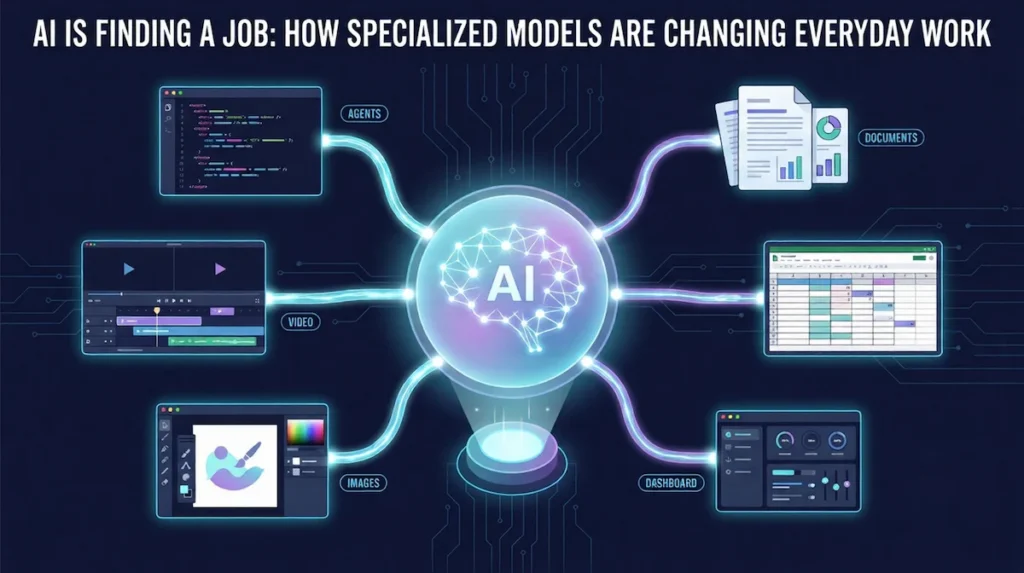
For the past few years, the AI industry has largely competed on one question: whose model is the smartest? That race is not over, but it is no longer the whole story. A new wave of AI launches suggests the next phase is about something more practical: models finding specific jobs inside everyday workflows.
AI Is Finding a Job
The early AI boom was defined by spectacle. Chatbots could write essays, explain code, summarize documents, generate images, and answer questions in ways that felt futuristic almost overnight. Every major launch seemed to revolve around the same basic comparison: which company had the biggest, smartest, most impressive model?
That race still matters. Frontier models are not going away. The most capable systems will continue to push reasoning, coding, science, and automation forward.
But the market is starting to mature. Instead of one giant model trying to do everything, AI is beginning to split into specialized roles. One model may be optimized for agents. Another may be built for video creation. Another may be designed for fast image drafting. Another may focus on coding, search, customer support, spreadsheets, or document analysis.
That shift matters because most people do not need the most powerful AI model in the world for every task. They need the right model for the job they are actually doing.
This week’s AI news fits that pattern. Anthropic introduced Claude Sonnet 5 as a more cost-efficient model for everyday agentic work. Google pushed Gemini further into conversational video creation with Gemini Omni. Google also introduced Nano Banana 2 Lite, a faster and cheaper image generation model built for rapid iteration.
Taken together, these are not just three separate product announcements. They point to a bigger change in the AI market. AI is moving from “one chatbot that does everything” toward a toolbox of specialized models that fit into real workflows.
Claude Sonnet 5 Shows the Agent Workhorse Lane
Anthropic’s Claude Sonnet 5 is a good example of where the AI model race is heading. The most interesting part is not simply that Anthropic launched another model. It is that Sonnet 5 is being positioned around efficient agentic work instead of pure flagship bragging rights.
Anthropic describes Claude Sonnet 5 as a model built for coding, agents, and everyday work, with examples focused on multi-step tasks, convention-following, and practical software workflows. In other words, this is not just a chatbot that answers a prompt and waits. It is aimed at the kind of AI usage where the model needs to stay on task, follow instructions, and complete work across multiple steps.
That is the agent lane.
Agents are only useful if they can run often enough to matter. A model that is brilliant but too expensive to use repeatedly becomes a demo. A model that is capable, reliable, and cheaper to run can become infrastructure.
That is why cost matters so much here. Enterprise AI does not live in one-off prompts. It lives in repeated workflows: checking documents, writing code, reviewing tickets, summarizing meetings, browsing internal knowledge, updating reports, and handling the endless small tasks that surround modern work.
A company does not want one magical answer. It wants thousands or millions of dependable actions at a cost that makes sense.
That is the role models like Claude Sonnet 5 are trying to fill. They are not necessarily about being the flashiest model on a benchmark chart. They are about being good enough, reliable enough, and affordable enough to become part of daily operations.
Anthropic’s Claude Sonnet 5 launch makes this clear by emphasizing coding agents, multi-step work, and efficient cost. That is a very different message from “look how smart this chatbot is.” It is closer to “this model can do a job.”
Gemini Omni Shows the Creative Workflow Lane
Google’s Gemini Omni points in a different direction. Instead of focusing mainly on text, code, or enterprise agents, Omni is about turning media creation into a conversation.
Google describes Gemini Omni as a model that can combine images, audio, video, and text as input to generate and edit video. The key idea is not just video generation. It is conversational video editing: start with an idea, an image, a clip, or another piece of media, then use natural language to shape the final result.
That is a major workflow shift.
Traditional video editing is powerful, but it is also technical. Timelines, cuts, layers, keyframes, effects, color tools, audio controls, export settings, and platform-specific formats all create friction. Professionals need that control, but everyday users often just want to turn an idea into a usable clip.
Gemini Omni is part of a larger push to make that process feel less like operating software and more like directing a creative assistant.
That does not mean professional video editors are suddenly obsolete. The best creative work still needs taste, pacing, accuracy, judgment, and revision. But it does mean more people may be able to make rough drafts, social clips, product visuals, ads, educational explainers, and concept videos without starting from a blank timeline.
That is the creative workflow lane. AI is not just answering questions. It is entering the production process.
Google’s Gemini Omni announcement describes the model as combining multiple input types and enabling video creation and editing through conversation. That is the important part. The model is not just smarter. It is being shaped around a specific creative job.
Nano Banana 2 Lite Shows the Fast Iteration Lane
Google’s Nano Banana 2 Lite is another useful example because it is not trying to be the most dramatic AI release in the world. It is trying to be fast, efficient, and cheap enough for repeated use.
That may sound less exciting than a giant flagship model, but for real workflows, speed and cost can matter more than spectacle.
Image generation is often an iterative process. A user does not usually create one image and stop. They test ideas, adjust prompts, change styles, fix text, try new compositions, swap backgrounds, create social variants, compare thumbnails, and generate multiple drafts before choosing one.
That kind of workflow rewards fast, low-cost models.
Google says Nano Banana 2 Lite is its fastest and most efficient Gemini image model, built for high-speed generation and editing at lower cost. Google’s launch material highlights use cases like rapid drafting, prototyping, and scalable image creation. That is not the same job as a slower, more expensive model designed for polished professional assets.
And that is exactly the point.
Sometimes the best model is not the most powerful one. Sometimes it is the model that lets a user try ten ideas quickly instead of waiting around for one expensive result.
Google’s Nano Banana 2 Lite announcement emphasizes low latency, cost efficiency, and rapid visual drafting. That makes it a good example of AI becoming less like a magic trick and more like a production tool.
The Pattern: AI Is Becoming a Toolbox
These launches are different, but they point in the same direction.
Claude Sonnet 5 is aimed at agentic work. Gemini Omni is aimed at conversational video creation. Nano Banana 2 Lite is aimed at fast image generation and editing. None of these models has to win every category to matter.
That is the important shift.
The AI industry is moving away from the idea that one model must be the best at everything. Instead, the market is starting to look more like a toolbox. You do not use a hammer to tighten a screw. You do not use a screwdriver to cut wood. You use the right tool for the job.
AI is beginning to work the same way.
A coding assistant does not need to be the best video model. A video model does not need to be the best spreadsheet analyst. An image model does not need to be the best legal summarizer. A small fast model does not need to beat a giant frontier model at deep reasoning if its real job is quick drafting, classification, extraction, or content variation.
This is how AI starts to become useful in normal work. Not as one giant chatbot sitting on the side of the screen, but as a set of specialized tools woven into the apps and tasks people already use.
Why This Matters for Everyday Users
For everyday users, this shift could be more important than another benchmark win.
Most people do not wake up hoping for a model with a slightly higher score on a technical leaderboard. They want help with real tasks. They want to clean up an email, build a presentation, make a short video, edit an image, organize notes, compare products, summarize a PDF, plan a trip, fix a spreadsheet, or automate some repetitive part of their day.
That requires AI to fit into workflows, not just conversations.
The current chatbot interface is useful, but it is also limited. The user has to stop what they are doing, open the AI tool, explain the context, copy the answer, paste it somewhere else, and then manually continue the work.
The next phase is different. AI models are starting to move into the work itself. They are being designed for agents, creative tools, browsers, office suites, developer environments, search systems, customer support tools, media apps, and business platforms.
That is when AI becomes less of a destination and more of a layer.
You may not always think, “I am using AI now.” You may simply notice that your video editor understands a plain-English request, your coding tool can fix a bug across files, your image editor can generate quick variations, or your work assistant can summarize a meeting and turn it into tasks.
That is AI finding a job.
Why Cost Is the Hidden Story
There is another important reason this specialization matters: cost.
Big frontier models are expensive to train, expensive to run, and power-hungry at scale. They are valuable for hard problems, but not every task needs that level of compute. Using the largest possible model for every tiny workflow is like driving a semi-truck to pick up a sandwich.
Specialized models can be more efficient because they are built around narrower jobs. A fast image model can prioritize visual iteration. An agent model can focus on instruction-following and multi-step task completion. A video model can focus on media generation and editing. A lightweight model can handle simple classification, extraction, or summarization without calling in the heavy machinery.
This is where AI economics and user experience meet.
If AI is too expensive, companies limit access. If it is too slow, users give up. If it is too general, it may feel impressive but not dependable. The models that win inside daily workflows may be the ones that are fast enough, cheap enough, and focused enough to be used constantly.
That is why “smaller,” “faster,” and “cheaper” should not be dismissed as boring. Those traits are often what turn technology from a demo into a habit.
This Also Changes the Competitive Map
This shift could also make the AI race harder to judge.
When the industry was mostly comparing chatbots, it was tempting to ask one simple question: which model is best? But as AI branches into different jobs, there may not be one clean winner.
Anthropic may be strong in agents and coding workflows. Google may be strong where AI connects to Search, YouTube, Android, Workspace, video, and image tools. OpenAI may continue pushing broad consumer AI, reasoning, and app-like experiences. Meta, xAI, Mistral, Qwen, DeepSeek, and others may compete in open models, local deployment, cost efficiency, speed, or developer flexibility.
The question becomes less “who has the smartest chatbot?” and more “who has the best AI stack for the workflow?”
That is a much more interesting fight.
A user making videos may care more about Gemini Omni than a text-only reasoning model. A developer may care more about Claude’s coding behavior than an image generator. A small business may care more about cheap image iteration than a flagship model that costs too much to use at scale. A local AI enthusiast may care more about open weights, quantization, and VRAM requirements than cloud model rankings.
AI is not becoming one market. It is becoming many overlapping markets.
The Risk: More Tools, More Confusion
There is a downside to all of this specialization. The more models branch into different jobs, the harder it becomes for normal users to understand what they should actually use.
Model names are already confusing. Pro, Flash, Lite, Sonnet, Opus, Haiku, Omni, Nano Banana, image models, video models, reasoning models, agent models, coding models, local models, open models, cloud models — it is a lot.
For regular users, the future cannot just be a menu of model names. It has to become simpler than that.
The best version of this future is invisible. A user should not need to know which exact model is running behind the scenes. The software should choose the right tool for the task: a cheap model for simple drafting, a stronger model for complex reasoning, a video model for media creation, an image model for visual edits, and an agent model for multi-step actions.
That is where the real product challenge begins. The companies that win may not be the ones with the longest model list. They may be the ones that make all these specialized systems feel simple.
Bottom Line
AI is entering a more practical phase. The industry is still chasing smarter frontier models, but the bigger shift may be happening in everyday workflows.
Claude Sonnet 5 points toward cheaper agentic work. Gemini Omni points toward conversational video creation. Nano Banana 2 Lite points toward fast, low-cost image iteration. Different models, different jobs, same larger trend.
AI is no longer just trying to be one big chatbot that answers everything. It is starting to become a toolbox.
That may sound less dramatic than another benchmark race, but it is probably more important for normal users. The future of AI will not be defined only by the smartest model in a lab. It will be defined by which models can quietly fit into the work people already do every day.
In other words, AI is finally finding a job.
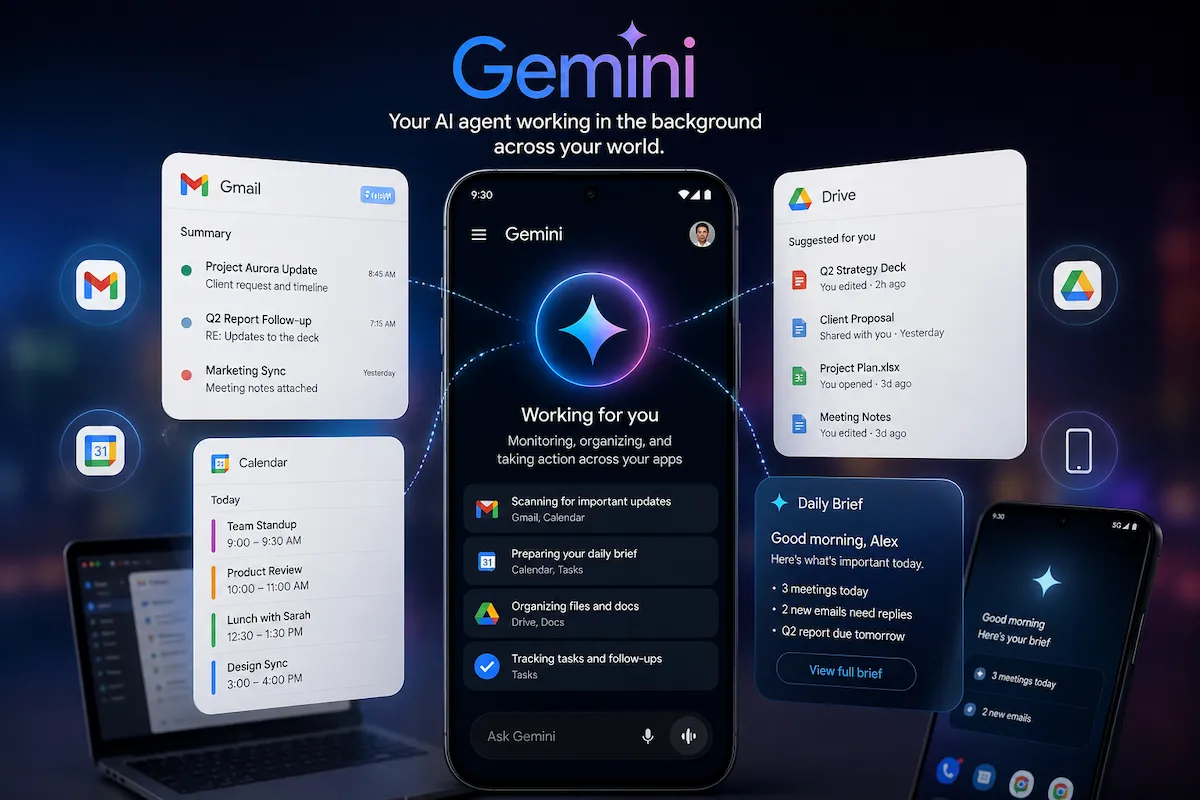 |
Google Gemini and the AI Agent Ecosystem AdvantageWhy deep ecosystem integration is giving Google a massive leg up in the race to build truly autonomous, production-ready AI agents. |
 |
Should Powerful AI Models Be Held Back? The Claude Mythos Security DebateAn analysis of the escalating industry friction surrounding open weight releases, deployment pauses, and the safety boundaries of next-tier model capabilities. |