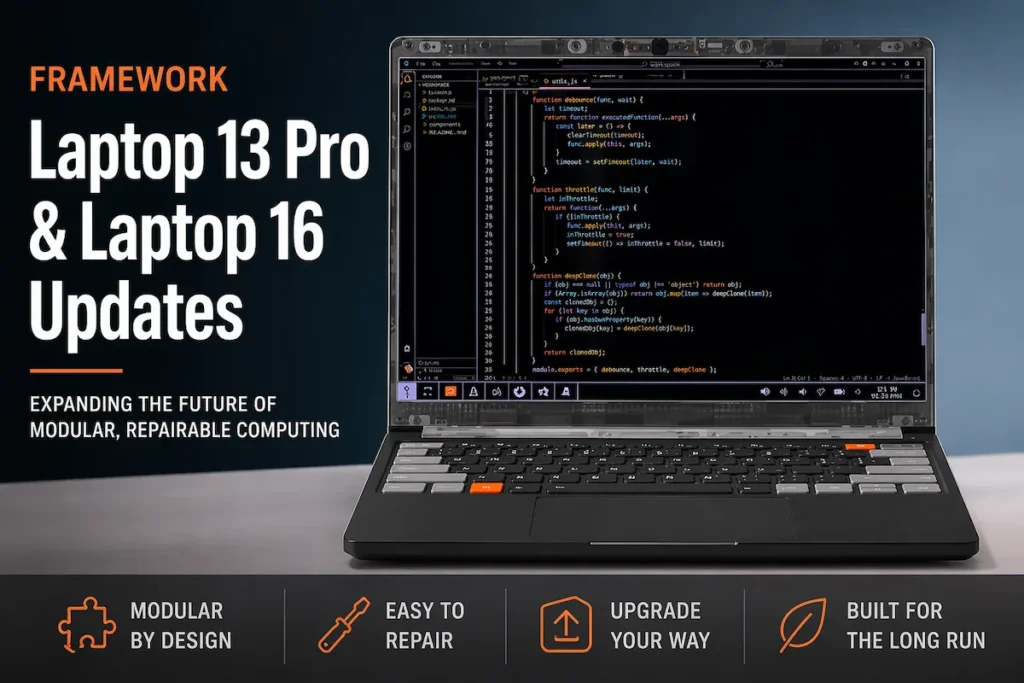
Framework has announced the new Laptop 13 Pro while also updating its existing 16-inch modular laptop, extending the company’s long-running push to make notebooks easier to repair, upgrade, and keep in service for longer.
The company has built its reputation around an idea that still feels unusual in the laptop market: users should be able to replace major components instead of treating a notebook as a sealed device with a limited lifespan. With the new 13 Pro and continued work on the 16-inch platform, Framework appears to be refining that vision rather than changing it.
What Framework announced
The headline addition is the Framework Laptop 13 Pro, a more advanced take on the company’s 13-inch modular system. Framework is positioning it as part of the same broader ecosystem built around replaceable parts, modular I/O, and long-term serviceability.
At the same time, the company also revealed updates to its 16-inch model, which remains the more ambitious expression of Framework’s design philosophy thanks to its larger chassis and support for deeper hardware customization.
What stands out most is not a sudden change in direction, but a continued effort to mature the modular laptop concept into something that appeals beyond enthusiasts and early adopters.
What appears to be confirmed
Based on currently available reporting and Framework’s established product direction, the clearest takeaways are:
- The Framework Laptop 13 Pro is now part of the company’s lineup.
- Framework is continuing to build around repairability and user-upgradeable components.
- The company’s modular expansion card approach for ports and connectivity remains central to the platform.
- The 16-inch model is receiving updates as Framework continues developing its larger modular system.
That means Framework is still betting that consumers will value a laptop they can maintain over time rather than replace outright every few years.
What is still evolving
Several practical details are still coming into focus, particularly around how configurations will be structured and how those choices affect real-world performance and value:
- Exact processor and graphics configuration tiers
- Battery performance and thermal behavior across different builds
- How pricing scales based on user-selected components and modules
- Regional availability timelines
- The extent of backward compatibility with older Framework parts and modules
Pricing, in particular, is less about a single fixed number and more about how buyers choose to configure their system. Framework’s modular approach means the final cost can vary significantly depending on selections like the mainboard, memory, storage, and expansion cards.
That flexibility is part of the value proposition—but it also makes direct comparisons with traditional pre-configured laptops more complex. Buyers will need to evaluate not just the base system, but the total cost of building a configuration that meets their performance and longevity expectations. For a deeper breakdown of what actually impacts long-term value, see our guide on what to look for in your next laptop and how long it will last.
As more details emerge, the key question is whether the Laptop 13 Pro can balance performance, battery life, and long-term upgrade value against more tightly integrated premium notebooks.
With Framework, the “price” of a laptop is less about the starting point and more about the build. That shifts the buying decision from choosing a model to effectively assembling a system—closer to how desktops are purchased than traditional laptops.
Why the Laptop 13 Pro matters
The Laptop 13 Pro looks important not because it abandons Framework’s original formula, but because it suggests the company is trying to make that formula more polished and more practical for a wider audience.
Framework has long appealed to users who care about ownership, repairability, and sustainability. The challenge has always been expanding that appeal beyond tinkerers and into the mainstream premium laptop market, where buyers often prioritize battery life, portability, finish quality, and performance consistency over serviceability.
The “Pro” branding suggests Framework sees room for a more performance-focused or premium-oriented version of its smaller platform, potentially aimed at developers, professionals, and buyers who want something more flexible than a typical sealed ultrabook.
The bigger idea: changing the laptop lifecycle
Framework’s larger argument is that a laptop should behave more like a long-term platform than a disposable appliance. In practical terms, that means users may be able to replace worn or outdated parts instead of replacing the entire machine.
That has several clear benefits:
- Longer usable life for the chassis and core system
- Lower long-term ownership costs if upgrades are available over multiple generations
- Easier repairs for components like keyboards, displays, storage, and batteries
- Greater flexibility through modular ports and replaceable internals
In an industry where soldered memory, glued-in batteries, and limited repair paths remain common, that still makes Framework stand out.
Why the Laptop 16 still matters
The updated 16-inch model remains a key part of Framework’s strategy because it pushes modularity further than the 13-inch systems can. A larger design gives Framework more room to experiment with user-replaceable performance hardware and more ambitious expansion concepts.
That makes the 16-inch machine important even if it stays more niche. It acts as a proof point for how far Framework believes laptop modularity can go when it is not constrained by ultra-thin design priorities.
If the 13 Pro is the more practical mainstream-facing product, the 16-inch platform is still the clearer expression of Framework’s long-term ambition.
The tradeoffs Framework still has to manage
Modularity has advantages, but it is not free. Designing a laptop to be opened, serviced, and upgraded introduces compromises that traditional manufacturers often avoid.
Those tradeoffs can include:
- Thicker or less aggressively optimized chassis designs
- Potentially higher component costs compared with tightly integrated systems
- Reliance on ecosystem support for future parts and upgrades
- More decision-making for the buyer, especially for users who prefer simple all-in-one purchasing
That does not weaken Framework’s pitch, but it does explain why modular notebooks are still a niche within the broader laptop market.
Why this matters beyond Framework
Framework’s announcements arrive at a time when repairability is becoming a bigger industry issue. Right-to-repair pressure has increased, regulators have taken a greater interest in product longevity, and more consumers are starting to question why premium electronics are often so difficult to service.
Large manufacturers have begun offering limited self-repair programs or replacement parts, but most still treat repairability as an add-on. Framework’s difference is that it treats repairability as a core design principle.
That gives the company a clearer identity than many larger competitors, even if it remains much smaller in scale.
What buyers should watch next
The success of the Laptop 13 Pro and the updated 16-inch model will likely depend on four things:
- Performance: whether the systems can stay competitive with traditional premium laptops in real-world use, especially as next-gen platforms like Intel’s upcoming Panther Lake laptops begin to set new expectations for efficiency and AI-ready performance
- Battery life and thermals: whether serviceability comes without major mobility compromises
- Pricing: whether Framework can make the long-term value argument feel practical, not just philosophical
- Backward compatibility: whether older parts, modules, and upgrade paths continue to work across generations
If Framework can deliver on those points, the company’s modular model becomes easier to recommend to buyers who are interested in longevity but do not necessarily think of themselves as enthusiasts.
Bottom line
The new Framework Laptop 13 Pro and the company’s latest 16-inch model updates do not radically change Framework’s vision. What they do show is that Framework is still steadily refining one of the most distinct ideas in the laptop market: a notebook that users can actually own, repair, and improve over time.
For consumers, that means a potentially longer-lasting laptop. For builders and tinkerers, it means continued access to one of the most flexible notebook ecosystems on the market. And for the broader PC industry, it is another reminder that repairability and modularity are no longer fringe ideas.
Framework still has to prove that its hardware can balance flexibility with mainstream expectations on performance, price, and polish. But if that balance improves with each generation, the company’s approach may look less like a niche experiment and more like a preview of where premium laptops eventually need to go.