Physical video game sales in the United States fell to a record low in 2025, totaling approximately $1.5 billion, according to market data from Circana. That represents the lowest annual spending on physical game software since national tracking began in 1995.
The decline reflects the industry’s long-running shift toward downloads, subscriptions, and digital-only hardware. Yet physical games have not disappeared. Instead, the market appears to be settling into a smaller, specialized niche—with Nintendo serving as its most important supporter.
Physical Game Sales May Be Approaching a Floor
The contraction of physical game sales is a structural transition rather than a sudden collapse. U.S. physical software spending fell sharply in 2024, declining 28%, before the rate of decline slowed to 11% in 2025.
Physical video games appeared to reach a historic low point in 2025. Then Nintendo complicated the obituary.
U.S. spending on new physical game software fell to approximately $1.5 billion in 2025, according to Circana data reported by industry analyst Mat Piscatella. It was the lowest annual total in records extending back to 1995 and an 11% decline from the previous year.
Only months later, however, the market posted a modest rebound. Spending on physical games increased during the 12-month period ending in May 2026, interrupting 16 consecutive years of decline. Piscatella attributed that change primarily to the arrival of Nintendo Switch 2.
The timing matters. Sony has announced that it will stop producing discs for new PlayStation games in January 2028. Microsoft continues to build Xbox around digital stores, subscriptions, cloud services, and hardware that often lacks a disc drive. Nintendo, meanwhile, has launched another console with a cartridge slot and continues to sell major first-party games in physical packages.
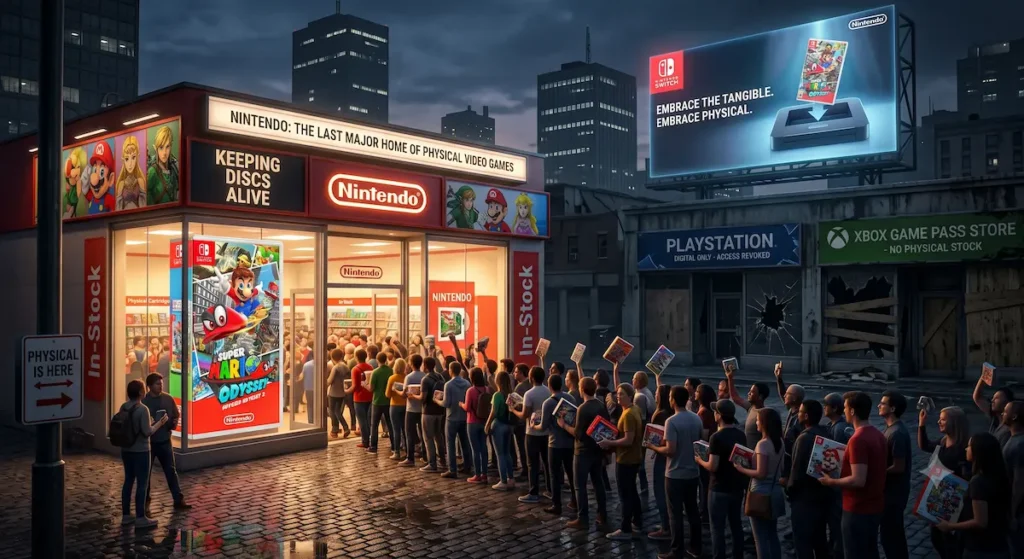
That raises a question that would have seemed unlikely a generation ago: Could Nintendo become the last major home of physical video games?
Sony Has Put an Expiration Date on New PlayStation Discs
The industry’s digital transition is no longer merely a projection. Sony Interactive Entertainment has placed a date on one of its most consequential steps.
Beginning in January 2028, Sony will discontinue physical disc production for all new games released on PlayStation consoles. Those games will instead be sold through the PlayStation Store and in digital formats offered by retailers, according to the company’s official announcement.
The decision does not affect PlayStation games released on disc before the cutoff. Sony has also not said that existing disc libraries will immediately become unusable. Nevertheless, the announcement establishes a clear endpoint for newly manufactured PlayStation game discs.
Sony described the change as a response to consumer preferences. Its financial reports have consistently shown that downloads account for the large majority of full-game sales on PlayStation 4 and PlayStation 5. Digital purchases, add-on content, and PlayStation Plus have also become central parts of the company’s gaming business.
For physical-media supporters, the significance is difficult to overstate. PlayStation has been one of the largest markets for game discs for more than three decades. Once new PlayStation releases stop appearing on disc, the remaining commercial market for conventional physical games will become considerably smaller.
Xbox Is Digital-First, but Its Disc Exit Is Not Official
Microsoft appears to be moving in the same general direction, although its position requires more careful wording.
The Xbox Series S has always been a digital-only console, and Microsoft later introduced an all-digital version of the more powerful Xbox Series X. Circana’s Piscatella reported that more than half of the Xbox Series consoles sold in the United States do not have physical drives.
Microsoft also defines its gaming strategy increasingly through Xbox Game Pass, digital content, cloud gaming, advertising, and access across consoles, PCs, mobile devices, and other screens. In its 2025 annual report, the company described Xbox content and services as encompassing games, in-game purchases, subscriptions, cloud gaming, advertising, and other online services.
That is a digital-first ecosystem, but it is not yet an officially digital-only one.
Microsoft has not announced a formal date for ending Xbox disc production. It also continues to release selected physical products. The company’s 2026 collector’s edition of Gears of War: E-Day, for example, includes an Xbox Series X game disc.
Analysts may expect Microsoft’s next-generation hardware to omit native disc support, but that remains a forecast rather than a confirmed company decision. The evidence points strongly toward a digital Xbox future; it does not yet provide the same definitive cutoff Sony has announced for PlayStation.
Nintendo Interrupted the Decline of Physical Game Sales
Against that backdrop, Nintendo’s position has become increasingly important.
According to Piscatella’s analysis of Circana data, U.S. spending on new physical games rebounded slightly during the 12 months ending in May 2026 after 16 years of consecutive declines. The launch of Nintendo Switch 2 was the principal reason.
This does not mean physical media is returning to its former position as the industry standard. The market remains dramatically smaller than it was during the peak years of game discs, and most game spending now occurs through digital storefronts, subscriptions, mobile games, downloadable content, and in-game purchases.
It does suggest, however, that there is still enough demand to support a physical market when the hardware, software, and audience align. At present, Nintendo is the company providing that alignment.
The Switch 2 launched with a physical cartridge slot. Nintendo continues to offer its prominent first-party releases in packaged editions, and the system can also play compatible physical Nintendo Switch games. Rather than treating cartridges as a legacy accessory, Nintendo incorporated them into the transition between its two console generations.
Nintendo Is Not Resisting Digital Distribution
Calling Nintendo the likely future of physical games does not mean the company is opposed to digital distribution. Its own financial results show precisely the opposite.
During the quarter ending June 30, 2026, Nintendo generated 132.7 billion yen in digital sales, an increase of 90% from the same quarter one year earlier. Digital products accounted for 61.5% of its dedicated-platform software revenue, up from 59.3%, according to Nintendo’s August 2026 financial results.
That percentage requires context. Nintendo’s digital category includes more than downloaded copies of games that are also available in stores. It also includes download-only software, add-on content, and Nintendo Switch Online revenue. It should not be compared directly with figures measuring only the percentage of complete games downloaded on PlayStation or Xbox.
The broader point is still clear: digital products now generate most of Nintendo’s software revenue. Nintendo is not choosing physical instead of digital. It is maintaining both channels while its competitors move closer to eliminating one of them.
That approach may be especially valuable to Nintendo because its business differs from those of Sony and Microsoft. Nintendo controls many of its most commercially durable franchises, sells heavily to families, and produces games that can remain on retail shelves for years rather than disappearing after a short launch window.
Why Physical Games Still Make Sense for Nintendo
Physical software offers Nintendo several strategic advantages even as downloads grow.
- Retail visibility: A boxed Mario, Zelda, Pokémon, or Animal Crossing game functions as advertising whenever it appears in a store.
- Gift purchases: Physical games remain easier to wrap, display, and give during birthdays and holiday periods than account-specific downloads.
- Resale and lending: Cartridges can generally be shared, traded, or sold without transferring a Nintendo Account.
- Collector demand: Packaging, special editions, and limited releases provide value beyond access to the software.
- Long-term catalog sales: Nintendo’s first-party games often remain commercially relevant throughout an entire hardware generation.
Nintendo has also begun acknowledging the different economics of the two formats more directly. Starting in May 2026, the company separated the suggested retail prices of new Nintendo-published Switch 2 exclusives in physical and digital formats. Nintendo said the change reflects the different costs of producing and distributing each version. The company explains the policy on its Switch 2 pricing support page.
That is an important signal. Instead of eliminating physical products because they cost more to manufacture, Nintendo appears willing to price the formats differently and let buyers decide which benefits they value.
Game-Key Cards Complicate the Meaning of “Physical”
Nintendo’s support for cartridges comes with a significant qualification. Not every Switch 2 card contains the game printed on its packaging.
The platform supports two types of physical media. A standard game card contains game data. A Game-Key Card contains a key that authorizes the user to download the game from Nintendo’s servers.
According to Nintendo’s explanation of Game-Key Cards, an internet connection and sufficient system or microSD Express storage are required for the initial download. Once the software is installed, it can be played without an internet connection, but the Game-Key Card must be inserted in the console.
The card can also be moved to another Switch 2, where the game can be downloaded and played using the same process. That preserves two important characteristics of conventional physical ownership: the product can be lent to someone else and potentially resold.
What it does not preserve is a self-contained copy of the software.
If Nintendo’s servers eventually stop providing the required files, possession of the card alone may not be enough to install the game on another system. That makes Game-Key Cards less suitable for long-term preservation than cartridges containing complete playable data.
Nintendo President Shuntaro Furukawa has said the format was introduced to accommodate the larger file sizes of Switch 2 software. It also gives publishers a way to sell a transferable retail product without placing the complete game on more expensive high-capacity flash memory.
The result is a genuine hybrid. A Game-Key Card is more flexible than a download tied permanently to one account, but it offers less independence than a complete game stored on a cartridge.
ITD Insight
Nintendo may preserve the physical object without always preserving the game on that object. Game-Key Cards retain lending, resale, and retail visibility, but they transfer part of ownership from the cartridge to Nintendo’s download infrastructure. The future of physical gaming may therefore depend not only on whether cartridges survive, but on what those cartridges actually contain.
Physical Games May Become a Nintendo-Led Specialty Market
The most likely future is not a broad revival of physical media. Digital distribution is too convenient for consumers and too financially attractive for publishers and platform owners.
Physical games are instead becoming a specialized market built around collectors, gifts, premium editions, transferable ownership, and a smaller group of consumers who distrust account-bound purchases.
Sony’s 2028 decision will accelerate that transition. Microsoft’s hardware mix and service strategy point in a similar direction, even though the company has not formally announced the end of Xbox discs. Nintendo is the only major platform holder currently positioned to support physical media as a standard part of another full console cycle.
Piscatella expects Nintendo to continue producing physical games through at least the end of the Switch 2 generation. That is an analyst forecast, not a permanent commitment from Nintendo, but it is consistent with the company’s current hardware, pricing, and release strategy.
Nintendo still benefits from the retail presence, giftability, collectibility, and transferability of cartridges. Those advantages are particularly valuable for a company whose games and characters appeal to families and whose biggest releases frequently remain in demand for years.
Nintendo Could Save Physical Games—and Redefine Them
Nintendo is unlikely to reverse the industry’s transition toward digital distribution. Its own revenue is already predominantly digital, and that share may continue to grow.
What Nintendo can do is prevent physical games from disappearing entirely.
As PlayStation prepares to end new disc production and Xbox expands beyond the traditional console, Nintendo may become the last major platform where buying a newly released game still routinely means purchasing a transferable object from a store.
Whether that represents the survival of physical ownership depends on the object itself. A cartridge containing a complete game can function independently for decades. A Game-Key Card depends on an initial download and the continued availability of remote software.
That distinction will determine whether Nintendo becomes physical gaming’s final defender or merely the company that manages its transition into something new.