Roku’s Pro Series LX OLED televisions bring up to 144Hz variable refresh rate, reflection-reducing screen technology, and an upgraded voice remote to the company’s premium TV lineup. Available in 55-inch and 65-inch sizes with listed prices starting at $1,299.99, the LX pairs those upgrades with Roku’s familiar streaming platform.
The LX sits above the standard Pro Series OLED, offering a higher gaming refresh ceiling and display enhancements aimed at more demanding viewing environments. For buyers considering an OLED upgrade, the question is how much those additions improve everyday viewing—and whether they justify the premium over Roku’s standard models and competing televisions.
Roku Pro Series LX Sizes and Pricing
Roku lists the Pro Series LX OLED at $1,299.99 for the 55-inch model and $1,599.99 for the 65-inch version. Their model numbers are 55RCD5 and 65RCD5, respectively.
The same product page lists the standard Pro Series OLED at $999.99 for 55 inches and $1,199.99 for 65 inches. At those prices, upgrading to the LX costs an additional $300 for the smaller screen or $400 for the larger one.
- 55-inch Pro Series LX OLED: $1,299.99, model 55RCD5.
- 65-inch Pro Series LX OLED: $1,599.99, model 65RCD5.
- 55-inch standard Pro Series OLED: $999.99.
- 65-inch standard Pro Series OLED: $1,199.99.
These listed prices provide a reference point rather than a guarantee of the final checkout price. Retailer promotions, stock, and delivery options can change the comparison, particularly for shoppers deciding between a larger standard model and a smaller LX.
Where the LX Fits in the OLED Market
The LX belongs on the comparison list alongside LG’s C-series and Samsung’s S90-series OLED televisions. Current-generation examples include the LG C6 and Samsung S90H. Earlier-generation models may also be relevant where retailers still have stock.
The useful comparison is between the same screen size at actual purchase prices. If a competing OLED falls within the LX’s price range, buyers should weigh measured HDR brightness, reflection handling, motion processing, gaming performance, and connectivity alongside the streaming interface. A higher refresh-rate specification alone does not establish better overall picture quality.
Roku’s software provides a familiar option for households already using its streaming devices. However, a separate Roku player can also bring that streaming experience to another brand’s television. The LX therefore needs a compelling combination of display performance, convenience, and price to make its strongest case.
This release establishes the LX’s advertised features. It does not establish how its picture quality compares with specific LG or Samsung models under the same test conditions.
Up to 144Hz VRR for Compatible Gaming Setups
The LX’s headline gaming upgrade is support for up to 144Hz variable refresh rate, compared with the standard Pro Series OLED’s 120Hz specification. Roku also lists FreeSync Premium and Automatic Gaming Mode among the lineup’s gaming features.
A higher refresh ceiling allows a compatible source to deliver more frequent image updates. That can make fast movement appear smoother when the connected hardware and game can produce enough frames to use the additional capacity. Connecting a lower-output source does not automatically turn its games into a 144Hz experience.
Variable refresh rate addresses a related problem: uneven frame delivery. By allowing the display’s refresh timing to follow the source, VRR can reduce visible tearing as frame rates fluctuate. Its benefit can therefore extend to games running below the screen’s maximum refresh rate.
For buyers, the relevant question is whether their gaming hardware supports the intended resolution, refresh rate, and VRR combination. Input lag, motion clarity, and picture quality in gaming modes also require testing; the specification sheet alone cannot establish those results.
HDMI Capabilities Need a Closer Look
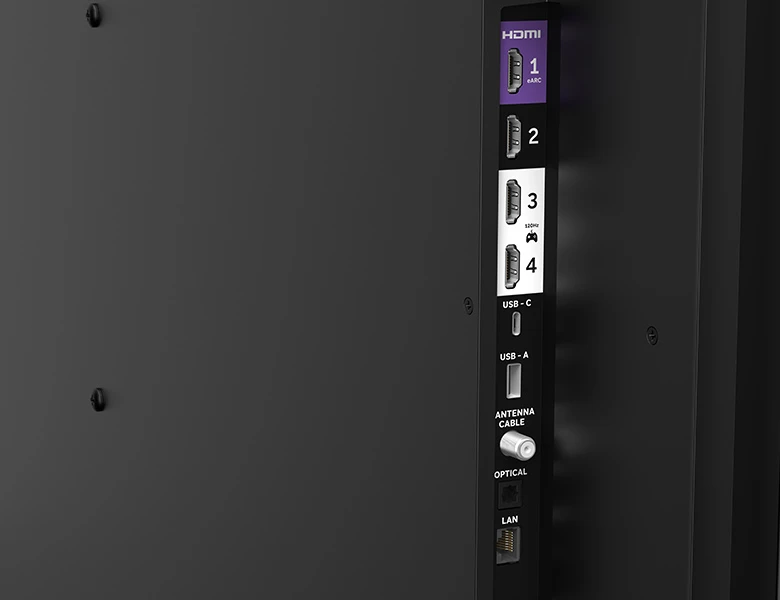
Connectivity is one area where Roku’s published information needs clarification. Its product page lists four HDMI 2.1 inputs, including one with eARC. However, its support comparison describes the broader Pro OLED range as having two HDMI 2.1 inputs capable of 120Hz.
Those descriptions do not provide a clear, model-specific account of which LX inputs support 4K at 144Hz with VRR, or the maximum bandwidth available on each port. Buyers should not interpret the four HDMI 2.1 labels as confirmation that every input supports identical gaming features.
The supplied connection-panel image labels HDMI 1 for eARC and marks HDMI 3 and 4 with a 120Hz gaming designation. It helps identify the connections, but does not resolve the LX’s per-port 144Hz capabilities.
This matters when connecting a soundbar alongside multiple gaming devices. An eARC soundbar occupies the television’s designated audio-return port. If that connection is also one of a limited number of high-refresh inputs, fewer remain available for directly connected consoles or PCs. This is a port-allocation issue; eARC does not automatically reduce the bandwidth of the other HDMI inputs.
The available information does not establish that this particular tradeoff applies to the LX. Buyers planning a multi-device setup should confirm the supported resolution and refresh-rate combinations for each input on the exact model.
Reflection Control Is Part of the Upgrade
Roku says the LX uses an advanced polarizer designed to reduce reflections. The company also positions it as offering a brighter picture and a wider range of colors than the standard Pro Series OLED.
Those improvements target a practical challenge for living-room televisions. Windows, lamps, and overhead lighting can interfere with dark scenes, making reflection handling relevant even when a display can produce deep blacks.
Reflection reduction and screen brightness address different parts of that problem. A reflection-reducing treatment aims to make ambient light less intrusive, while greater brightness increases the light produced by the display. Together, they may improve viewing in a bright room, but their effectiveness depends on the implementation and the room itself.
The product specifications reviewed for this article do not provide a measured peak-brightness figure or standardized reflection results. Roku’s claims explain the LX’s intended advantages, but they do not establish how it ranks against competing OLED televisions.
A More Capable Remote and Familiar Streaming Software
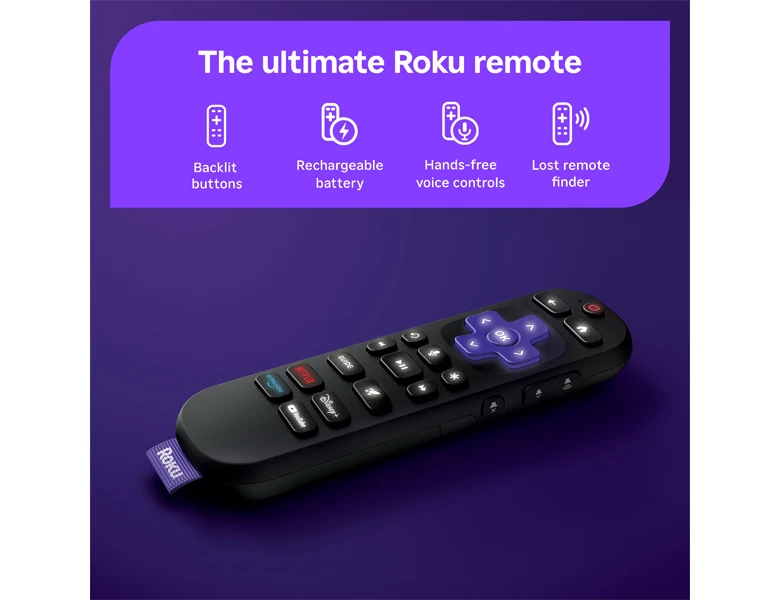
The LX includes Roku’s Voice Remote Pro, with backlit buttons, hands-free voice control, a rechargeable battery, and a lost remote finder. These conveniences affect everyday use, from finding controls during a movie to searching without entering text one character at a time.
Both OLED ranges use Roku OS and include Roku Smart Picture Max. Roku markets the picture-processing feature as a way to optimize viewing, although its effectiveness across different content and picture preferences requires evaluation.
For existing Roku users, the integrated platform offers continuity: an OLED upgrade with a familiar approach to finding apps and entertainment. That convenience is part of the product’s appeal, even as display quality remains central to the purchase.
Why This Matters
The LX gives Roku shoppers a more specific upgrade path. The standard OLED supplies the core display technology and streaming platform, while the LX adds features aimed at gaming and rooms with more challenging lighting.
The value of those additions depends on how the television will be used. Someone watching films primarily in a dark room may place less weight on reflection reduction and a 144Hz ceiling than someone using the same screen for daytime viewing and high-refresh PC gaming.
ITD Insight
Roku’s familiar interface gives the LX a clear audience, but buyers can also add a Roku player to competing televisions. The LX’s lasting appeal will depend on whether its display performance and everyday conveniences justify its price against the alternatives available at checkout.
What Buyers Should Watch Next
The most useful next evidence will be independent measurements of brightness, reflection handling, input lag, and gaming-mode picture quality, alongside clearer documentation of HDMI capabilities. At $1,299.99 and $1,599.99, the Pro Series LX OLED offers a defined set of upgrades; those results will help buyers decide how much the upgrades are worth for their room and connected devices.