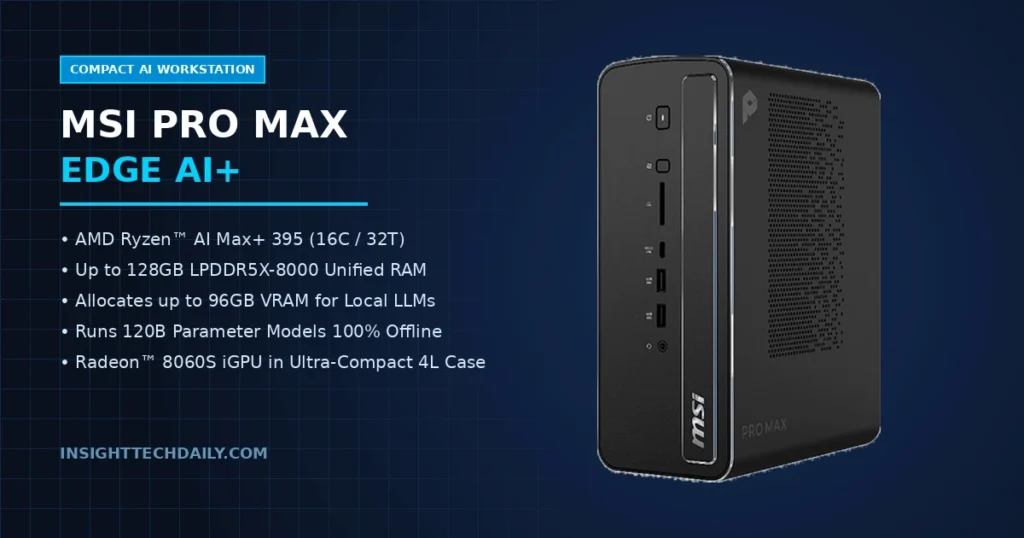
Micro-Star International (MSI) has launched the PRO MAX EDGE AI+, a compact 4-liter desktop designed for local artificial intelligence workloads. Its defining feature is not simply raw processing power, but access to as much as 128GB of LPDDR5X-8000 unified memory in a system small enough to sit on a desk.
At the top of the range, the desktop is powered by AMD’s Ryzen AI Max+ 395 processor. MSI says as much as 96GB of system memory can be assigned to the integrated Radeon 8060S graphics processor. That unusually large graphics-memory allocation gives developers and researchers room to load quantized large language models that exceed the memory capacity of most consumer graphics cards.
AMD Strix Halo Hardware in a Compact Desktop
The Ryzen AI Max+ 395 combines 16 Zen 5 CPU cores and 32 threads with 64MB of L3 cache. Its integrated Radeon 8060S GPU uses AMD’s RDNA 3.5 architecture and contains 40 compute units. A separate XDNA 2 neural processing unit provides up to 50 TOPS of dedicated AI acceleration.
MSI advertises up to 126 TOPS of total AI performance across the processor’s CPU, GPU, and NPU. Buyers should treat that combined figure as a broad platform rating rather than the performance of a single accelerator. The three components are suited to different operations, use different software paths, and cannot necessarily contribute their peak performance to the same workload at the same time. Large-model text generation will generally depend most heavily on the integrated GPU and memory subsystem, while the NPU is better suited to supported lower-power AI tasks.
AMD lists the memory bandwidth of this platform at 256GB/s. MSI houses it in an aluminum chassis measuring 97.5 x 188.4 x 248.5mm and weighing approximately 2.9kg. Its Frozr AI Pro cooling system uses three fans, copper heat pipes, and heatsinks over key components. A built-in 300W Flex ATX power supply avoids the external power brick commonly used by mini PCs.
Large Memory Capacity Does Not Guarantee High Speed
The PRO MAX EDGE AI+ addresses one of the biggest obstacles in local AI inference: fitting a model into available memory. A 70-billion-parameter model may require roughly 35GB just for weights at 4-bit precision and about 70GB at 8-bit precision, before allowing for runtime overhead, context cache, and other allocations. Actual requirements vary with the model, quantization format, context length, and inference software.
With up to 96GB available to the GPU, the MSI system should accommodate many quantized models in the 70B class and some larger models. MSI promotes support for models containing as many as 120 billion parameters, but that number should be understood as a capacity claim. Whether a particular 120B model fits—and whether it runs at an acceptable speed—will depend on its architecture and configuration.
Memory bandwidth is the main trade-off. Autoregressive text generation frequently moves large quantities of model data for every generated token, so capacity and bandwidth affect the experience in different ways. The system’s 256GB/s memory bandwidth is generous for an integrated processor but well below that of many high-end discrete accelerators.
For that reason, it is not useful to assign the machine a universal token-generation rate. Results can change substantially with model architecture, quantization, prompt length, context size, power profile, operating system, inference engine, and speculative-decoding settings. MSI advertises a result of 15 tokens per second for a 109B model, but this is a manufacturer-provided figure rather than an independent benchmark. Comparable third-party testing will be needed to establish performance across commonly used models and software.
Connectivity and Storage
The system includes two USB4 Type-C ports rated at 40Gbps, three USB Type-A ports rated at 10Gbps, two USB 2.0 Type-A ports, 2.5Gb Ethernet, Wi-Fi 7, Bluetooth 5.4, HDMI 2.1, DisplayPort 1.4a, audio connections, and an SD 4.0 card reader. It supports as many as four displays.
Two PCIe 4.0 M.2 slots provide storage for models, local datasets, and applications. Because large model files can consume tens or hundreds of gigabytes, buyers should consider both SSD capacity and sustained storage performance when choosing a configuration.
Privacy Benefits, With Important Qualifications
MSI is positioning the desktop for developers, analysts, researchers, and organizations that want to process proprietary or regulated information without routinely sending it to a third-party AI service. Local inference can reduce cloud dependence, recurring API charges, network latency, and the exposure created by transmitting prompts and documents to an external provider.
Local operation does not, by itself, guarantee security or regulatory compliance. Protection still depends on operating-system configuration, disk encryption, user access controls, application telemetry, network policy, model provenance, software updates, physical security, and an organization’s broader governance practices. The machine provides a useful technical foundation for private AI, but it is not a complete security solution.
Clustering Claims Need More Detail
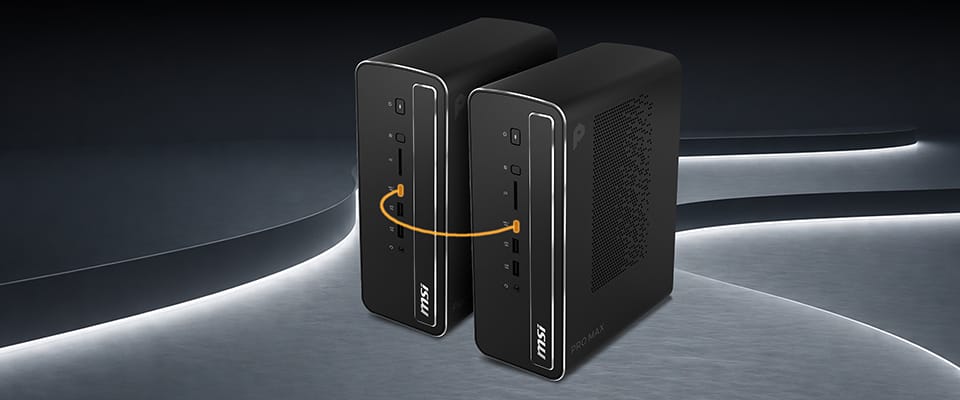
MSI also says multiple PRO MAX EDGE AI+ systems can be combined to run models containing as many as 670 billion parameters. In principle, distributing a model across several machines increases the available memory. In practice, performance depends heavily on the number of nodes, interconnect, inference framework, model architecture, and the amount of communication required between systems.
MSI has not yet published enough benchmark detail to judge how responsive such a cluster would be in typical deployments. The 670B figure should therefore be viewed as a model-capacity claim, not evidence that a clustered configuration will match the throughput of a purpose-built GPU server.
Early Assessment
The PRO MAX EDGE AI+ is an appealing example of how unified-memory processors are changing compact workstation design. It brings a 16-core CPU, capable integrated graphics, and an unusually large memory pool to a chassis far smaller than a conventional multi-GPU workstation.
Its most convincing uses are likely to include private retrieval-augmented generation, document analysis, coding assistants, model evaluation, and experimentation with quantized 30B-to-70B models. Users whose priority is maximum token throughput, model training, or mature support for software built around NVIDIA CUDA may still be better served by a discrete-GPU workstation or server.
MSI had not announced broadly available retail pricing at the time of the launch. The final value proposition will depend on configuration pricing, sustained performance, acoustics, power consumption, and software compatibility—particularly the maturity of AMD GPU acceleration in the buyer’s preferred operating system and inference tools. Until independent reviews are available, the PRO MAX EDGE AI+ is best regarded as a promising local-AI workstation with exceptional memory capacity and several performance questions still to be answered.
Sources: MSI launch announcement, MSI product specifications, and AMD Ryzen AI Max+ 395 specifications.
 |
I Built a Prime Day Mini AI PC Around an Open-Box 24GB Intel Arc Pro B60See how a compact AM5 system with 24GB of GPU memory brings serious local AI experimentation within reach of home users, creators, and homelab builders. |
 | Can a Mini PC Replace a Desktop in 2026?See where today’s compact PCs can match traditional desktops—and where thermals, expansion, and dedicated graphics still give full-size towers an advantage. |
 | Apple’s 1.5TB M7 Ultra Rumor Points to a New Class of Local AI WorkstationExplore why a rumored 1.5TB unified-memory ceiling could turn a future M7 Ultra Mac into an unusually capable workstation for running large AI models locally. |