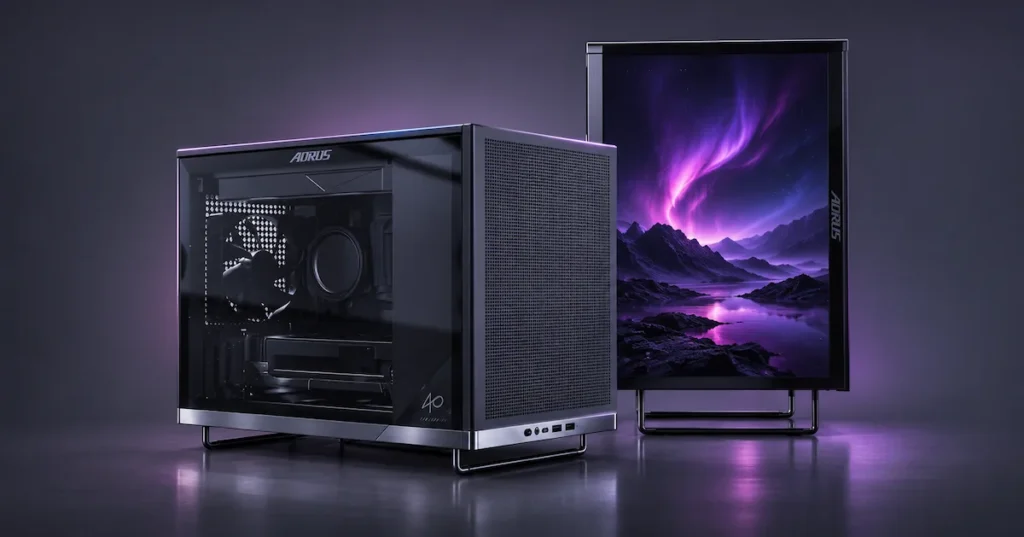
Gigabyte’s experimental monitor-equipped PC case is heading to Las Vegas with an industry award, and its display specifications appear to have stepped up significantly since its first public showing. On November 13, 2026, Gigabyte announced that its AORUS C510 GLASS INFINITY micro-ATX chassis received a 2027 CES Innovation Award ahead of a full showcase at CES 2027, which runs January 6–9, 2027.
While Gigabyte’s own press release describes only a “16-inch high refresh rate gaming display,” the official 2027 CES Innovation Awards listing—published following the Consumer Technology Association’s November 9, 2026 honoree announcement—provides a more specific hardware detail: it identifies the chassis as a 2027 Honoree in the Gaming & eSports category with an integrated 16-inch 240Hz OLED panel.
That distinction matters because the case’s biggest question mark when it first appeared as a prototype at Computex 2026 was the screen itself. Even with a CES award badge attached, however, Gigabyte has still not published a retail product page, pricing, or a release window, leaving buyers with an intriguing concept rather than a finalized product.
What Changed Between Computex 2026 and the CES 2027 Listing
Gigabyte first introduced the AORUS C510 GLASS INFINITY alongside its 40th-anniversary INFINITY Series lineup in a June 2, 2026 Computex announcement. When Club386 inspected the prototype on the show floor on June 4, 2026, the built-in 16-inch panel ran at 1080p and 165Hz, and the outlet noted that the screen was not bright enough to cut through the showroom lighting. Gigabyte told Club386 at the time that it was working to increase light output.
Moving from a 1080p 165Hz prototype panel to the 16-inch 240Hz OLED specification cited on the CES Innovation Awards page would represent a major upgrade in motion clarity and contrast. Still, key display details remain unconfirmed. Neither Gigabyte’s November 13 release nor the CES listing states the OLED panel’s resolution, peak brightness in nits, adaptive-sync support, or video and power cabling requirements, and Gigabyte’s PC chassis catalog does not yet include a specification sheet for the C510.
A Compact Micro-ATX Layout Built Around Convertible Hardware
Beyond the screen, the core idea behind the AORUS C510 GLASS INFINITY is reducing the clutter of moving a desktop PC without locking buyers into laptop or proprietary mini-PC components. According to Gigabyte’s announcement and the CES listing, the 16-inch display can mount on either side of the chassis to act as a primary monitor, a secondary screen, or a system telemetry panel, or detach onto its own stand for independent placement on a desk.
The chassis also relies on detachable U-shaped metal feet designed to serve three roles depending on where they are mounted:
- Underneath the case: Supports a horizontal desktop orientation while preserving bottom clearance for airflow.
- On the rear panel: Allows the case to stand vertically while leaving room for rear power-cable routing.
- On top of the chassis: Converts into a carrying handle so the system can be moved without a separate strap or built-in grip.
Despite its portable pitch, the chassis is built around standard desktop hardware rather than proprietary slim parts. During the Computex 2026 prototype demonstration, Club386 reported a 25-liter micro-ATX enclosure housing an AMD Ryzen 7 9850X3D processor, an AORUS GeForce RTX 5090 Infinity 32GB graphics card, a standard ATX power supply, a 240mm liquid cooler radiator, and support for back-connect motherboards. Gigabyte’s November announcement also highlights ventilated front and top panels intended to sustain airflow under gaming, streaming, and content-creation workloads.
How It Compares to Other Screen-Equipped PC Cases
Built-in displays are no longer unusual on enthusiast PC cases, though most existing designs treat the screen as a decorative or monitoring accessory rather than a standalone monitor. For example, as Club386 has noted in its case coverage, Hyte’s dual-chamber Y70 Touch Infinite replaces a corner glass panel in a large ATX showcase enclosure with a fixed 14.9-inch 2.5K touchscreen geared toward system diagnostics, widgets, and chat overlays.
Gigabyte’s approach targets a smaller niche: LAN-party attendees, dorm or apartment users with tight desks, and creators or testers who want a portable tower that retains standard GPU and motherboard upgrade paths. Because the 16-inch panel can detach onto its own stand and run at 240Hz, it avoids the awkward viewing angle of a screen permanently fixed to the side of a tower—assuming the stand, cabling, and display performance hold up in retail hardware.
InsightTechDaily Analysis: Practical Questions Still Unanswered
An Innovation Awards Honoree designation—one of more than 350 selections listed across the 2027 CES Innovation Awards directory—signals that CTA judges saw merit in the concept’s engineering, not that the case is ready for retail scrutiny. Several practical tradeoffs will determine whether the AORUS C510 GLASS INFINITY works well outside a trade show booth:
- Price-to-value math: Bundling a 16-inch 240Hz OLED panel directly into a micro-ATX case could push the retail price well above conventional compact cases plus a separate portable monitor. Buyers will also want to know whether the screen is covered by a standard monitor-length warranty and whether it can be replaced independently if damaged.
- Thermals and side-panel airflow: Mounting a solid 16-inch display onto either side of a 25-liter chassis carrying high-wattage components raises obvious questions about intake, exhaust, and heat transfer to the panel itself.
- OLED burn-in and portability: Leaving the same telemetry dashboard on screen for long periods can increase OLED burn-in risk. Features such as pixel shift can help reduce that risk. How practical the top-mounted handle is will depend on how much the fully built PC weighs and how securely the handle attaches to the case.
CES 2027 in January should clarify whether the 240Hz OLED configuration resolves the brightness limits seen on the June prototype—and, just as importantly, whether Gigabyte is ready to attach a real price tag and shipping date to one of the more unusual micro-ATX case concepts of the past year.