Gemini 3.7 Flash combines stronger coding and agentic capabilities with introductory pricing aimed squarely at high-volume production workloads.
The generative AI market is moving beyond headline-grabbing demonstrations. For developers and enterprises, the more consequential questions now concern reliability, latency, and the cost of completing real work at scale.
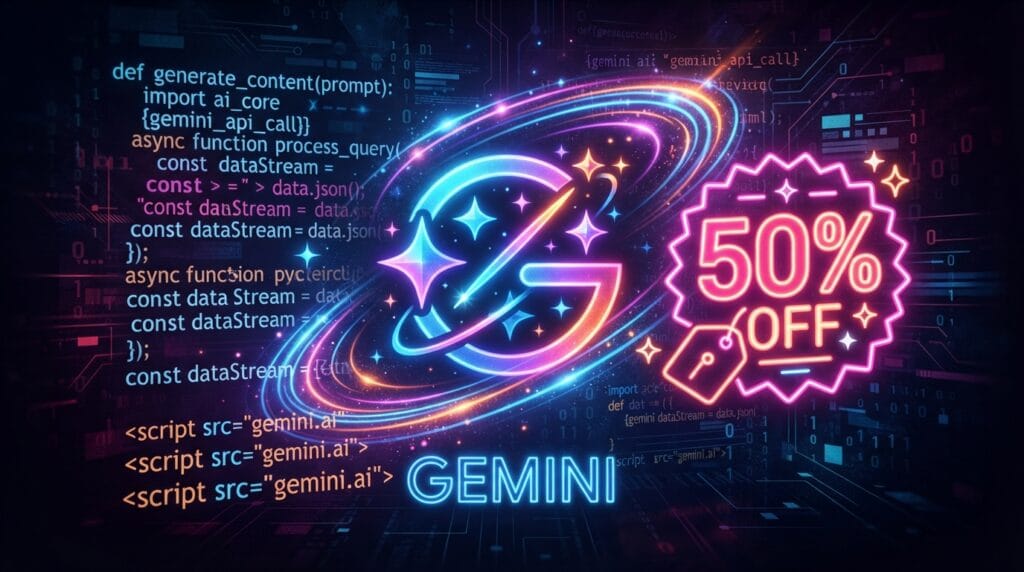
Google’s release of Gemini 3.7 Flash reflects that shift. Positioned as the company’s most capable Flash model for agentic workflows and multimodal reasoning, it is designed for software engineering, tool use, and other complex tasks that require repeated model calls. Google is pairing the release with a temporary 50% reduction from its planned standard price—an offer that could make the model especially attractive for teams building high-volume AI systems.
A Model Designed for the Agentic Era
Early enterprise AI applications typically revolved around isolated prompts followed by human review. Agentic systems operate differently. They may inspect code, call external tools, evaluate results, revise a plan, and repeat the process until an objective is complete.
That difference changes what matters in a model. A small delay or unnecessary reasoning step may seem insignificant during a single chat interaction, but it becomes costly when multiplied across dozens of tool calls and thousands of concurrent tasks. Successful production agents therefore depend on more than benchmark intelligence. They also require dependable instruction-following, efficient tool use, predictable behavior, and acceptable end-to-end costs.
Gemini 3.7 Flash is intended to address that combination. Google says the model improves first-pass coding accuracy, adherence to design requirements, instruction-following, and the ability to recover when a workflow encounters an obstacle. Those improvements could reduce the number of corrective steps an agent needs, potentially lowering both execution time and total token consumption.
For developers, that may prove more valuable than a marginal increase on a general-purpose benchmark. A model that completes a task correctly in fewer attempts can be cheaper and faster in practice, even when its per-token price is not the lowest available.
Introductory Pricing Changes the Calculation
Through December 31, 2026, Gemini 3.7 Flash costs $0.75 per million input tokens and $3.75 per million output tokens on Google’s standard paid API tier. On January 1, 2027, those rates are scheduled to rise to $1.50 and $7.50, respectively.
Google is also extending the discount to context caching, batch processing, and flexible inference. Batch and Flex workloads receive an additional reduction, bringing their introductory rates to $0.375 per million input tokens and $1.875 per million output tokens.
The promotion matters because agentic applications can generate substantially more usage than conventional chatbots. A single task might require the model to read a large context, create a plan, call several tools, inspect the results, correct errors, and produce a final response. Multiply that process across a development team or customer-facing service, and inference costs can rise quickly.
Lower introductory pricing gives organizations room to prototype and stress-test these systems with less financial exposure. It also gives Google an opportunity to place Gemini more deeply inside production environments before the standard rates take effect.
ITD Insight
Google’s discount is best understood as a developer-acquisition strategy, not simply a sale. AI infrastructure becomes increasingly difficult to replace once an organization has built its prompts, evaluation systems, caching strategy, tool definitions, and monitoring around a particular platform. By lowering the cost of adoption now, Google can encourage teams to build those foundations around Gemini. The offer is still temporary, however. Organizations evaluating the model should calculate their long-term costs using the rates scheduled for January 2027—not only the discounted launch price.
Why First-Pass Accuracy Matters
Coding agents rarely succeed or fail on code generation alone. They must understand repository structure, preserve existing behavior, follow project conventions, modify the correct files, run tests, and respond intelligently when something breaks.
Every incorrect edit can trigger another cycle of analysis, tool calls, and token usage. As a result, first-pass accuracy affects more than developer satisfaction; it directly influences the economics of an automated workflow.
Gemini 3.7 Flash’s emphasis on more accurate initial code generation could therefore be significant. If the model completes tasks with fewer revisions, teams may see improvements in both latency and cost per completed task. Better instruction-following and design adherence could also make it more useful for front-end development, where technically valid output may still fail if it does not match the requested layout or visual system.
The model’s value will ultimately depend on how those improvements translate to real repositories. Published benchmarks provide useful signals, but development teams should still test it against their own languages, frameworks, code-review standards, and tool configurations.
Agentic Workflows Need More Than Speed
Low latency remains important, particularly when a model sits at the center of an interactive application. Yet raw token-generation speed tells only part of the story.
An agent can respond quickly while still taking an inefficient route—calling unnecessary tools, repeating failed actions, or producing changes that require extensive correction. The more meaningful measurement is often total time and cost per successful task.
Gemini 3.7 Flash is positioned as a “workhorse” model for precisely this reason. Its appeal rests on balancing intelligence and efficiency across an entire workflow rather than maximizing either quality or speed in isolation.
Context caching may further improve that balance for applications that repeatedly reference the same material. Developers can cache frequently reused information such as system instructions, repository context, schemas, or reference documents instead of paying to process the entire payload with every request. Google has also reduced context-caching prices during the introductory period.
Strategic Implications for the AI Market
Google’s launch reinforces a broader change in competition among model providers. Model quality remains essential, but the market is increasingly being shaped by price-to-performance ratios, tool reliability, multimodal support, and integration with development platforms.
The temporary discount puts pressure on rival providers by lowering the cost of testing Gemini in production. Google also benefits from controlling much of the infrastructure surrounding its models, including its cloud platform and custom AI accelerators. That vertical integration may give it more flexibility in how it prices and distributes AI services, although Google does not publicly disclose the operating margins of individual Gemini models.
For OpenAI, Anthropic, and other providers, the challenge is no longer simply to offer the strongest model. They must demonstrate that their systems complete real tasks reliably and at a competitive total cost.
Developers, meanwhile, should avoid making decisions from token prices alone. Migration effort, failure rates, latency, observability, context requirements, and the number of tool calls needed to finish a task can all outweigh a nominal pricing advantage.
Bottom Line
Gemini 3.7 Flash is rolling out through the Gemini API, Google AI Studio, Android Studio, Google Antigravity, and Google’s enterprise agent platforms. It is also being used to power Gemini Spark for eligible Google AI Pro and Ultra subscribers.
The release shows how quickly the AI market is moving from capability contests toward production economics. Google is betting that developers will favor a model that combines strong coding and agentic performance with a price low enough to support frequent, iterative use.
The introductory discount makes Gemini 3.7 Flash compelling for experimentation, but the most important question is not whether it is inexpensive per token. It is whether the model can complete real workflows with fewer mistakes, fewer retries, and less supervision.
That is the measure that will determine whether Gemini 3.7 Flash becomes a genuine production workhorse—or simply another competitive entry in an increasingly crowded model market.