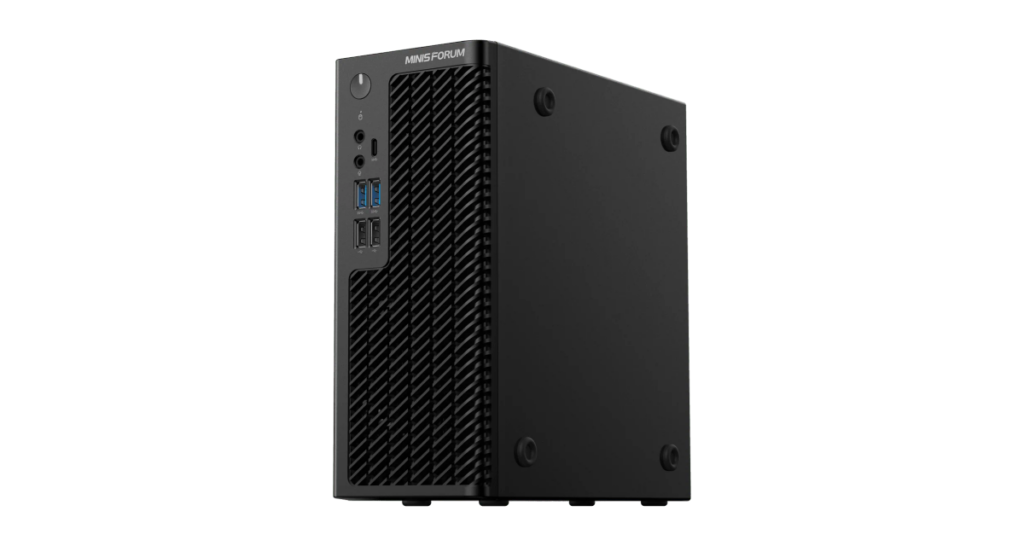
MINISFORUM has opened US orders for the T5 Max-388, a $1,559 mini PC with AMD’s Ryzen AI Max+ 388, Radeon 8060S graphics and 48GB of shared memory. The company estimates shipping will begin in early December 2026. MINISFORUM US listing
The T5 Max-388 comes in one US configuration with a 1TB SSD. MINISFORUM shows the $1,559 price alongside a $1,949 reference price. The store also lists a different memory specification from the one MINISFORUM published for IFA 2026. The retail listing says LPDDR5-6400, while the earlier brochure specified LPDDR5X-8000 for this model.
Ryzen AI Max+ 388 and Radeon 8060S in a compact desktop
The Ryzen AI Max+ 388 is an eight-core, 16-thread Strix Halo processor with Zen 5 CPU cores and a boost clock of up to 5.0 GHz. Its integrated Radeon 8060S runs at up to 2.9 GHz and has 40 RDNA 3.5 compute units, the same count as the Radeon 8060S in AMD’s 16-core Ryzen AI Max+ 395. The difference in CPU cores is most relevant to workloads that can keep many threads busy, such as CPU rendering or large software builds. AMD processor specifications
AMD rates the chip’s neural processing unit at up to 50 TOPS and the overall platform at up to 118 TOPS. Those peak compute ratings describe different scopes. For a local AI application, the relevant questions are which accelerator the software supports and how much memory the model and its working data require.
Storage, ports and networking
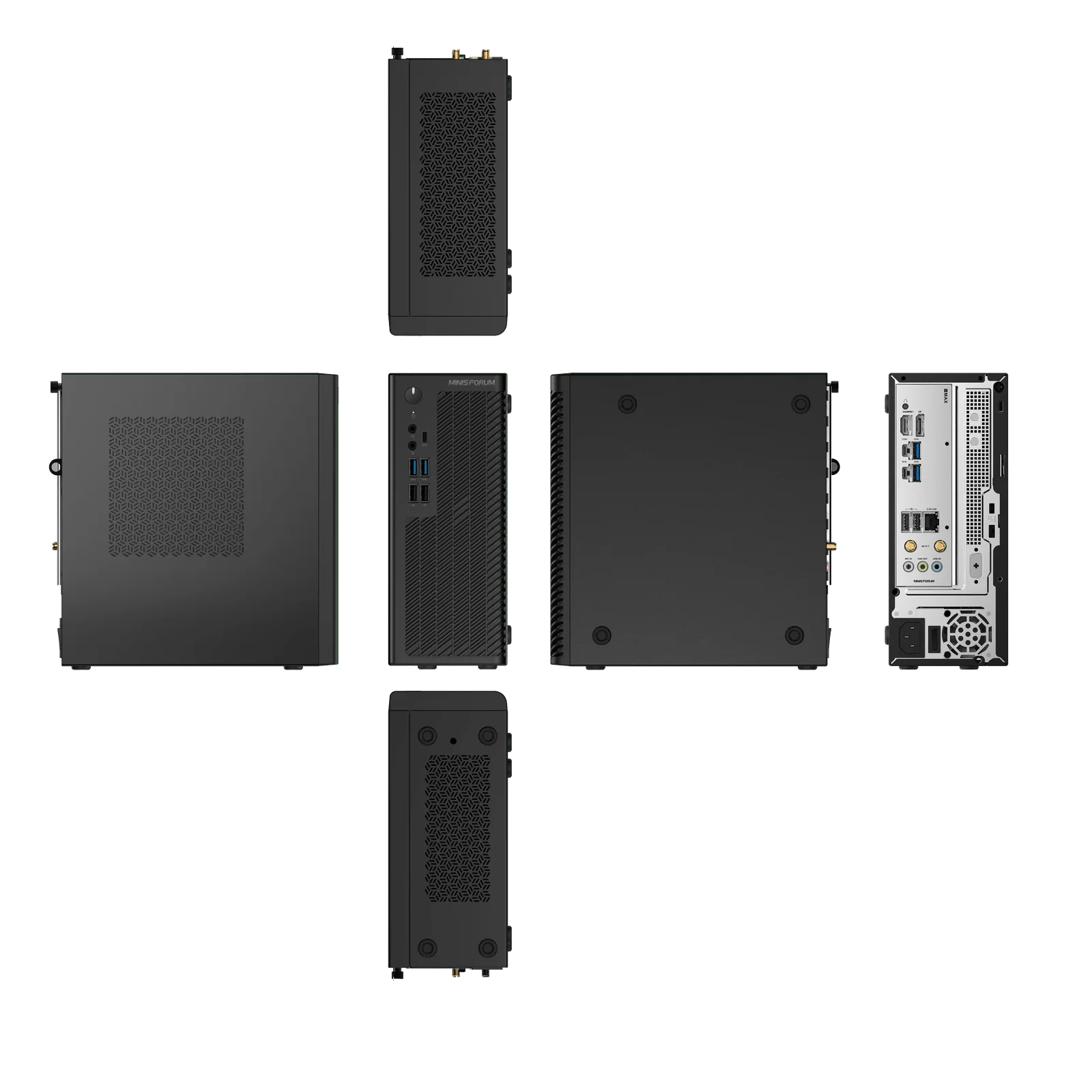
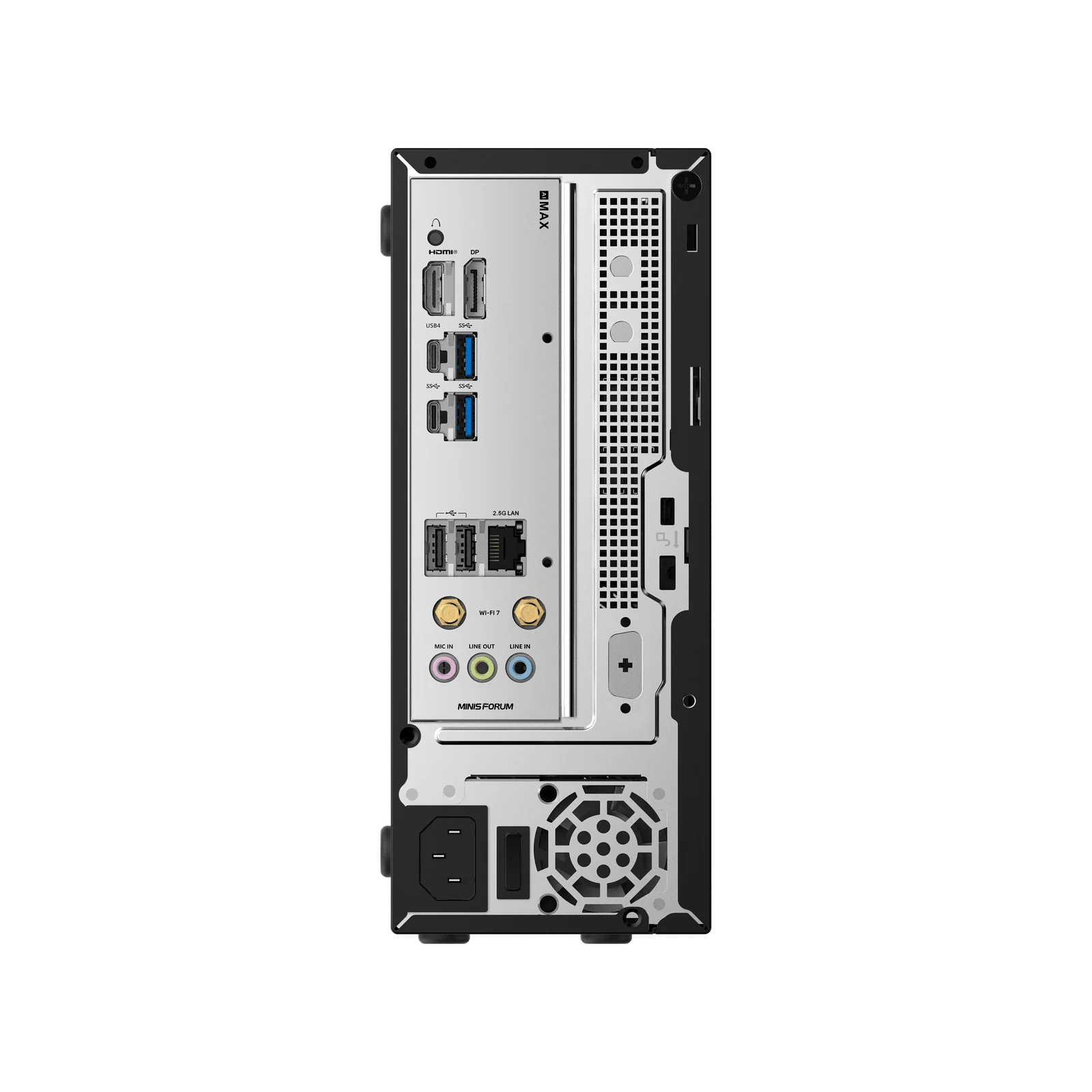
The 4.9-liter metal chassis houses a 350W power supply, a setup familiar from small-form-factor desktops with internal Flex-ATX supplies. An AC cord plugs straight into the rear panel, so there’s no external power brick to tuck behind the desk. MINISFORUM lists dimensions of 225 × 96 × 228 mm and specifies six heat pipes and a fan.
For storage, the chassis has two M.2 2280 PCIe 4.0 x4 slots in total. MINISFORUM lists support for drives up to 8TB per slot, so there’s room to add a second drive for games, media or model files alongside the included 1TB SSD. The 48GB of onboard memory is soldered, making storage the part of this configuration with a clear upgrade path. VideoCardz launch coverage
At the rear, HDMI 2.1 and DisplayPort 2.1 sit alongside a 40Gbps USB4 port and a separate USB-C port with video output. The USB-C port on the front handles data, so a USB-C monitor belongs on one of the rear video-capable ports. Networking includes 2.5GbE, Wi-Fi 7 and Bluetooth 5.4.
Why the memory specification matters
| Specification | IFA 2026 | US retail |
|---|---|---|
| Memory type | LPDDR5X | LPDDR5 |
| Transfer rate | 8,000 MT/s | 6,400 MT/s |
| Theoretical bandwidth | 256 GB/s | 204.8 GB/s |
The US listing’s transfer rate is 20% below the IFA figure. The bandwidth estimates assume both configurations use the full 256-bit memory interface AMD specifies for the Ryzen AI Max+ 388.
Radeon 8060S draws from the same memory pool as the CPU. Games that spend more time moving textures and other data may be more sensitive to memory bandwidth than games limited by CPU work or shader throughput. Resolution, settings and the game engine can all change where that limit falls. The transfer-rate difference therefore establishes the size of the bandwidth gap on paper. Measuring the frame-rate impact would require a controlled comparison.
MINISFORUM reports 223 fps in Counter-Strike 2 and 122 fps in Cyberpunk 2077 in its own 1440p testing, with ray tracing off in Cyberpunk. The listing gives those results without a full breakdown of graphics presets or upscaling settings. A test that holds those settings constant across memory configurations would help isolate how much of a difference bandwidth makes. MINISFORUM gaming figures
MINISFORUM uses different memory labels across its regional stores. Its Hong Kong listing calls the 48GB in its Ryzen AI Max+ 388 model LPDDR5X and gives the same 6,400 speed figure. The listings establish the advertised speed for each market, while the difference in memory labels leaves the exact chips in US retail units to be confirmed.
ITD Insight
Memory capacity and speed answer two different questions for local AI. Capacity helps determine whether a model, its working data and the rest of the system can fit in memory at the same time. Once they fit, bandwidth can affect how quickly the GPU reads model weights during inference, so a useful benchmark would report both the model configuration and its generation speed.
Bottom Line
The $1,559 US launch gives buyers a compact way to get AMD’s 40-CU Radeon 8060S with 48GB of shared memory. Buyers can add SSD capacity later, while the factory memory specification is fixed. For anyone shopping primarily for the integrated GPU, tests of the US retail configuration will give a better basis for comparing gaming and local AI performance across Strix Halo systems.