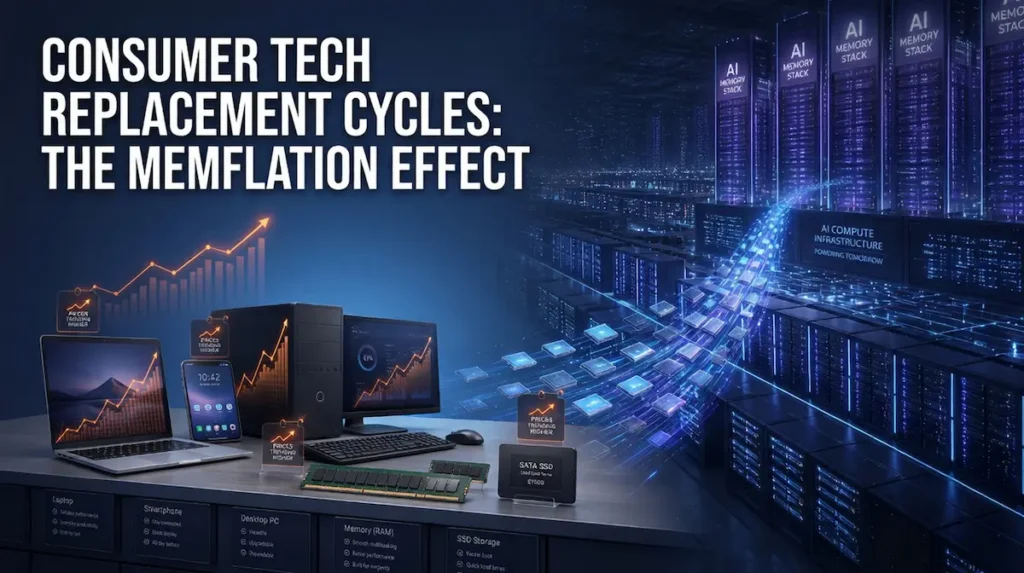
For years, the consumer technology market followed a relatively dependable upgrade rhythm. Smartphones were commonly replaced every few years, while personal computers were refreshed when performance, battery life, software compatibility, or workplace requirements made an older system difficult to justify.
That cycle is now being stretched. Rising memory and storage costs are increasing the price of new computers and smartphones at the same time that many existing devices remain capable enough for everyday use. The result is a market in which consumers and businesses have more reasons to postpone upgrades—and fewer affordable replacement options when they are finally ready to buy.
This is not simply a temporary retail slowdown. Market researchers increasingly describe it as a structural supply-and-allocation problem driven by the rapid expansion of artificial intelligence infrastructure. High-bandwidth memory, server DRAM, and enterprise storage are commanding enormous investment and manufacturing attention, leaving the client-device market exposed to tighter supply and higher component costs.
AI Infrastructure Is Reshaping the Memory Market
The current pressure is not caused by a universal shortage of raw silicon. It reflects a shift in where memory manufacturers are directing capital, advanced packaging capacity, and production resources.
Samsung Electronics, SK Hynix, and Micron Technology are investing heavily in high-bandwidth memory products such as HBM3E and HBM4, which are needed for AI accelerators and large-scale data center systems. Enterprise storage demand is also rising as cloud providers build the infrastructure required to train, serve, and store data for increasingly large AI workloads.
These premium markets are more attractive to memory suppliers than low-margin consumer components. Although HBM, standard DRAM, and NAND flash do not all use identical production processes, the companies producing them must still decide where to direct fabrication investment, engineering resources, packaging capacity, and future expansion.
According to TrendForce’s third-quarter 2026 memory forecast, artificial intelligence server demand continues to support elevated memory pricing even as consumer demand weakens. The firm expects conventional DRAM contract prices to rise by another 13% to 18% quarter over quarter during the third quarter, while NAND flash contract prices are forecast to increase by approximately 10% to 15%.
Those increases are slower than some of the extreme jumps recorded during the earlier stages of the shortage, but they still leave PC manufacturers, smartphone vendors, system builders, and consumers dealing with substantially higher costs than they faced in 2025.
Why HBM Demand Affects Ordinary Computers
High-bandwidth memory is considerably more complex than the memory installed in a typical desktop or laptop. HBM stacks multiple memory dies vertically and connects them through advanced packaging technologies designed to deliver exceptional bandwidth close to an AI accelerator or graphics processor.
Producing those stacks requires additional manufacturing steps, high-quality dies, advanced packaging capacity, and close integration with processor suppliers. A single AI system can also contain far more memory value than a conventional consumer computer, giving suppliers a powerful financial incentive to prioritize the data center market.
That does not mean a factory can instantly convert every DDR5 production line into an HBM line. However, sustained demand for premium server memory influences investment decisions throughout the industry. Capacity expansions, equipment purchases, packaging investments, and research spending increasingly favor the products generating the strongest returns.
For the consumer market, the practical effect is straightforward: client DRAM and NAND supply is not expanding quickly enough to keep pricing near its previous lows.
Memory Inflation Is Changing the Cost of a PC
The cumulative effect on device manufacturing is substantial. In a February 2026 market outlook, Gartner estimated that combined DRAM and solid-state-drive prices could rise by 130% by the end of 2026 compared with 2025 levels.
Gartner expects those component increases to push average PC prices approximately 17% higher and smartphone prices approximately 13% higher during 2026.
The changing economics are visible throughout the device bill of materials:
- Memory consumes more of the budget: Gartner estimates that memory will account for approximately 23% of a PC’s bill of materials in 2026, up from about 16% in 2025.
- Manufacturers have less room to absorb costs: Premium devices can spread a component increase across a larger selling price, but low-cost systems operate with much narrower margins.
- Entry-level hardware is under pressure: Gartner expects the sub-$500 PC segment to effectively disappear by 2028 if current cost trends continue.
- Specifications may be reduced: Manufacturers can respond by raising prices, lowering memory and storage capacities, reusing older platforms, or concentrating production on more profitable models.
The final outcome will not necessarily be the literal disappearance of every computer priced below $500. Retail promotions, refurbished machines, education-focused systems, Chromebooks, and clearance models may continue to occupy that range. However, buyers should expect fewer new mainstream Windows laptops offering balanced specifications at entry-level prices.
Early PC Growth Was Driven by Buyers Moving Purchases Forward
The first quarter of 2026 initially appeared more encouraging. According to IDC’s Personal Computing Device market data, worldwide PC shipments increased 3% year over year to 65.6 million units.
That growth did not represent a broad recovery in underlying demand. IDC attributed much of the increase to pull-forward purchasing, as consumers, commercial buyers, and distribution partners placed orders before expected price increases and potential product shortages. Windows migration projects and new product launches provided additional support.
The weakness became more visible during the following quarter. IDC reported that worldwide PC shipments declined 4.9% year over year in the second quarter of 2026, falling to 68.2 million units. Global smartphone shipments also declined 6.7% during the quarter as memory costs placed disproportionate pressure on lower-priced devices.
For full-year 2026, IDC expects global PC shipments to fall 11.3%. It also forecasts an 18.3% increase in PC average selling prices and warns that meaningful relief from the memory shortage may not arrive before the end of 2027.
Gartner’s separate forecast is similarly pessimistic, projecting a 10.4% decline in worldwide PC shipments and an 8.4% decline in smartphone shipments during 2026.
Buyers Are Keeping Their Devices Longer
Higher prices naturally change the upgrade calculation. Gartner expects average PC lifetimes to increase approximately 15% among business buyers and 20% among consumers by the end of 2026.
For a household, replacing a computer becomes harder to justify when a comparable new system costs significantly more but provides only a modest improvement in normal productivity, web browsing, streaming, and communication. Businesses face a similar calculation across hundreds or thousands of machines, where even a relatively small increase in per-device pricing can substantially raise the cost of a planned refresh.
Smartphone users are also becoming more comfortable keeping devices for longer periods. Modern processors remain fast enough for common applications, camera improvements are increasingly incremental, and premium phones are receiving longer software-support commitments than earlier generations.
Several factors are helping extend device lifespans:
- Longer software support: Google and Samsung now advertise up to seven years of operating-system and security support for selected flagship devices. Apple does not publish the same fixed support guarantee, but it has historically maintained major iPhone software support across multiple generations.
- Incremental year-to-year improvements: Many annual processor, display, and camera upgrades are meaningful without being transformative enough to require an immediate purchase.
- Better performance headroom: A well-equipped computer or smartphone purchased several years ago may still handle common workloads without difficulty.
- Repair and refurbishment options: Battery replacements, storage upgrades, renewed devices, and used hardware can postpone the need for an entirely new system.
- Pressure on household budgets: Housing, food, energy, insurance, and borrowing costs can push optional electronics purchases further down the priority list.
The Risk of Extending Hardware Lifespans
Keeping a capable device for longer is not inherently a problem. In many cases, it is the most economical and environmentally responsible decision. However, longer replacement cycles also create risks when devices remain in service after their practical support life has ended.
Unsupported operating systems may stop receiving security updates. Aging batteries can become unreliable. Storage devices can wear out, and older business systems may become increasingly difficult to manage alongside newer hardware.
Businesses delaying upgrades should therefore distinguish between systems that are merely old and systems that have become operational liabilities. A computer that still performs adequately and receives security updates may remain useful for years. A machine that cannot run a supported operating system or meet current security requirements may need replacement regardless of market pricing.
What Consumers Should Do
Consumers who expect to need a computer, SSD, or memory upgrade within the next year should monitor pricing rather than assuming components will steadily become cheaper. Promotional discounts will still appear, but the baseline cost underneath those sales may remain higher than it was during the oversupplied memory market of previous years.
Buyers should also pay closer attention to fixed specifications. Soldered memory and non-upgradeable storage can make a discounted laptop less attractive if its configuration will become restrictive before the rest of the system reaches the end of its useful life.
For a general-purpose Windows computer, 16GB of RAM should increasingly be treated as a practical minimum rather than a premium feature. Buyers planning to keep a system for several years—or use it for content creation, local artificial intelligence, software development, or heavier multitasking—should strongly consider 32GB when the price difference is reasonable.
Refurbished business laptops and desktops may also become more appealing. Commercial systems often offer better serviceability and stronger construction than the least expensive new consumer models, although buyers should verify battery condition, warranty coverage, operating-system support, and component specifications.
What Businesses Should Do
Enterprise procurement teams may need to replace rigid three- or four-year refresh schedules with more selective lifecycle management. Systems can be evaluated according to workload, security eligibility, repair history, warranty status, and employee requirements rather than being replaced solely because they have reached a predetermined age.
At the same time, waiting too long carries its own costs. Emergency replacements, inconsistent hardware fleets, increased support demands, and security exposure can erase the savings created by delaying purchases.
Organizations planning major deployments should also account for the possibility that quoted hardware prices may not remain valid for as long as they did in a more stable component market. Longer procurement windows, earlier supplier discussions, and carefully structured contracts may become increasingly important.
When Could Prices Stabilize?
The longer-term outlook depends on two forces: how quickly memory manufacturers can expand production and whether AI infrastructure demand continues growing at its current pace.
New fabrication plants, equipment installations, and advanced packaging facilities require years of planning, construction, qualification, and customer validation. Manufacturers are expanding capacity, but those projects cannot immediately resolve a shortage affecting products shipping today.
Supply could also improve if cloud providers moderate their infrastructure spending, AI accelerators become more memory-efficient, or customers delay data center deployments. Conversely, continued growth in model size, inference demand, and AI service adoption could absorb new capacity almost as quickly as it becomes available.
Long-term supply agreements between memory manufacturers, hyperscalers, and enterprise customers may make future demand more predictable, but they can also reserve large volumes before those components reach the open market.
A More Expensive, Replacement-Driven Hardware Market
The consumer electronics industry is not facing the end of the upgrade cycle. It is moving toward a slower and more selective version of it.
Consumers will still replace broken phones, aging laptops, and underpowered desktops. Businesses will still modernize systems when security, reliability, and productivity demand it. What is changing is the assumption that each new product generation automatically justifies a purchase.
Until memory supply expands or AI infrastructure demand slows, higher component costs are likely to keep retail prices elevated and place the greatest pressure on affordable devices. Buyers should expect longer ownership periods, fewer compelling entry-level configurations, and a growing emphasis on repairability, memory capacity, software support, and long-term value.
The old rhythm of upgrading simply because two or three years have passed is becoming harder to defend. In the emerging hardware market, the most important question is no longer how old a device is—it is whether that device still does the job safely and reliably.
 |
Apple’s M7 Ultra Could Bring 1.5TB of Unified Memory to Local AIApple’s rumored next-generation workstation architecture could make exceptionally large AI models more accessible outside traditional GPU servers. |
 |
AI Agents Are Driving a New Wave of Data Center CPU DemandAs autonomous AI systems handle longer and more complex workloads, data centers are expanding beyond GPUs and investing in more CPUs, memory, storage, and supporting infrastructure. |