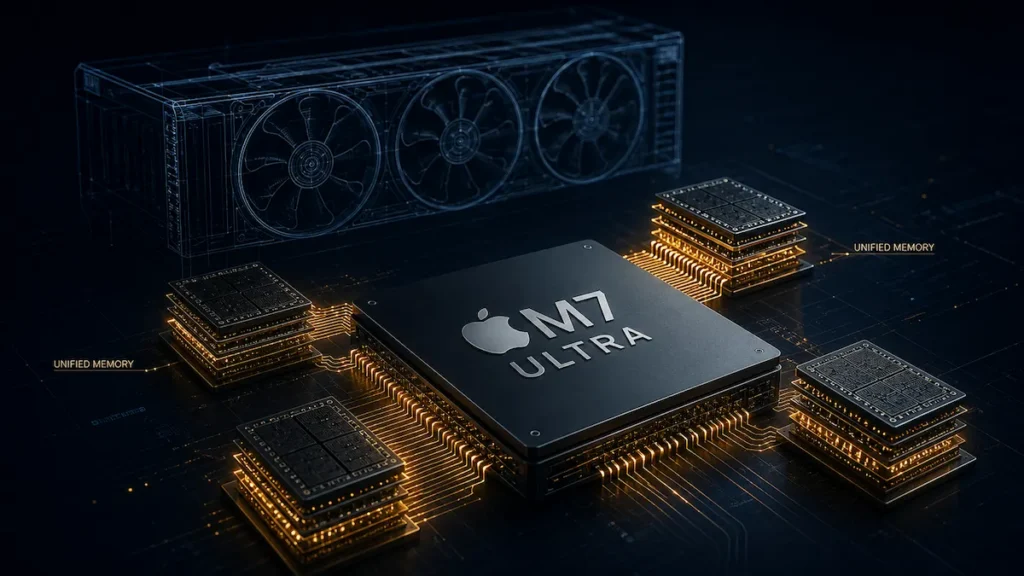
Apple’s most ambitious future chip may not be defined by CPU cores or graphics performance alone. A new report claims the company is developing an M7 Ultra processor capable of supporting as much as 1.5TB of unified memory, potentially giving a future Mac enough capacity to run exceptionally large artificial intelligence models locally. The configuration is far from guaranteed, but it points toward a new role for Apple’s highest-end computers.
According to reporting from Bloomberg’s Mark Gurman, summarized by Tom’s Hardware, Apple is targeting 2028 for the M7 Ultra. The chip is reportedly being designed to support up to 1.5TB of unified memory while delivering a major increase in AI performance.
The report does not say that Apple has already committed to selling a 1.5TB configuration. Memory availability and pricing could determine whether the maximum-capacity version ever reaches customers. Apple has also not confirmed the chip, its specifications, its product placement, or its release schedule.
Why 1.5TB of Unified Memory Would Be a Major Change
The most striking part of the rumor is not simply that Apple may increase memory capacity. It is the scale of the proposed increase.
Apple’s current M3 Ultra can be configured with up to 512GB of unified memory. That is already unusually large for a compact workstation and allows the CPU, GPU, Neural Engine, and other accelerators to work from a shared memory pool without maintaining completely separate system RAM and graphics-memory allocations.
A future 1.5TB configuration would triple that capacity.
That distinction matters for local AI because model weights, the context window, temporary processing data, and the key-value cache all compete for available memory. A system can have enormous theoretical compute performance and still be unable to load a model if the weights do not fit inside accessible memory.
Discrete GPUs normally rely on their own dedicated VRAM. Once a workload exceeds that VRAM capacity, some data may need to spill into system memory across PCI Express, often reducing performance substantially. Apple’s unified-memory architecture gives its processors a different advantage: a much larger portion of the installed memory can potentially remain directly accessible to the integrated GPU.
That does not automatically make an Apple processor faster than a dedicated NVIDIA accelerator. It does, however, allow Apple to compete on a different axis: the size of the workload that can remain entirely inside one coherent memory pool.
What “Closer to Blackwell” Actually Means
The report also says the M7 Ultra could move Apple’s AI performance closer to the class of dedicated accelerators based on NVIDIA’s Blackwell architecture.
That wording requires some restraint.
It does not mean a future Mac has been confirmed to equal an NVIDIA B200, GB200 system, DGX platform, or multi-GPU Blackwell rack. NVIDIA uses Blackwell across several products with dramatically different power limits, memory configurations, interconnects, and performance levels.
The more reasonable interpretation is that Apple wants the M7 Ultra to behave less like a conventional desktop processor and more like a specialized AI workstation chip. That would require improvements in several areas:
- matrix and tensor-processing throughput;
- memory bandwidth;
- GPU and Neural Engine utilization;
- lower-precision AI formats;
- software support for large local models;
- and sustained performance under long workloads.
Today’s M3 Ultra already provides 819GB/s of memory bandwidth and is marketed for workloads including large language models, AI video processing, scientific computing, and 3D rendering. A future M7 Ultra would need to move well beyond simply adding capacity. Feeding an enormous memory pool fast enough to keep its compute hardware occupied could be the harder engineering problem.
The headline number is 1.5TB, but capacity alone will not determine whether the M7 Ultra becomes a serious AI workstation. Memory bandwidth, model compatibility, sustained cooling, and software optimization will decide whether that memory can be used efficiently.
The Memory Supply May Decide Whether It Ships
The 1.5TB target reportedly depends on conditions in the memory market improving before the chip arrives.
That qualification is important because the AI infrastructure boom has increased demand for several forms of high-performance memory. Data-center accelerators, AI servers, workstations, and conventional consumer devices are competing for manufacturing capacity, advanced packaging resources, and premium memory components.
The report does not establish exactly what type of memory Apple would use for the M7 Ultra. It could involve a future generation of high-density low-power memory, a more advanced package design, or another custom implementation. Claims that the product will definitely use HBM4, vertically stacked memory, microfluidic cooling, or a specific TSMC packaging process go beyond the available reporting.
What can be said with confidence is that installing 1.5TB of high-bandwidth memory close to a large system-on-chip would be expensive. It would also require Apple to secure substantial memory capacity for a relatively specialized product at a time when memory manufacturers can sell premium components into high-volume AI infrastructure deployments.
The memory market may therefore affect more than the final price. It could determine whether Apple offers the full 1.5TB configuration, limits it to server hardware, delays it, or ships lower-capacity versions instead.
This May Be About Servers as Much as Macs
The M7 Ultra rumor is often discussed as though it refers only to a future Mac Studio or Mac Pro. The broader report suggests Apple may have more than one destination in mind.
Apple is reportedly preparing server hardware based on its own Ultra-class silicon, with an M7 Ultra server product potentially following after the consumer or workstation version. That creates several possible uses for the architecture:
- a future Mac Studio for developers, researchers, and media professionals;
- a renewed Mac Pro with a more clearly differentiated purpose;
- internal Apple AI servers;
- Private Cloud Compute infrastructure;
- or a combination of local and server products using related silicon.
This broader context may explain why Apple would pursue such an extreme memory ceiling. A 1.5TB configuration would be excessive for most conventional desktop work, but it becomes more understandable when viewed as a common architecture that could serve both professional Macs and Apple-controlled AI infrastructure.
What 1.5TB Could Mean for Local AI Models
Large memory capacity would allow a future Apple system to load models that are impractical on most individual workstations today.
Model memory requirements vary considerably depending on parameter count, numerical precision, architecture, context length, and runtime overhead. As a rough illustration, one trillion parameters stored at 8-bit precision would require approximately 1TB for the weights alone. At 4-bit precision, the raw weights would require roughly 500GB before accounting for additional runtime memory.
That does not mean a 1.5TB Mac would effortlessly run every trillion-parameter model. Mixture-of-experts designs, multimodal components, context caches, inference frameworks, and memory-bandwidth demands complicate the calculation. Training or extensively fine-tuning such models would remain far more demanding than simply loading them for inference.
Still, the capacity could make several advanced workloads more practical on one machine:
- very large quantized language models;
- multiple AI models operating simultaneously;
- long-context research and document analysis;
- large code-generation systems with extensive repositories loaded into memory;
- high-resolution generative video and image models;
- scientific datasets processed alongside machine-learning models;
- and private enterprise inference without routinely sending data to external cloud providers.
For many professional users, that last point may be the most commercially important.
Apple’s Real Advantage Could Be Private AI Capacity
Apple has spent years connecting on-device processing with privacy. Its current strategy combines local processing with Private Cloud Compute when a request requires a larger server-based model.
An M7 Ultra with hundreds of gigabytes—or potentially more than a terabyte—of unified memory could push much more work toward the local side of that equation.
Organizations working with source code, legal documents, unreleased media, medical research, proprietary engineering data, or internal business records may prefer to keep sensitive information on hardware they directly control. A powerful local AI workstation would not eliminate the need for cloud services, but it could reduce how frequently private data has to leave the organization.
This is where Apple could build a meaningful distinction from conventional workstation vendors. NVIDIA is likely to retain a major advantage in the maturity of CUDA, enterprise AI frameworks, and broad developer support. Apple could instead emphasize a tightly integrated combination of:
- large shared memory capacity;
- lower power consumption than multi-GPU systems;
- quiet workstation design;
- macOS integration;
- and local control over sensitive data.
The market would not need the M7 Ultra to beat every Blackwell product. It would need the machine to make large private models easier to deploy than an equivalent collection of GPUs, server components, and specialized software.
Could This Finally Give the Mac Pro a Clear Purpose?
The Apple silicon Mac Pro has struggled to justify its position above the Mac Studio. Both systems can use the same M2 Ultra processor, while the Mac Pro’s principal advantage is PCI Express expansion rather than replaceable graphics or upgradeable system memory.
An extreme AI configuration could give a future Mac Pro a more distinct identity, especially if Apple needs a larger chassis for cooling, expansion, networking, storage, or sustained operation.
However, current reporting does not confirm that the 1.5TB M7 Ultra will appear in a Mac Pro. Apple could place it in a future Mac Studio, reserve the maximum memory capacity for server deployments, or offer the same processor with different limits across several products.
The Mac Studio may actually be the more obvious workstation candidate. It already serves as Apple’s compact high-performance desktop, and reports have suggested Apple is investigating improved thermal hardware for future versions as local AI workloads become more demanding.
Cooling and Power Will Matter More Than the Chassis Size
Large AI workloads differ from short desktop performance bursts. Model inference, code generation, rendering, and scientific processing can keep compute units and memory interfaces busy for extended periods.
That makes sustained performance more important than peak benchmark numbers.
A future M7 Ultra would need a cooling system capable of maintaining its performance without excessive throttling or noise. Apple may be able to remain more efficient than a collection of discrete accelerators because its CPU, GPU, Neural Engine, media engines, and memory controllers are integrated into one architecture. Even so, moving toward dedicated-accelerator levels of AI performance will increase cooling and power-delivery demands.
No credible report has established a 500-watt target or confirmed liquid cooling for the product. Those possibilities should remain speculation unless Apple or a reliable supply-chain source provides more detail.
Software Could Be the Deciding Factor
Hardware capacity is only useful when applications can take advantage of it.
Apple has Metal, Core ML, MLX, Accelerate, and its broader developer ecosystem, but NVIDIA’s CUDA platform remains deeply embedded in AI research and production software. Many popular models and inference tools are optimized for NVIDIA hardware first, with Apple support arriving later or relying on community-developed implementations.
By 2028, Apple will need more than an impressive chip. It will need:
- mature support for widely used open-weight models;
- efficient low-precision inference;
- better multi-model orchestration;
- strong developer tools;
- reliable access to the Neural Engine and GPU;
- and professional applications that can exploit unusually large memory configurations.
If the software remains limited, the M7 Ultra could become a technically remarkable but narrowly useful machine. If Apple improves the complete platform, it could create one of the most approachable ways to run data-center-sized models outside a data center.
The Price Could Be as Extreme as the Specification
A system containing 1.5TB of high-performance memory would not be a mainstream Mac.
Even without knowing Apple’s eventual memory technology, such a configuration would likely carry an enormous premium. The memory itself, advanced packaging, chip yield, cooling system, power delivery, and low expected production volume could push the highest-end machine deep into professional or enterprise pricing.
A five-figure price would not be surprising, but attaching a specific figure such as $20,000 today would be premature. By 2028, memory prices, production yields, product positioning, and competition could all look substantially different.
The more relevant question is whether the machine could offer a lower total cost than assembling and maintaining an equivalent multi-GPU workstation or small AI server. For organizations already paying for cloud inference, local hardware may also be evaluated against recurring usage charges rather than the price of an ordinary desktop computer.
A Lot Can Change Before 2028
The proposed release window leaves Apple operating in a fast-moving market.
By 2028, NVIDIA, AMD, Intel, and other chip designers will have introduced additional AI architectures. Workstation GPUs may offer far larger memory pools, model quantization may improve, inference algorithms may become more efficient, and smaller specialized models may reduce the need to run enormous general-purpose systems.
Apple must therefore aim beyond today’s requirements. A 1.5TB memory ceiling sounds extraordinary in 2026, but its value in 2028 will depend on the models and professional workflows available at that time.
The company also has to avoid a familiar workstation problem: building an extremely capable fixed configuration that cannot adapt as quickly as modular competitors. Unified memory offers capacity and efficiency advantages, but it is not user-upgradeable. Buyers would have to select their long-term memory requirement when ordering the machine.
What Is Reported and What Remains Speculation
At this stage, the following details have been reported but remain unconfirmed by Apple:
- Apple is developing an M7 Ultra processor.
- The chip could arrive in 2028.
- It is being designed to support up to 1.5TB of unified memory.
- The largest configuration depends on memory-market conditions.
- Apple is targeting a major increase in AI performance.
- The architecture may also be used in a future Apple server product.
The following details have not been established by the available reporting:
- the exact memory type;
- the final memory bandwidth;
- the number of CPU, GPU, or Neural Engine cores;
- the manufacturing process used for every component;
- the chip’s power consumption;
- the cooling-system design;
- performance parity with a particular Blackwell product;
- the final price;
- or whether the 1.5TB option will ship in a Mac Studio, Mac Pro, server, or several products.
Bottom Line
The rumored M7 Ultra is best understood as a sign of where Apple believes high-end computing is going.
The company may be preparing for a workstation market in which local AI capacity matters as much as CPU speed, video rendering, or conventional graphics performance. A machine with up to 1.5TB of unified memory could run models that currently require specialized servers or multiple expensive GPUs, while keeping sensitive data under the user’s direct control.
However, the most dramatic possibilities remain years away and depend on more than Apple’s chip designers. Memory availability, manufacturing cost, software support, cooling, bandwidth, and competition will all shape the final product.
The strongest conclusion is not that Apple has already built a desktop Blackwell competitor. It is that Apple appears willing to reshape its most powerful silicon around local AI—and that unified memory may become the central feature of its workstation strategy rather than merely a supporting specification.
All M7 Ultra specifications and release details discussed in this article are based on third-party reporting. Apple has not officially announced the processor or confirmed that a 1.5TB configuration will be released.
 |
Local AI Hardware Demands Surge as Chinese MoE Models Challenge U.S. Open-Weight StandardsEfficient MoE models are changing the local AI hardware conversation. For everyday users, VRAM and unified memory are becoming more important than raw benchmark speed alone. |
 |
I Built a Prime Day Mini AI PC Around an Open-Box 24GB Intel Arc Pro B60See how a compact AM5 system with 24GB of GPU memory brings serious local AI experimentation within reach of home users, creators, and homelab builders. |