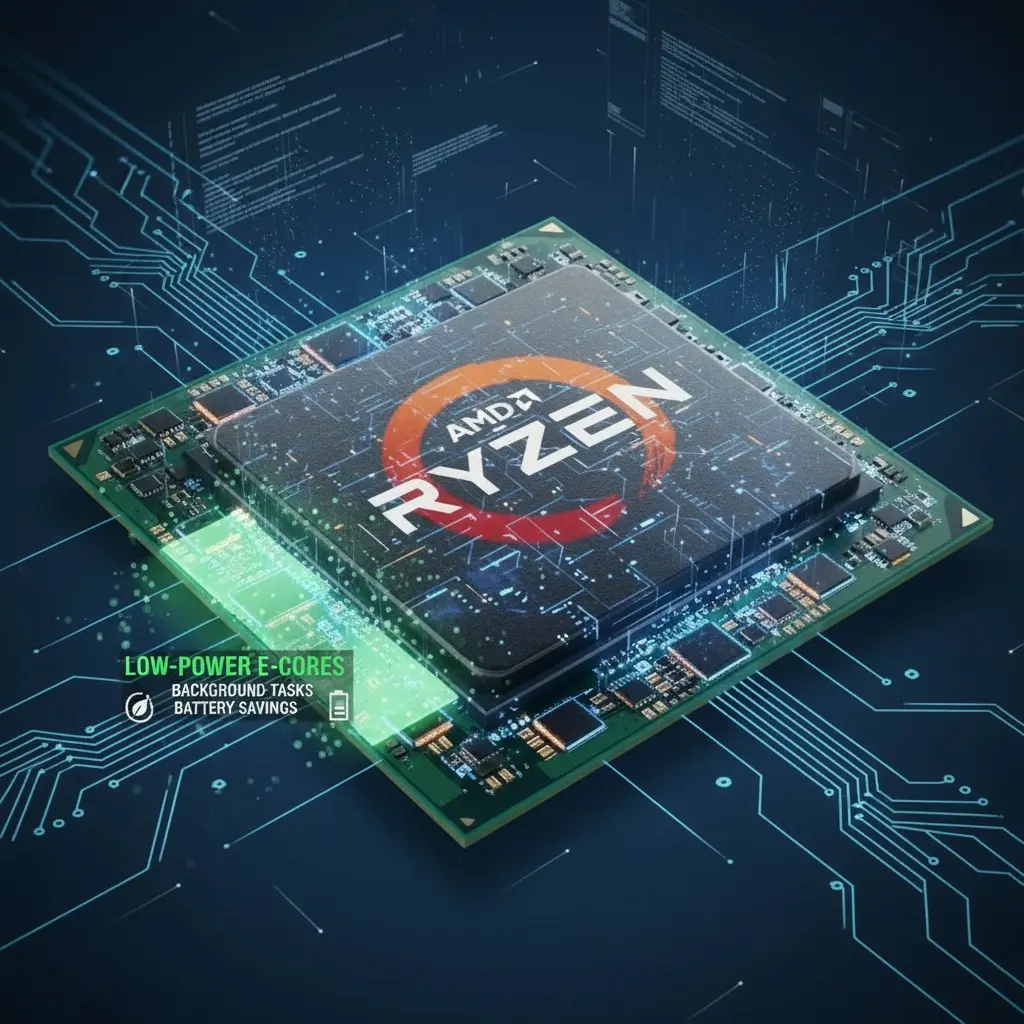
AMD low-power CPU cores may be coming to future Ryzen processors, based on new Linux kernel patches that introduce support for a dedicated Low Power core type designed for background and idle workloads.
AMD’s New Low-Power Core Hint Starts in Linux
A recent AMD patch series submitted for the Linux kernel introduces a new Low Power CPU core type for AMD heterogeneous processors. That may sound like a small software detail, but kernel patches are often where future hardware support begins long before a product reaches store shelves.
The change was first highlighted through AMD’s Linux kernel patch activity, where the company added early software support for recognizing this new class of low-power core in AMD heterogeneous processors.
AMD did not suddenly announce a new Ryzen chip. What is happening is that Linux is being prepared to recognize another class of AMD CPU core beyond the usual performance and efficiency-style classifications already handled by the x86 topology code.
In practical terms, the patch helps the operating system understand what kind of CPU cores are available and how they should be categorized. Modern processors are no longer just collections of identical cores. The operating system increasingly needs to know which cores are fast, which cores are efficient, and which cores are best suited for very light background work.
That is where this gets interesting. AMD already has compact Zen cores, such as Zen 4c and Zen 5c, but those are not the same thing as Intel-style “little” cores. AMD’s dense Zen c cores are designed to save die space and improve core density while preserving the same broad Zen instruction set and software compatibility. They are compact versions of the same basic Zen architecture, not a completely separate low-power housekeeping core.
This new Linux work suggests AMD may be preparing for something more nuanced: a core type designed specifically around minimal power consumption during background or idle workloads.
Why This Is Different From Zen 4c and Zen 5c
AMD’s current dense-core strategy has been one of the company’s more clever architectural moves. Instead of following Intel’s exact big-core/little-core split, AMD built smaller Zen c cores that maintain strong compatibility with their larger Zen counterparts. That approach is especially useful in servers and mobile chips where AMD wants to fit more cores into a limited silicon area.
But dense does not automatically mean ultra-low-power.
Zen 4c and Zen 5c are best understood as area-efficient Zen cores. They can offer more cores in the same physical space, often with lower clocks and different cache arrangements, but they are still designed as real Zen CPU cores capable of serious work. That makes them very different from a tiny background core that exists mainly to handle light system tasks while the larger compute resources stay asleep.
That distinction matters for laptops, handhelds, and battery-powered devices. A dense Zen core may be efficient compared with a larger high-clocked core, but it is not necessarily the same thing as a dedicated low-power core built for idle maintenance, background services, audio handling, light browser tasks, or standby-adjacent workloads.
If AMD’s future processors really do include this kind of low-power tier, it would represent a more specialized approach than the company’s current dense-core strategy.
The Intel Comparison: Similar Goal, Not Necessarily the Same Design
The obvious comparison is Intel’s hybrid CPU strategy. Since Alder Lake, Intel has used a mix of Performance cores and Efficient cores in many consumer processors. The basic idea is simple: heavy foreground work goes to the P-cores, while lighter or background work can be handled by the E-cores.
Intel later pushed that idea further with mobile architectures like Meteor Lake and Lunar Lake, where certain low-power E-cores can operate in a more power-efficient region of the chip. The goal is to let the processor handle lighter workloads without fully waking the more power-hungry compute resources.
AMD’s patch does not prove that the company is copying Intel’s exact layout. It does not confirm a separate low-power island, a specific tile design, a cache structure, or a final consumer product configuration. Those details remain unknown.
What it does suggest is that AMD may be preparing Linux for a more explicit low-power CPU tier. That could serve a similar system-level purpose to Intel’s low-power cores, even if AMD’s final implementation looks different under the hood.
That is the careful way to read this news: not as proof of an Intel clone, but as a sign that AMD is taking low-power task handling more seriously in future heterogeneous processor designs.
Why the Operating System Scheduler Matters
Hybrid CPU designs only work well when the operating system understands the hardware. If the scheduler sends a demanding foreground task to the wrong core, performance can suffer. If it sends a tiny background task to a high-performance core, power gets wasted.
That is why these Linux patches matter. The kernel needs accurate information about each core type so it can make better decisions about where work should run. A laptop playing a video, syncing files, checking notifications, or keeping background services alive should not have to wake its highest-performance cores every time a lightweight task appears.
On Windows, Intel has leaned heavily on Thread Director and hardware feedback mechanisms to help with this kind of scheduling. On Linux, the kernel has its own scheduler infrastructure and energy-aware behavior. AMD exposing better core-type information gives Linux a clearer map of what the processor can do.
That does not automatically guarantee perfect battery life or flawless scheduling on day one. But it is necessary groundwork. Before a future AMD chip can use low-power cores effectively, the operating system has to know those cores exist and understand how to classify them.
What This Could Mean for Zen 6
The patch itself does not explicitly say “Zen 6.” That is important. Early Linux enablement work often points toward future hardware, but it does not always map cleanly to final branding or product names.
That said, the timing naturally invites speculation around AMD’s next major client and mobile CPU generation. Zen 6 has already been widely discussed as AMD’s next-generation architecture, and industry coverage is now connecting this low-power core patch to the possibility of future Zen 6-era processors using a third CPU core type.
The safest interpretation is this: AMD appears to be preparing software support for a future processor design that includes a low-power core classification. Whether that arrives in every Zen 6 mobile chip, only certain laptop processors, handheld-focused APUs, or later designs remains to be seen.
For everyday users, the exact branding matters less than the direction. AMD seems to be moving toward a world where its processors are not just judged by peak boost clocks and multi-core benchmark scores, but also by how intelligently they sip power when the system is doing ordinary background work.
Why Laptops and Handheld Gaming PCs Stand to Benefit Most
The most obvious beneficiaries would be laptops, thin-and-light notebooks, and handheld gaming PCs. These are the devices where idle power, standby behavior, light browsing efficiency, and background task handling can make a real difference in daily use.
Modern handhelds like the Steam Deck, ASUS ROG Ally, Lenovo Legion Go, and similar Windows-based portable gaming systems all face the same basic problem: performance is impressive, but battery life is always fighting physics. The CPU, GPU, memory, display, storage, wireless radios, and background OS tasks all compete for a limited battery.
A dedicated low-power core tier would not magically turn a handheld into an all-day gaming device. The GPU is still the main power draw during actual gameplay. But it could help reduce wasted energy during lighter moments: downloading updates, browsing a game library, idling at the desktop, running chat apps, handling audio, or maintaining basic system services.
That may sound boring compared with a huge benchmark jump, but it is exactly the kind of improvement users actually feel. Cooler idle behavior, fewer random fan spikes, longer standby time, and better battery life during light use can make a device feel much more polished.
This Is About Efficiency, Not Raw Speed
It is tempting to treat every CPU story as a performance story. More cores. Higher clocks. Bigger benchmarks. Better gaming numbers.
This one is different.
If AMD’s future chips include a true low-power core tier, the biggest improvements may show up in the quiet moments: when the system is awake but not working hard. That includes web browsing, video playback, background updates, notification handling, cloud sync, launcher activity, and the usual pile of operating system maintenance tasks that run whether the user asked for them or not.
Those workloads do not need a full-power Zen core screaming to life. They need just enough compute to stay responsive without wasting energy.
That is why this type of architecture matters. The future of CPU design is not only about making the fastest cores faster. It is also about making sure the right core handles the right job at the right time.
Why AMD Is Doing This Through Linux First
Seeing this show up in Linux first is not strange. It is how a lot of hardware enablement happens.
Linux is open, widely used by developers, and deeply important across servers, workstations, handhelds, embedded systems, and enthusiast PCs. Hardware vendors often submit patches early so the ecosystem is ready before final products launch. By the time new silicon arrives, the goal is for the kernel, scheduler, drivers, and monitoring tools to already understand the basic hardware behavior.
That does not mean Linux users are the only audience for the hardware. It simply means Linux is one of the first public places where these future-facing details become visible.
For AMD, this is also strategically useful. The company has spent years building credibility with Linux users, open-source developers, server operators, and enthusiast communities. Preparing Linux properly for heterogeneous CPU behavior helps avoid the kind of scheduling confusion that can make otherwise good hardware feel inconsistent.
What We Still Do Not Know
There are still several unanswered questions.
We do not know which exact processors will use these low-power cores. We do not know whether this will appear broadly across future Ryzen mobile chips or only in specific designs. We do not know whether desktop processors will benefit, or whether this is mainly a mobile and handheld feature. We also do not know how much power AMD can actually save in real-world systems.
Most importantly, we do not yet know the physical implementation. A Linux core-type classification tells us how software should identify the core. It does not fully reveal how AMD arranged the silicon, how much cache the core has, how it clocks, how it shares power domains, or whether it sits in a distinct region comparable to Intel’s low-power island approach.
That is why this story should be treated as a strong signal, not a full product reveal.
Bottom Line
AMD’s new Linux patch is not a flashy product launch, but it may be an important clue about where future Ryzen processors are headed. By introducing support for a dedicated Low Power CPU core type, AMD appears to be preparing for a more flexible processor design that can better separate heavy foreground work from lightweight background activity.
That does not mean AMD is simply copying Intel, and it does not prove every Zen 6 chip will ship with a third core tier. But it does suggest AMD is laying the software foundation for processors that care more about idle efficiency, background responsiveness, and battery life.
For everyday users, the payoff would not be a massive jump in raw speed. It would be the kind of improvement that makes laptops and handhelds feel better in normal use: quieter fans, cooler idle behavior, fewer wasted watts, and potentially longer battery life when the system is doing light work.
In other words, this is not the loudest CPU story of the year. But for mobile Ryzen devices, handheld gaming PCs, and the next generation of efficient x86 hardware, it could become one of the more important ones.
 |
Future Chip Design: Why 3D Architecture May Be the Next Big AI Hardware BreakthroughAs AI workloads push against the memory wall, chipmakers are looking beyond traditional flat designs. 3D architecture could become one of the most important paths to faster, more efficient processors. |
 |
Intel and AMD’s ACE Extensions Show x86 Is Not Done Fighting in the AI EraAs Arm, NPUs, and custom AI silicon gain attention, Intel and AMD are trying to make x86 more relevant for on-chip AI. ACE extensions could be part of that counterattack. |