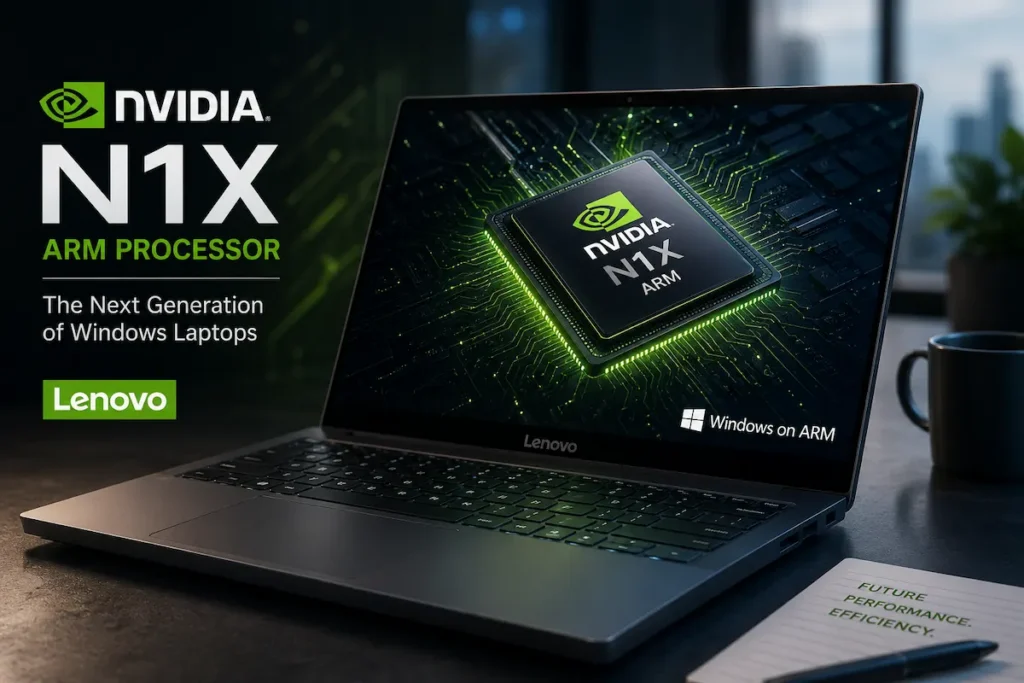
VideoCardz reports that a Lenovo-controlled authentication page included references to “NVIDIA N1x Portal PROD” and “NVIDIA N1x Portal Test,” a sign that NVIDIA’s long-rumored ARM-based PC processor may be moving deeper into OEM-side preparation for future Windows laptops.
NVIDIA has not officially announced the chip, and final specifications remain unconfirmed. But OEM-side infrastructure is rarely meaningless. When a company like Lenovo appears to be preparing internal systems around a new platform, it usually means hardware validation, support workflows, or launch planning is already underway somewhere behind the curtain.
That makes this leak more interesting than a standard processor rumor. If NVIDIA’s N1X platform arrives as expected, it could become one of the most serious attempts yet to challenge the traditional x86 laptop market dominated by Intel and AMD.
More importantly, it could change what buyers expect from thin-and-light Windows laptops. Instead of choosing between battery life and graphics performance, NVIDIA may be trying to combine ARM efficiency with a much stronger integrated GPU than Windows ultraportables typically offer.
Lenovo’s “NVIDIA N1x Portal” Reference Is the Signal
The newly surfaced Lenovo references reportedly point to backend or support-related infrastructure labeled around “NVIDIA N1x Portal” systems. Public visibility appears limited, so this should not be treated as a full product confirmation.
Still, it is a meaningful breadcrumb.
Large PC makers do not usually build internal support pathways for fantasy hardware. These systems often appear months before a public announcement, especially when an OEM is preparing drivers, documentation, support pages, or validation workflows for a new device family.
The Lenovo connection matters because NVIDIA’s rumored N1X chip is not expected to be a conventional laptop processor. Multiple reports have suggested NVIDIA is working with MediaTek on an ARM-based Windows laptop SoC that combines ARM CPU cores with a Blackwell-derived integrated GPU.
If that direction holds, NVIDIA would not simply be entering the laptop CPU market. It would be entering the broader platform fight now forming around AI PCs, ARM laptops, integrated graphics, and software ecosystems.
That broader fight is already visible in the current five-way AI PC chip war, where Intel, AMD, Apple, Qualcomm, and NVIDIA are all trying to define what the next generation of personal computing should look like.
The Most Important Part May Not Be the ARM CPU
Windows-on-ARM discussions usually revolve around CPU efficiency, battery life, and whether legacy Windows apps behave properly. NVIDIA’s rumored N1X platform shifts the focus toward graphics.
That is where the story gets more disruptive.
Rumors have pointed to configurations with as many as 6,144 CUDA cores integrated directly into the SoC. That number remains unconfirmed, and final retail silicon could look very different. But even a smaller version of that idea would be a major departure from how most Windows ARM laptops are currently positioned.
Today’s Snapdragon X laptops are mainly sold around productivity, battery life, AI features, and quiet operation. They are not primarily pitched as gaming or creator workstations. NVIDIA, however, does not enter a market with a neutral GPU reputation. Its brand is tied directly to gaming, CUDA, AI acceleration, creator workloads, and driver support.
That raises expectations immediately.
If NVIDIA puts a serious integrated Blackwell-class GPU inside an ARM laptop chip, consumers will not compare it only against other efficient ultraportables. They will compare it against entry-level gaming laptops, creator notebooks, Apple Silicon Macs, and eventually AMD and Intel systems with stronger integrated graphics.
NVIDIA Could Change the Windows-on-ARM Conversation
Qualcomm has already done the hard work of making Windows-on-ARM feel more credible for mainstream laptops. Snapdragon X systems helped push the category beyond the old “interesting but compromised” label.
But the ecosystem still has gaps.
As we covered in our look at Snapdragon X Adreno GPU support and Cinebench compatibility on Windows ARM, benchmark support, graphics APIs, driver paths, and software assumptions can still create visibility problems for ARM-based Windows hardware. In other words, the chip can be capable, but the software stack still has to recognize and use it properly.
That is the challenge NVIDIA would inherit on day one.
NVIDIA can bring GPU credibility, developer relationships, CUDA tooling, and gaming experience. But it still has to operate inside Windows-on-ARM, where legacy app compatibility, emulation behavior, anti-cheat systems, launchers, and driver expectations all matter.
For productivity users, small compatibility problems are annoying. For gamers, they can be deal-breakers.
That difference matters. A spreadsheet app running slightly slower through emulation is one thing. A major game failing to launch because of anti-cheat support, graphics translation, or driver behavior is another thing entirely.
The Software Problem Is Still Real
Hardware alone will not decide whether NVIDIA succeeds here.
Windows-on-ARM has improved, but it is still not invisible to users in the way Apple’s ARM transition became for many Mac buyers. Apple controlled the hardware, operating system, developer tools, and much of the migration path. Windows is messier because it has to support a much wider range of hardware, software, drivers, games, and enterprise environments.
That creates a higher bar for NVIDIA.
If N1X laptops are marketed as premium AI PCs with strong battery life, NVIDIA can probably compete on efficiency, GPU acceleration, and software ecosystem strength. But if they are marketed as thin-and-light gaming-capable machines, the expectations become much tougher.
NVIDIA would need strong DirectX behavior, reliable GPU drivers, acceptable performance through emulation for older x86 titles, broad launcher support, and fewer anti-cheat headaches than Windows ARM has historically seen.
That is not impossible. But it is very different from simply building a fast chip.
Why Lenovo’s Involvement Matters
Lenovo’s appearance in the leak is important because it is one of the largest PC manufacturers in the world, with reach across consumer laptops, business machines, workstations, and enterprise fleets.
If Lenovo is preparing infrastructure around N1X systems, that suggests NVIDIA’s platform may be moving beyond lab hardware and into the type of OEM planning needed for real products.
That does not mean launch is imminent. PC makers often prepare support systems long before products appear publicly. But it does suggest this is not just a speculative chip floating around a rumor cycle.
It also raises an interesting positioning question: what kind of laptop gets NVIDIA N1X first?
The most likely starting point would be premium thin-and-light systems where battery life, AI acceleration, and graphics performance can justify higher pricing. But NVIDIA’s brand could also pull the platform toward creator laptops, portable gaming systems, or hybrid machines that sit between ultraportables and entry-level gaming notebooks.
This Fits the Bigger Chip War
The timing also makes sense.
The PC market is moving into a much more experimental phase. Intel is reworking its mobile roadmap around AI-focused heterogeneous chips. AMD is pushing stronger integrated graphics and larger AI-focused platforms. Qualcomm is trying to make ARM a mainstream Windows option. Apple continues to show what tightly integrated silicon can do when the hardware and software stack are controlled together.
NVIDIA entering this category would intensify all of that.
Unlike Qualcomm, NVIDIA already has a massive software ecosystem around gaming, AI, rendering, workstation acceleration, and CUDA-based development. That does not guarantee success in Windows laptops, but it gives NVIDIA a different kind of leverage.
This is why the rumored N1X platform matters beyond one Lenovo leak. It fits directly into the larger architecture fight we explored in our NVIDIA, Apple, Qualcomm, and x86 chip war analysis. The next PC era may not be defined by one instruction set or one benchmark. It may be defined by which company can combine performance, efficiency, AI acceleration, graphics, developer support, and software compatibility into the most complete package.
Why This Matters for Laptop Buyers
For consumers, the biggest implication is simple: the definition of a thin-and-light laptop may be changing.
Historically, buyers who wanted real graphics performance had to accept tradeoffs. That usually meant a larger chassis, dedicated GPU, more heat, louder fans, shorter battery life, and higher prices.
Apple Silicon showed that tightly integrated designs could deliver strong performance without always following that old laptop formula. NVIDIA may now be trying to bring a similar idea into the Windows world, but with a much heavier emphasis on graphics, AI acceleration, and gaming.
If successful, that could pressure the entire Windows laptop market to move faster. Intel and AMD would need to respond with stronger integrated graphics and AI platforms. Qualcomm would need to improve GPU support and gaming credibility. Microsoft would need to keep making Windows-on-ARM less visible to users.
That last point may be the most important. For ARM laptops to win mainstream buyers, the architecture has to disappear. People do not want to think about emulation layers, compatibility lists, or native app support. They want the laptop to work.
What We Still Do Not Know
There are still several major unknowns.
- NVIDIA has not officially announced the N1X platform.
- Final CPU, GPU, memory, and NPU specifications remain unconfirmed.
- Launch timing is still unclear.
- Lenovo’s exact role has not been publicly detailed.
- Real-world Windows-on-ARM gaming compatibility remains uncertain.
- Power consumption, thermals, and battery life are still unknown.
- Pricing against Intel, AMD, Qualcomm, and Apple systems has not been revealed.
Those unknowns matter. A powerful integrated GPU would be impressive, but the full platform has to work as a laptop. That means thermals, drivers, battery life, app support, game compatibility, OEM design, and pricing all have to line up.
That is a much harder test than appearing in an internal support portal.
Bottom Line
The Lenovo “NVIDIA N1x Portal” reference is one of the clearest public signs yet that NVIDIA’s ARM laptop ambitions are moving into real OEM preparation territory.
If the rumored platform delivers anything close to the expected combination of ARM efficiency, Blackwell-class integrated graphics, AI acceleration, and NVIDIA software support, it could become one of the most important shifts in the Windows laptop market in years.
But the final test will not be whether NVIDIA can build impressive silicon. NVIDIA can probably do that part.
The harder question is whether it can make a new Windows-on-ARM platform feel seamless enough for mainstream laptop buyers, creators, and gamers. In the next phase of the PC market, the winner may not simply be the company with the fastest chip. It may be the company that makes the architecture disappear.