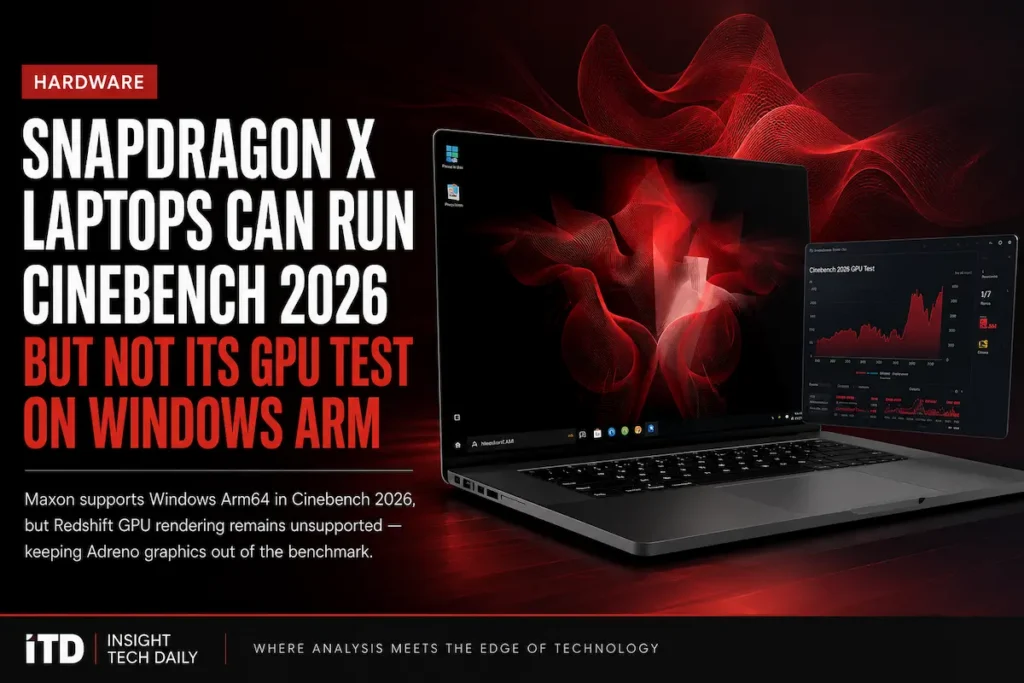
Cinebench 2026 runs natively on Windows Arm64 systems, but Maxon’s own support documentation confirms that Redshift GPU rendering is not supported on Windows Arm. That leaves Snapdragon X-class Adreno integrated graphics outside one of the industry’s most recognizable GPU benchmark paths — not because the laptops cannot run Cinebench, but because the relevant GPU rendering path is not available on the platform today.
What Changed
A developing discussion around Snapdragon X-series laptops has drawn attention to a narrower but meaningful platform issue: some Windows on Arm machines can run modern benchmark software, yet still cannot participate in all of the benchmark’s most relevant test modes.
The immediate focus is Cinebench 2026, Maxon’s rendering benchmark based on its Redshift engine. Maxon offers a dedicated Windows Arm64 build of Cinebench 2026 and says the benchmark supports Arm64 CPUs on Windows. However, the company’s current Windows Arm limitations page states that Redshift supports only CPU rendering on Windows Arm, with “no GPU rendering.”
That distinction matters. A Snapdragon X laptop can be recognized as a valid Windows Arm platform for CPU testing, while its Adreno integrated GPU remains excluded from Redshift-based GPU benchmarking in that environment. In practical terms, the hardware is present, the operating system is supported, and the application has an Arm64 build — but the GPU benchmark path is still unavailable.
Confirmed Details
- Maxon provides a Windows Arm64 version of Cinebench 2026.
- Cinebench 2026 uses Redshift to evaluate CPU and GPU capabilities.
- Maxon’s current Windows Arm limitations documentation states that Redshift supports only CPU rendering on Windows Arm and does not support GPU rendering there.
- Maxon’s Cinebench technical information lists Windows 11 on Snapdragon compute platforms as supported for the CPU-side benchmark requirements, while GPU requirements on Windows are framed around compatible Nvidia and AMD hardware rather than Qualcomm Adreno graphics.
Separately, an enthusiast report by M. Kaine on the Linus Tech Tips forums claims that Cinebench 2026 produces a “No devices available” result when attempting to force GPU testing on a Snapdragon system, and argues that Adreno graphics are effectively blocked from GPU participation. That specific behavior has not been independently confirmed by Maxon in public documentation located by InsightTechDaily, so it should be treated as third-party testing rather than an official support statement.
The Real Issue Is Not Just One Benchmark
The more important story is structural. Benchmarks do not simply measure hardware; they measure hardware through specific software stacks. When a major rendering engine supports some GPU backends but not others, performance visibility becomes uneven across platforms.
On Windows, Maxon’s public Redshift requirements currently emphasize Nvidia CUDA-class hardware and AMD RDNA-class GPUs. On macOS, Apple Silicon is supported. On Windows Arm, however, Maxon’s documentation currently restricts Redshift to CPU rendering.
That leaves Qualcomm’s Adreno graphics in an awkward position. Snapdragon X processors may have capable integrated graphics for certain workloads, but if a widely referenced rendering benchmark cannot engage that GPU path on Windows Arm, reviewers and buyers lose one standardized lens for comparing it against Apple, AMD, Intel, and discrete GPU systems.
The practical problem is not that every benchmark must support every accelerator on day one. It is that Windows on Arm is now mature enough to compete in mainstream premium PCs, and support gaps in widely cited tools can distort how visible that progress is to reviewers, buyers, and developers.
Why This Matters in the 2026 Chip War
This support gap matters because the PC market is no longer defined by a simple Intel-versus-AMD rivalry. As InsightTechDaily explored in The 2026 Five-Way Chip War: Nvidia, Apple, and Qualcomm Challenge the x86 Duopoly, the modern processor battle is increasingly about platform control: silicon, operating systems, developer tooling, software compatibility, and AI acceleration all reinforcing one another.
Qualcomm’s Windows-on-Arm push sits directly inside that broader fight. Snapdragon laptops do not need to win every benchmark to matter, but they do need access to the same kinds of software visibility that help shape market perception. When a recognizable GPU benchmark excludes a platform’s graphics path, the result can be interpreted as a hardware weakness even when the immediate issue is software support.
That concern also mirrors the argument in our broader AI PC analysis, The AI PC Chip Battle: Intel, AMD, Apple, Nvidia, and Qualcomm Fight for the Future of Computing. In that piece, Qualcomm’s central challenge was not framed as silicon alone. It was whether Windows on Arm could build the kind of developer adoption and software support needed to compete more fully with x86 and Apple Silicon. Cinebench 2026’s Redshift GPU limitation is a small but revealing example of that larger ecosystem test.
Benchmark Gaps Can Become Perception Gaps
Benchmark omissions can create a perception problem. A platform that cannot run a commonly referenced GPU test may look less competitive than it really is, even when the limitation comes from software support rather than silicon capability.
That is especially relevant for Windows on Arm in 2026. Qualcomm and Microsoft have spent the past two years positioning Snapdragon PCs as broader alternatives to traditional x86 laptops, with a particular emphasis on battery life, AI acceleration, and increasingly capable integrated systems.
Yet benchmark culture still shapes market understanding. Reviewers use common test suites because they create repeatable comparisons. Enthusiasts rely on them because they simplify purchasing decisions. OEMs use them because they provide shorthand for progress. When one class of hardware is absent from a benchmark chart, that absence can be misread as weakness rather than incompatibility.
For consumers, the effect is subtle but real. Someone comparing high-end thin-and-light laptops may see Apple Silicon, Intel Arc-class integrated graphics, AMD Radeon integrated GPUs, and discrete Nvidia graphics represented in professional-rendering tests, while Snapdragon’s Adreno GPU appears missing from the same frame. Without context, the gap looks like a performance gap. In reality, at least in this case, it is first a support gap.
What About DirectCompute or Vulkan?
The candidate framing around DirectCompute or Vulkan reflects a broader developer concern, but the public documentation reviewed here does not directly state that the absence of those paths is the sole reason Redshift GPU rendering is unavailable on Windows Arm. Maxon’s current position is simpler and more limited: GPU rendering is not supported for Redshift on Windows Arm.
Third-party commentary has argued that a lack of an appropriate Windows Arm GPU backend is effectively what blocks Adreno participation in tools such as Cinebench 2026. That is plausible in a general software architecture sense, especially given the way rendering engines depend on specific compute frameworks and driver maturity, but it remains analysis unless Maxon or Qualcomm provides a more explicit technical explanation.
What can be said confidently is that Maxon supports GPU rendering on several hardware ecosystems, but not on Windows Arm today. As a result, Snapdragon X graphics are excluded from Cinebench’s Redshift GPU workload regardless of the broader capabilities of the underlying Adreno hardware.
Windows on Arm’s Visibility Problem
This is not the first time software maturity has shaped perceptions of Arm-based Windows PCs. Native application availability, game compatibility, driver behavior, emulation quality, and development tooling have all influenced how the platform is judged. The difference now is that Windows on Arm hardware has become sufficiently ambitious that toolchain omissions are more conspicuous.
Maxon’s Windows Arm limitations page also notes other graphics-related caveats for Cinema 4D, including Qualcomm GPU driver weaknesses in more complex simulations on first-generation Elite hardware and a lack of hardware features needed for Redshift Live on that generation. Those notes underscore that this is not purely a benchmark politics story; software support and driver readiness are part of the technical reality.
Still, the result is the same from a market-observation standpoint: Snapdragon systems may be absent from some of the charts most frequently used to summarize GPU capability. That complicates not only consumer comparisons, but also any serious attempt to evaluate how quickly Windows on Arm graphics are improving over time.
What Remains Unclear
- Whether Maxon plans to add Redshift GPU rendering support for Windows Arm systems in a future release.
- Whether support would target Qualcomm Adreno graphics specifically, a broader Windows Arm compute path, or both.
- How current and next-generation Snapdragon X GPUs would compare in Cinebench’s GPU test if support existed.
- Whether other professional rendering, compute, or benchmark suites have similar Windows Arm GPU visibility gaps.
Maxon’s downloads page shows continuing investment in Windows Arm builds across multiple products, including Cinebench itself. That suggests Windows Arm is not being ignored as a platform. But the present support boundary is still clear: Redshift GPU rendering remains unavailable on Windows Arm at the time of publication.
Bottom Line
Snapdragon X laptops are not absent from Cinebench 2026 entirely. Maxon supports Windows Arm64 systems for the benchmark and offers a native Arm build. The problem is narrower and more consequential: Redshift GPU rendering is currently unsupported on Windows Arm, which keeps Qualcomm Adreno graphics out of Cinebench’s GPU evaluation path.
That does not prove Adreno would win or lose in a direct Redshift GPU comparison. It proves that the comparison is not available through this widely referenced tool today. For a Windows on Arm ecosystem pushing deeper into premium PCs, that kind of software-defined visibility gap matters.