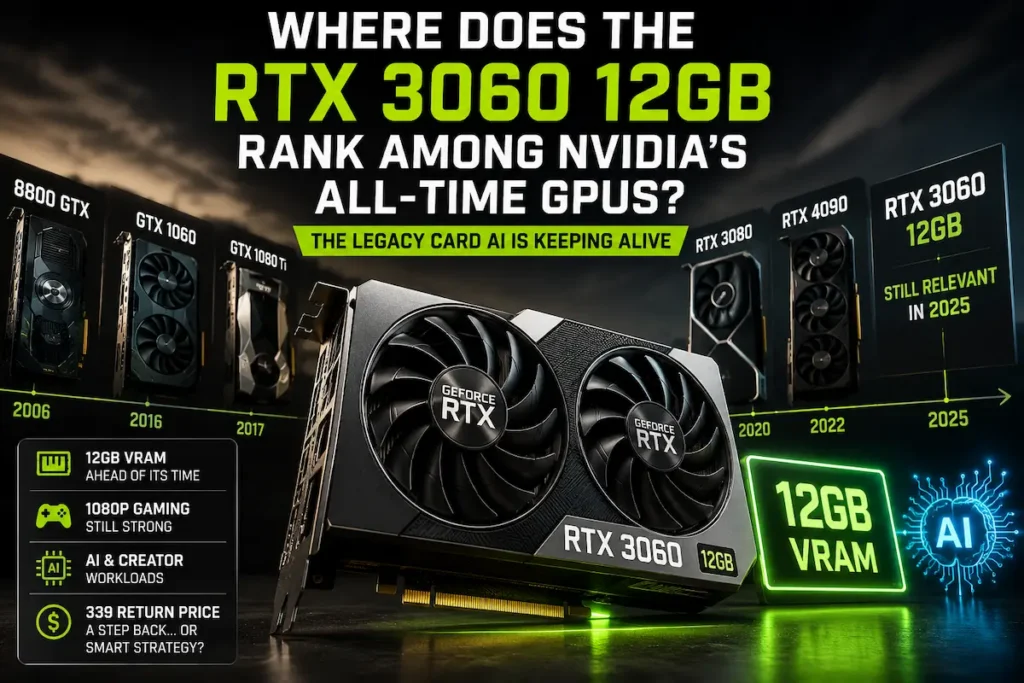
The RTX 3060 12GB is not the fastest Nvidia graphics card ever made. It is not the most efficient, the most glamorous, or the most technically advanced. But five years later, it is still relevant — and that may make it one of the most important GeForce cards Nvidia has ever released.
The graphics card market has a funny way of deciding which products become legends.
Sometimes it is obvious. The GeForce 8800 GTX was a monster. The GTX 1080 Ti became a high-end icon. The GTX 1060 became the people’s gaming card for an entire generation. Those cards earned their reputations through clear performance wins, unusually long lifespans, or sheer market dominance.
Then there is the GeForce RTX 3060 12GB.
On paper, it should not be this interesting. It launched as a mainstream Ampere card in 2021. It was slower than the RTX 3060 Ti, nowhere near the RTX 3080, and awkwardly positioned during one of the worst GPU shortages PC gamers had ever seen. For many buyers, the RTX 3060 was not the dream card. It was the card they could maybe find, maybe afford, and maybe justify.
And yet here we are years later, still talking about it.
New retail stock of the RTX 3060 12GB has reportedly started showing up again around the $339 mark, which is almost surreal for a card that originally launched with a $329 MSRP. That price is not exactly a bargain in 2026. But the fact that the RTX 3060 12GB can even re-enter the conversation says something important about its place in Nvidia history.
This card did not become legendary because it was the fastest. It became legendary because Nvidia accidentally gave the mainstream market the one thing that aged better than almost anything else: 12GB of VRAM.
The RTX 3060 12GB Was Weird From Day One
The RTX 3060 12GB has always been a strange card.
When Nvidia launched it, the memory configuration immediately stood out. The RTX 3060 had 12GB of GDDR6, which meant it had more VRAM than several more expensive cards in the same generation. The RTX 3060 Ti had 8GB. The RTX 3070 had 8GB. Even the original RTX 3080 shipped with 10GB.
That did not mean the RTX 3060 was faster than those cards. It was not. GPU performance is not just a VRAM number. Memory bandwidth, shader count, cache, clock speeds, power limits, and architecture all matter.
But the RTX 3060 12GB had something that aged unusually well. It had breathing room.
At launch, that 12GB configuration felt almost excessive for a mainstream 1080p card. Today, it looks less like overkill and more like accidental foresight. Modern games are heavier. Texture packs are larger. Bad PC ports are less forgiving. Local AI workloads have entered the consumer conversation. Suddenly, the RTX 3060 12GB looks less like an oddball and more like a survivor.
The People’s Champion Argument
If we are ranking Nvidia GPUs by raw performance, the RTX 3060 12GB does not get close to the top. That list belongs to the flagship monsters: the 8800 GTX, GTX 1080 Ti, RTX 3080, RTX 4090, and other cards that moved the high-end market forward.
But if we are ranking Nvidia GPUs by real-world impact, the RTX 3060 12GB deserves a serious conversation.
For years, it has been one of the most recognizable GPUs in the PC gaming world. It showed up in budget builds, prebuilt desktops, creator PCs, student rigs, starter workstations, and used-market upgrade paths. It became one of those cards that normal people actually owned, not just one that reviewers benchmarked.
The history of PC gaming is not only written by halo products. It is written by the cards that millions of people use to play games, edit videos, learn Blender, try Stable Diffusion, run local models, and keep older systems alive longer than expected.
By that standard, the RTX 3060 12GB has a real claim as one of Nvidia’s most important mainstream GPUs.
ITD Insight
The RTX 3060 12GB is not a legend because it crushed benchmarks. It is a legend because it gave mainstream buyers something that stayed useful: enough VRAM to survive a messy era of bigger games, rougher PC ports, and growing interest in local AI workloads.
Where It Ranks Among Nvidia’s All-Time GPUs
So where does the RTX 3060 12GB actually belong on the all-time Nvidia list?
It is not top five overall. That would be too generous. Cards like the GeForce 8800 GTX, GTX 1080 Ti, GTX 1060, RTX 3080, and RTX 4090 have stronger claims depending on whether you value architecture, performance, popularity, or historical disruption.
But the RTX 3060 12GB absolutely belongs in the broader all-time conversation.
Here is the fairest way to rank it:
- All-time performance ranking: Not close to the top.
- All-time value-at-launch ranking: Complicated, because the GPU shortage ruined normal pricing.
- All-time mainstream relevance ranking: Extremely high.
- All-time longevity ranking: Surprisingly strong.
- All-time “Nvidia accidentally made this age better than expected” ranking: Near the top.
If the GTX 1060 was the great 1080p workhorse of the late 2010s, the RTX 3060 12GB became the messy, pandemic-era successor that refused to leave. It was not as clean of a value story. It did not arrive in a normal market. But it became one of the default answers for people who needed a practical NVIDIA GPU with enough memory to last.
That puts it somewhere in the top 10 to top 15 most important Nvidia consumer GPUs, depending on how much weight you give to popularity, longevity, and usefulness beyond gaming.
That may sound high, but the card has earned it.
The 12GB VRAM Decision Changed Everything
The RTX 3060 12GB’s entire legacy comes back to memory.
In a cleaner timeline, Nvidia probably would have given this card 8GB and moved on. That would have made the product stack easier to explain. It would have avoided the awkward situation where a cheaper card had more VRAM than more expensive models.
Instead, the RTX 3060 got 12GB, and that choice gave it a second life.
For gaming, the extra memory helps in texture-heavy titles and poorly optimized PC ports. It does not magically make the GPU faster, but it can help prevent the ugly problems that appear when a card runs out of memory: stutters, hitching, texture pop-in, or forced lower settings.
For creators, 12GB is useful for video editing, 3D work, and heavier asset workflows.
For local AI hobbyists, it matters even more. A 12GB NVIDIA card can run workloads that simply do not fit as comfortably on many 8GB GPUs. CUDA support also gives NVIDIA a software advantage in many AI and creator applications, even when AMD cards may offer more raw VRAM for the money.
That is why the RTX 3060 12GB stayed relevant after newer cards arrived. It was not winning every benchmark. It was winning the “can I actually load this thing?” argument.
The RTX 4060 Problem
The awkward part is that Nvidia already made a newer mainstream successor: the RTX 4060 8GB.
In many normal gaming situations, the RTX 4060 is the better modern card. It is more power efficient. It supports newer Ada Lovelace features, including DLSS 3 Frame Generation. It usually makes more sense for buyers who care about lower power draw, newer features, and a cleaner warranty-era purchase.
But the RTX 4060 also has one obvious weakness: 8GB of VRAM.
That is why the RTX 3060 12GB refuses to disappear. The older card gives up efficiency and newer features, but it keeps the memory advantage. In a market where many buyers are nervous about 8GB GPUs aging poorly, that advantage still has emotional power.
This is the strange place the RTX 3060 occupies. It is old enough to be inefficient, but not old enough to be useless. It is slower than newer cards in some ways, but more comfortable in certain memory-heavy situations. It is not the obvious recommendation for everyone, but it is still annoying enough to newer 8GB cards that people keep comparing them.
That is usually a sign of a memorable GPU.
The $339 Price Is the Problem
Here is where the nostalgia has to stop.
The RTX 3060 12GB may be a historically important card, but $339 is not an exciting price for it in 2026.
That is almost the same as its original launch MSRP. For a five-year-old graphics card architecture, that feels wrong. Technology is supposed to get cheaper over time. Buyers are supposed to get more performance for the same money, not revisit the same price point half a decade later.
At that price, the RTX 3060 12GB becomes a very specific recommendation rather than a broad one.
It makes sense only if you specifically want:
- NVIDIA software support
- CUDA compatibility
- 12GB of VRAM
- Acceptable 1080p gaming performance
- A new card rather than a used-market gamble
For pure gaming, many buyers should compare newer options carefully. The RTX 4060 is more efficient and has newer features. AMD’s midrange cards may offer stronger raster performance or larger memory configurations depending on pricing and availability. Used GPUs can also be tempting, though they come with their own risks.
The RTX 3060 12GB becomes much easier to recommend closer to the $250 range. At $339, it is less of a slam-dunk deal and more of a specialized tool with a famous name.
Why Nvidia Might Still Want It Around
The return of the RTX 3060 12GB also says something about Nvidia’s broader strategy.
Not every buyer wants a flagship GPU. Not every system builder wants to pay for the newest architecture. Not every market segment needs cutting-edge silicon. Older, mature chips can still serve budget PCs, entry creator systems, and regions where newer GPUs remain expensive.
There is also a supply-chain angle. Newer Nvidia products compete for advanced manufacturing capacity, and Nvidia’s highest-margin business is now heavily tied to AI accelerators and data center hardware. Keeping older consumer GPUs alive can help cover lower price bands without putting as much pressure on the newest nodes.
That does not automatically make the RTX 3060 12GB a great buy. But it does explain why a card like this can keep coming back. It fills a weird hole in the market: affordable-ish NVIDIA, enough VRAM to matter, and broad software compatibility.
The All-Time Nvidia GPU Hall of Fame Test
To decide whether the RTX 3060 12GB belongs among Nvidia’s all-time greats, we have to ask what makes a GPU legendary.
Is it peak performance? Then no, the RTX 3060 does not qualify.
Is it architecture leadership? Again, probably not. Ampere was important, but the RTX 3060 itself was not the card that defined the architecture.
Is it value? At launch, that answer was muddied by the GPU shortage. In today’s $339 return, the value argument is even harder.
But if the test is usefulness over time, the RTX 3060 12GB has a much stronger case.
It stayed relevant because it landed at the intersection of three trends:
- PC games becoming more memory hungry
- Creators needing affordable NVIDIA cards
- Local AI making VRAM matter to normal enthusiasts
That combination turned a midrange card into a long-term reference point. Years later, people still use it as the comparison target whenever an 8GB GPU launches at an uncomfortable price.
That is legacy.
Bottom Line
The RTX 3060 12GB is one of Nvidia’s strangest success stories.
It was not the best Ampere card. It was not the fastest card in its class forever. It was not even blessed with a normal launch environment, thanks to the chaos of the pandemic-era GPU market.
But it had the right memory configuration at the right time. That 12GB buffer helped it outlive expectations, stay useful for gamers and creators, and become a favorite among budget local AI experimenters. It also made Nvidia’s newer 8GB mainstream cards look more awkward than they otherwise would have.
So where does it rank among Nvidia’s all-time GPUs?
Not in the top tier of performance legends. That group belongs to cards like the 8800 GTX, GTX 1080 Ti, RTX 3080, RTX 4090, and other headline-making giants.
But among mainstream Nvidia GPUs that regular people actually bought, used, defended, and kept alive? The RTX 3060 12GB belongs high on the list.
It is probably not a top-five Nvidia GPU of all time.
But it is absolutely a Hall of Very Useful card — and in the real world of PC gaming, that may matter more than another benchmark crown.
 |
Local AI Hardware Demands Surge as Chinese MoE Models Challenge U.S. Open-Weight StandardsEfficient MoE models are changing the local AI hardware conversation. For everyday users, VRAM and unified memory are becoming more important than raw benchmark speed alone. |
 |
The Real State of Gaming PCs: Performance, Prices, and What Actually Matters in 2026Gaming PCs are still powerful, flexible, and upgradeable, but the buying math has changed. Here is what actually matters in 2026, from GPUs and CPUs to RAM, storage, pricing, and long-term value. |