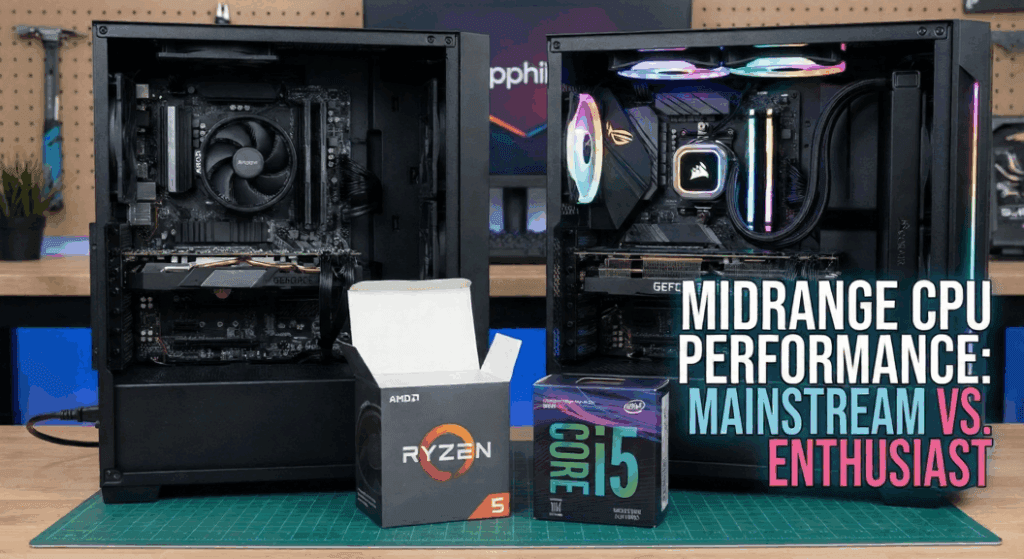

Midrange CPU Launches Blur the Line Between Mainstream and Enthusiast PCs
For most of the past two decades, buying a desktop CPU followed a familiar script. Entry-level chips handled everyday tasks, midrange parts offered a balance of price and performance, and flagship models existed for enthusiasts who wanted the fastest possible silicon regardless of cost or power draw. That hierarchy made upgrade decisions relatively straightforward.
Heading into 2026, that script has clearly broken down.
A new wave of so-called “midrange” desktop CPUs from both Intel and AMD is delivering performance that, in many real-world workloads, rivals what were considered flagship processors just one or two generations ago. At the same time, true top-tier CPUs are becoming more specialized—pushing higher core counts, aggressive boost behavior, or niche gaming optimizations that only a subset of buyers can fully take advantage of.
The result is a blurred line between mainstream and enthusiast PCs. Price tiers no longer map cleanly to everyday performance, and the “best” CPU increasingly depends on how a system will actually be used.
This article examines what has changed, why midrange CPUs are suddenly so capable, and how buyers should rethink traditional CPU tiers when planning an upgrade.
The Traditional CPU Ladder Is Breaking Down
For years, CPU lineups were structured like a staircase. Each step came with predictable gains in cores, cache, clock speeds, and performance, alongside matching increases in price and power consumption.
Intel’s Core i3, i5, i7, and i9 branding—and AMD’s Ryzen 3, 5, 7, and 9 equivalents—made it easy to assume where a processor fit. While generational details changed, the hierarchy itself remained familiar.
That predictability has eroded.
A modern midrange CPU—such as Intel’s Core i5 or AMD’s Ryzen 5 class—now frequently offers:
- Six to eight high-performance cores
- Boost clocks exceeding 5 GHz
- Large shared caches
- Support for current memory and I/O standards
Just a few years ago, those specifications would have placed a processor firmly in enthusiast territory. Today, they sit squarely in the middle of the product stack.
Meanwhile, flagship CPUs are increasingly about pushing extremes: more cores for heavily threaded workloads, specialized cache designs for gaming, or short-duration boost behavior that looks impressive in benchmarks but delivers diminishing returns in everyday use.
Why Midrange CPUs Have Become So Powerful
Architectural Gains Are Compounding
Both Intel and AMD have delivered meaningful architectural improvements across recent generations. Higher instructions per clock (IPC), better branch prediction, wider execution engines, and improved memory controllers all translate into higher real-world performance without dramatic increases in core count.
When these gains compound over multiple generations, the results are striking. A current midrange CPU can outperform a flagship processor from just a few years ago in many common tasks, even at similar clock speeds.
This is especially noticeable in lightly threaded and mixed workloads—web browsing, office productivity, content creation, and most games—where efficiency matters more than raw core count.
Core Counts Have Shifted Down the Stack
What once defined a high-end desktop CPU is now standard in the midrange.
AMD pushed higher core counts into mainstream pricing early with Ryzen, and Intel has since followed suit. Today, eight-core configurations are common in CPUs that buyers still perceive as “midrange.”
Hybrid architectures, combining performance and efficiency cores, have further expanded thread counts without a proportional increase in price. While not every workload benefits equally, this shift has helped midrange CPUs excel in multitasking and always-on scenarios.
Platform and Manufacturing Maturity
Current CPU platforms are also benefiting from maturity. Memory compatibility, power behavior, and firmware stability—often pain points during major transitions—are far less problematic than in earlier cycles.
For buyers, this translates into:
- More consistent out-of-the-box performance
- Improved efficiency and thermals
- Broader motherboard and memory compatibility at lower price points
These advantages rarely appear in spec sheets, but they meaningfully improve day-to-day usability.
Near-Flagship Performance, With Fewer Tradeoffs
Gaming: Diminishing Returns at the Top
In gaming—especially at higher resolutions where the GPU is the primary bottleneck—the performance gap between modern midrange CPUs and flagship models is often measured in single-digit percentages.
Flagship processors still hold advantages in edge cases, such as competitive esports at extremely high frame rates or CPU-heavy simulation titles. For most players, however, those differences are difficult to perceive and rarely justify the significant price premium.
As a result, spending hundreds more on a CPU may deliver impressive benchmark results, but little tangible improvement in how games actually feel.
Productivity and Always-On Workloads
In productivity scenarios, the picture is more nuanced.
Midrange CPUs perform exceptionally well in tasks such as photo editing, light to moderate video work, software development, and general multitasking. They also excel in low-power and always-on roles, making them increasingly popular for homelabs, virtualization, and home servers.
Flagship CPUs still dominate heavily threaded workloads like large-scale 3D rendering or professional video encoding. However, those workloads represent a smaller share of the desktop market than marketing often implies.
Flagship CPUs Are Changing, Too
The narrowing gap is not just about midrange CPUs improving. Flagship CPUs themselves are evolving in ways that make them less universally appealing.
Higher Power, Higher Platform Costs
Top-tier CPUs increasingly rely on elevated power limits to achieve headline performance. That often brings additional requirements, including high-end cooling, premium motherboards, and more robust power delivery.
For enthusiasts, this complexity can be part of the appeal. For many buyers, it represents higher costs and diminishing returns.
Specialization Over Generalization
Some flagship CPUs are now tuned for very specific use cases, such as maximizing gaming performance through large caches or prioritizing multi-threaded throughput at the expense of efficiency.
These designs can be impressive, but they are less “one size fits all” than flagship CPUs of the past. Buyers who don’t match the target workload may end up paying for capabilities they rarely use.
Rethinking CPU Tiers in 2026
The key takeaway is simple: CPU branding tiers matter less than ever.
A modern midrange CPU can serve as:
- A high-end gaming processor
- A capable productivity or content creation engine
- An efficient, long-term platform for homelab and always-on workloads
Meanwhile, flagship CPUs often deliver marginal gains for everyday use while introducing higher platform costs and power demands.
The Bottom Line
Midrange CPU launches are no longer incremental updates—they are redefining what mainstream PCs can do. By delivering near-flagship performance at lower price points, they are forcing buyers to rethink long-held assumptions about CPU tiers and value.
For most consumers, this is an opportunity rather than a problem. The challenge is no longer finding enough performance, but recognizing when “more” is simply unnecessary.
In a market where the middle has become exceptionally strong, the smartest upgrade may be the one that prioritizes use case over labels—and value over bragging rights.
Related Reading
As performance improves across the PC market, pricing pressures are reshaping buying decisions well beyond desktop CPUs. Our recent analysis looks at how rising component costs are pushing the entry point for premium laptops higher—and what that could mean for buyers rethinking value across platforms.
Rising Component Costs Are Pushing the “Premium Floor” for Laptops Past $2,000