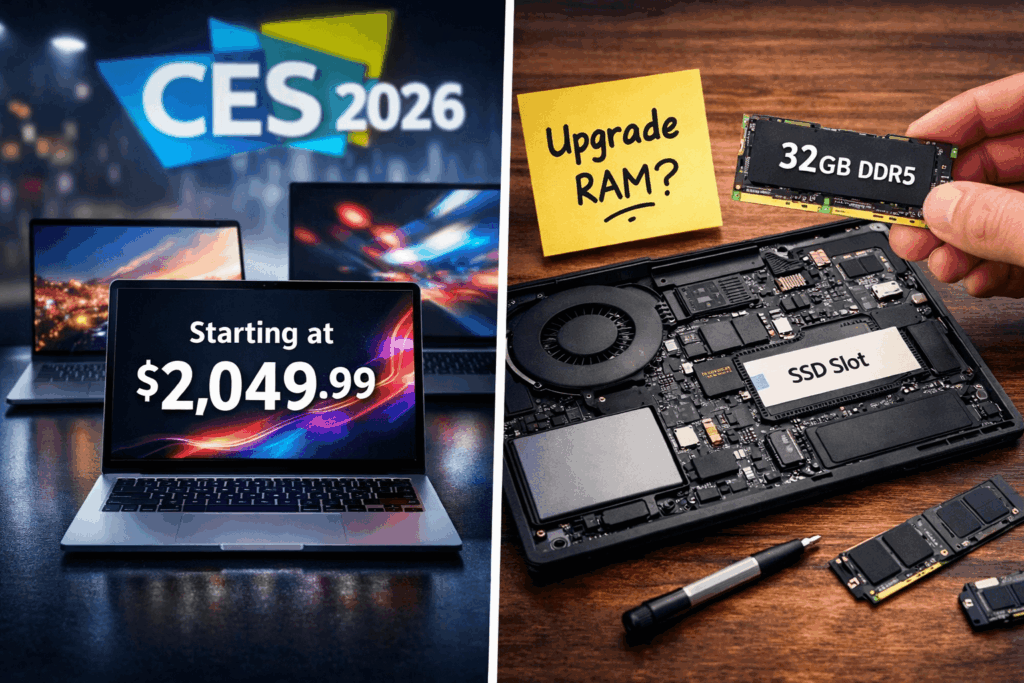

Premium laptops have always been expensive. What’s changing in early 2026 is the starting point for many of them — the “premium floor” where base configurations land before you’ve clicked a single upgrade box.
At CES 2026, Dell brought back the XPS brand with new XPS 14 and XPS 16 models priced in the U.S. at $2,049.99 and $2,199.99 for launch configurations. HP’s CES 2026 story is more split: its flagship consumer OmniBook Ultra 14 (Intel) has been widely listed around $1,549.99, while HP’s ultra-premium business tier has already normalized $2K+ starts in recent cycles.
Not every “flagship” laptop crosses $2,000. But the headline trend is real: in several marquee lineups, the first rung on the ladder is moving up — and the forces behind that creep (memory, storage, and design choices made in the name of thinness and on-device AI) may end up changing what buyers reward next.
The CES 2026 signal: premium branding, premium starting prices
Dell’s CES move wasn’t subtle. XPS is back as a halo line again, and the entry price is already “options sheet” territory. The modern premium recipe is familiar: high-end displays (including OLED options), Intel’s latest Core Ultra platform family, and LPDDR5X memory targets that can scale to large capacities.
HP, meanwhile, refreshed the OmniBook family broadly and positioned the OmniBook Ultra 14 as a flagship consumer ultraportable. The Intel version has been positioned well below $2,000 at launch, with other variants (including Snapdragon-based options) expected on different timelines and price bands.
What’s actually confirmed from CES coverage
- Dell’s XPS 14 and XPS 16 launch configurations start above $2,000 in the U.S.
- HP’s OmniBook Ultra 14 (Intel) has been presented as a $1,549.99-class starting point by multiple outlets.
- The broader “AI PC” push is accelerating, with vendors centering NPUs, premium panels, and higher memory ceilings in both marketing and product planning.
The more interesting question is why the premium floor is rising for some of the most visible models — and why manufacturers keep pointing to bill-of-materials (BOM) pressure.
BOM pressure is real — and memory is one of the loudest culprits
The simplest explanation for premium pricing creep is that several key components have gotten more expensive, and some categories are forecast to get worse before they get better.
In early January 2026, TrendForce forecasted sharp increases in 1Q26 contract pricing: conventional DRAM up roughly 55–60% QoQ, with NAND flash up roughly 33–38% QoQ in its outlook. That kind of swing doesn’t automatically map 1:1 to what a shopper sees on a shelf — but it does change how OEMs build (and price) base configurations.
Contract pricing vs. what shoppers see
Most of these forecasts refer to contract pricing (what large OEMs negotiate), not retail stickering for consumers. But OEM BOM costs are influenced by those contract markets, and when costs jump, it typically shows up as one (or more) of the following:
- Higher base MSRPs
- Weaker “base” configs (the “good” spec starts higher)
- More aggressive upsell ladders (the value spec is never the starting spec)
LPDDR5X: efficient, expensive, and often non-upgradeable
Modern thin-and-light premium laptops frequently lean on LPDDR5/LPDDR5X because it’s power-efficient and supports strong battery-life claims. The catch: in many premium designs, LPDDR is effectively onboard/soldered, which creates two downstream effects:
- You typically can’t upgrade later.
- OEMs must predict what “enough RAM” looks like for years, not months.
Put that together with rising memory costs and the incentive becomes obvious: if RAM is fixed and OEMs worry 16GB will feel tight sooner than buyers expect, it becomes rational (for them) to move the “real” entry spec up-market — and the entry price moves with it.
The AI PC baseline is 16GB — but premium pressure is tugging toward 32GB+
It’s worth separating marketing narratives from platform requirements.
Microsoft’s published minimum requirements for Copilot+ PCs include:
- An NPU capable of 40+ TOPS
- 16GB of DDR5/LPDDR5 RAM
- 256GB of storage
So strictly speaking, Windows’ AI PC baseline doesn’t mandate 32GB. But in practice, multiple forces are pushing higher-memory configurations into the center of the premium narrative.
1) Real-world local AI + modern multitasking can be memory-hungry
Running models locally (especially larger LLMs, vision workloads, or “everything at once” creative workflows with browsers and background AI features) can stress memory quickly — particularly on systems where the CPU/GPU/NPU share system memory resources.
2) Soldered memory raises the cost of being wrong
If memory were easily upgradeable, 16GB could be a comfortable default again — buyers could correct later. With fixed LPDDR5X, you choose once. That tends to polarize the market:
- Casual buyers stay at 16GB
- Premium buyers jump to 32GB “just in case”
In a rising DRAM environment, that jump is not cheap — and it pushes more systems over the $2,000 line.
3) OEMs still want the holy trinity: thin, quiet, long battery life
Premium laptops are often trying to be three things at once: performance-forward, quiet/cool, and long-lasting on battery. LPDDR-class memory helps deliver that story — but the configuration strategy becomes part engineering decision, part risk management.
Why the $2,000+ base matters: it changes buyer psychology
A $200–$400 increase isn’t just arithmetic; it changes how people shop. When entry premium models cross $2,000, more buyers start asking:
- “Am I paying for performance I’ll actually use?”
- “How long will this stay enough?”
- “What happens if I need more memory in two years?”
Those questions become especially pointed when the most expensive upgrades (RAM and SSD) are also the ones that are often the least user-serviceable.
Does this open the door for modular / repairable laptops again?
If premium laptops are going to be expensive and fixed-spec, a subset of buyers will look for a different value proposition: longevity through upgradeability.
Framework is the clearest example of a brand built around that idea — positioning laptops as systems you can customize, upgrade, and repair rather than replace. It’s not the only approach, but it’s the cleanest illustration of what “a second chance” can look like for memory and storage decisions.
What modularity can (and can’t) solve
Where modularity helps:
- You can buy a lower-cost configuration today and upgrade RAM/SSD later.
- You reduce the penalty of choosing “wrong” at purchase time.
- Repairs don’t necessarily mean replacing the whole device.
Where modularity struggles:
- The thinnest designs and highest battery-life claims often rely on tight packaging and fixed components.
- Some premium features (ultra-thin chassis targets, certain thermal layouts) fight against modularity.
So the opportunity for modular brands isn’t “beat everyone at thinness.” It’s “win on total cost of ownership and longevity” — especially as premium pricing climbs.
The trade-off triangle: thinness, performance, and upgradeability
The premium laptop market is one big exercise in compromise management.
- Thinness vs. sockets: sockets take space and complicate mechanical layouts. Soldered parts simplify industrial design — until prices rise enough to make the trade feel punitive.
- Performance vs. thermals: as OEMs push peak CPU/NPU performance, sustained cooling matters. Some designs get thicker; others chase efficiency and “bursty” performance.
- Upgradeability vs. simplicity: upgradeable designs can mean more modules and support complexity. OEMs love simplicity — but “simple” becomes a harder sell when buyers feel locked into expensive checkout decisions.
What to watch next (and what’s still unknown)
Confirmed / well-supported
- Dell’s new XPS 14 and XPS 16 launch configurations start above $2,000 in the U.S.
- Memory pricing pressure is expected to remain significant into early 2026, with TrendForce forecasting notable contract price increases.
- Copilot+ PC minimum specs include 16GB RAM and 256GB storage with a 40+ TOPS NPU baseline.
- Premium ultraportables frequently rely on LPDDR-class memory that is often non-upgradeable in practice.
Plausible, but not yet proven
- A sustained shift where most premium bases normalize above $2,000 across brands (HP’s consumer OmniBook Ultra 14 Intel start suggests it’s not universal).
- A measurable “modular rebound” where upgradeable laptops gain meaningful mainstream share.
- 32GB becoming the expected premium default (the trend is visible in buyer behavior and marketing, but platform requirements still start at 16GB).
The bottom line
The premium laptop market is entering 2026 with a new tension: vendors want to sell “AI-ready” experiences and premium industrial design at a time when memory and storage economics are making those designs more expensive to build.
When a flagship premium line re-launches with $2,049.99 as the first price a buyer sees, it’s a signal that the segment’s center of gravity is shifting upward.
If that shift sticks, it will do something subtle but powerful: it will make upgradeability and repairability feel less like enthusiast preferences — and more like rational insurance policies, especially when soldered memory turns a checkout decision into a multi-year commitment.
In other words: the next wave of premium differentiation might not be another OLED spec bump. It might be something more radical in 2026 — giving the buyer a second chance.
Note: Pricing and configurations can change quickly after CES as OEMs expand SKU availability and retailers adjust listings.
More CES 2026 coverage from InsightTechDaily
- HP consolidates OMEN gaming hardware under HyperX — How brand streamlining reflects shifts in premium PC and gaming strategy.