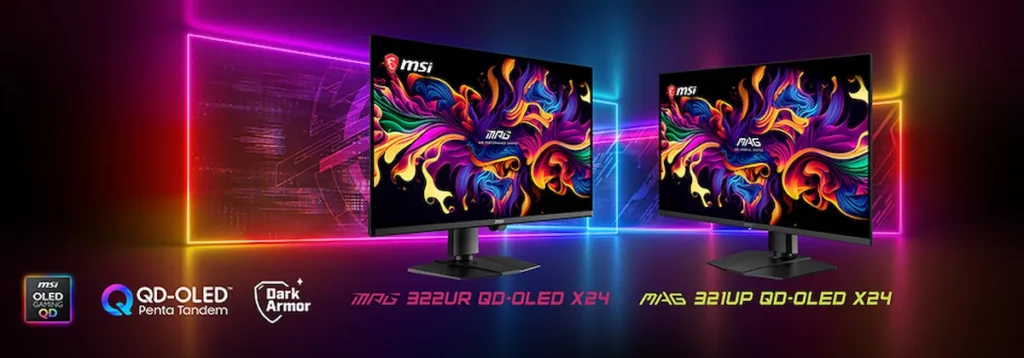
MSI is making a familiar pitch to PC gamers in 2026: OLED can now be faster, clearer, and less risky for everyday use than many buyers may assume. But this latest push is less about reinventing the category and more about targeting the exact pain points that have kept some users from fully embracing QD-OLED monitors in the first place.
At the center of MSI’s new monitor lineup is its 5th-generation tandem QD-OLED panel technology, now paired with high-refresh gaming designs including a 34-inch ultrawide 360Hz model. The company is also highlighting a new RGB stripe subpixel layout for sharper text, a DarkArmor Film layer designed to reduce the purple or reddish tint sometimes seen on earlier QD-OLED panels under ambient light, and a broader OLED care stack aimed at improving long-term durability.
A More Practical OLED Story
For the last few years, OLED monitors have been easy to admire on a spec sheet. They offer near-instant pixel response, deep blacks, and standout HDR contrast. The challenge has been everything around that core experience. Many buyers still worry about burn-in, text rendering in desktop workloads, and how well QD-OLED holds up in bright or mixed-use environments.
MSI’s latest approach suggests the next phase of OLED adoption will not be driven by color or contrast alone. Instead, it may depend on whether these displays can function as reliable, all-day primary monitors—not just high-end gaming panels.
What MSI’s Tandem OLED Design Actually Changes
MSI says its new panels use a 5-layer tandem OLED design with EL Gen 3 technology. In simple terms, tandem OLED spreads the lighting workload across multiple emission layers rather than relying on a single layer to do all the work. The goal is improved efficiency, higher sustained brightness, and reduced material stress over time.
That matters because burn-in is tied to uneven wear. Static elements like taskbars, browser chrome, and HUDs are exactly the kind of content that have historically raised concerns for productivity users. By distributing that load, tandem OLED is designed to reduce the rate at which visible wear develops.
This does not eliminate burn-in as a category concern. But it does shift the conversation toward implementation quality—how well manufacturers balance hardware design, panel management, and long-term support.
Why the RGB Stripe Layout Matters More Than It Sounds
One of the more meaningful changes here is the move to an RGB stripe subpixel layout. Earlier QD-OLED panels often used non-standard layouts that could introduce subtle text fringing or softness in desktop applications.
MSI is now emphasizing improved “crystal text” clarity, which is more important than it may sound. Many high-end gaming monitors are now used as primary displays for work, not just gaming. If text rendering improves in a noticeable way at typical viewing distances, this change could remove one of the last major friction points for OLED in productivity environments.
For the first time, OLED monitor buyers may be evaluating these panels less on compromise and more on preference.
DarkArmor Film and the Bright-Room Problem
Another key part of MSI’s pitch is its DarkArmor Film layer. While QD-OLED has delivered excellent image quality in controlled lighting, earlier panels could exhibit a purple or reddish cast under ambient light, particularly in darker scenes.
MSI says DarkArmor Film is designed to improve light absorption, reduce internal reflections, and maintain deeper black levels in brighter environments. If effective, this would address a usability gap that has limited OLED’s appeal in offices, bedrooms, and mixed-use setups.
In other words, this is not just about improving peak image quality—it is about making that quality more consistent in real-world conditions.
360Hz Means OLED Is No Longer Just Catching Up
Performance is still part of the story. MSI’s 34-inch MPG 341CQR QD-OLED X36 pairs this panel generation with a 360Hz refresh rate and 0.03ms response time, while a separate 27-inch model pushes as high as 500Hz at 1440p.
That does not automatically make OLED the default choice for every competitive player, but it significantly narrows the gap with traditional esports-focused LCD panels. Buyers no longer have to assume that choosing OLED means giving up high-end refresh rate performance.
The result is a category that is increasingly competitive across both image quality and speed.
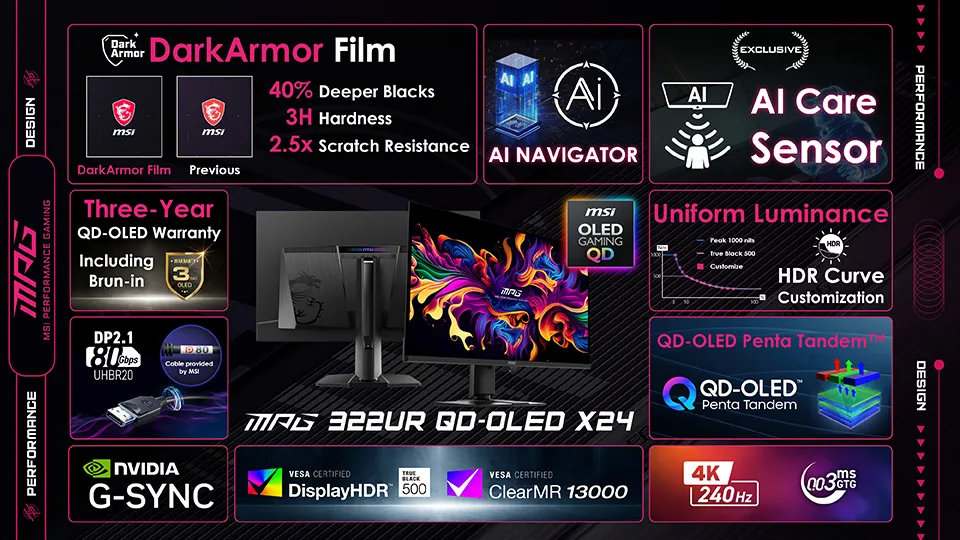
Image credit: MSI
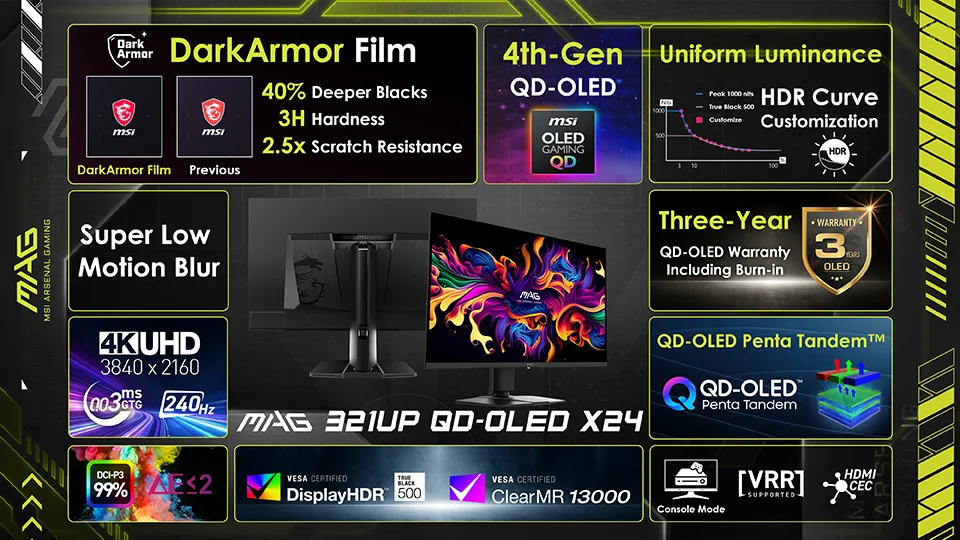
Image credit: MSI
The Bigger Shift: OLED vs. Price, Not OLED vs. Practicality
That may be the most important takeaway. OLED monitor decisions were once framed around tradeoffs: exceptional contrast, but questionable durability; smooth motion, but weaker text clarity; premium visuals, but limited flexibility in bright environments.
MSI’s latest panel push suggests those objections are becoming harder to apply across the board. IPS and Mini-LED still hold advantages in cost, peak brightness, and long-term familiarity. But as usability improves, the decision may increasingly come down to price tiers rather than fundamental compromises.
For many buyers, that represents a meaningful shift in how OLED fits into the market.
What Buyers Should Watch Next
The key question now is whether these improvements hold up over time. MSI is clearly moving toward a more mature OLED implementation with tandem panel design, improved subpixel layouts, and refined surface treatments. But long-term ownership experience will ultimately determine how meaningful these changes are.
Buyers should pay close attention to real-world testing, warranty support, and how aggressively panel protection features operate during everyday use. Those details will define whether this generation represents a turning point or simply another incremental step.
Still, MSI’s 5th-generation QD-OLED push points in a clear direction. If these improvements prove consistent outside of demos and specifications, OLED may be moving from a premium enthusiast option to a more practical high-end default for both gaming and productivity.
The push toward next-generation displays and AI-focused hardware is happening across the entire PC ecosystem—not just in monitors. If you’re tracking where high-end computing is heading next, these recent InsightTechDaily features provide useful context: