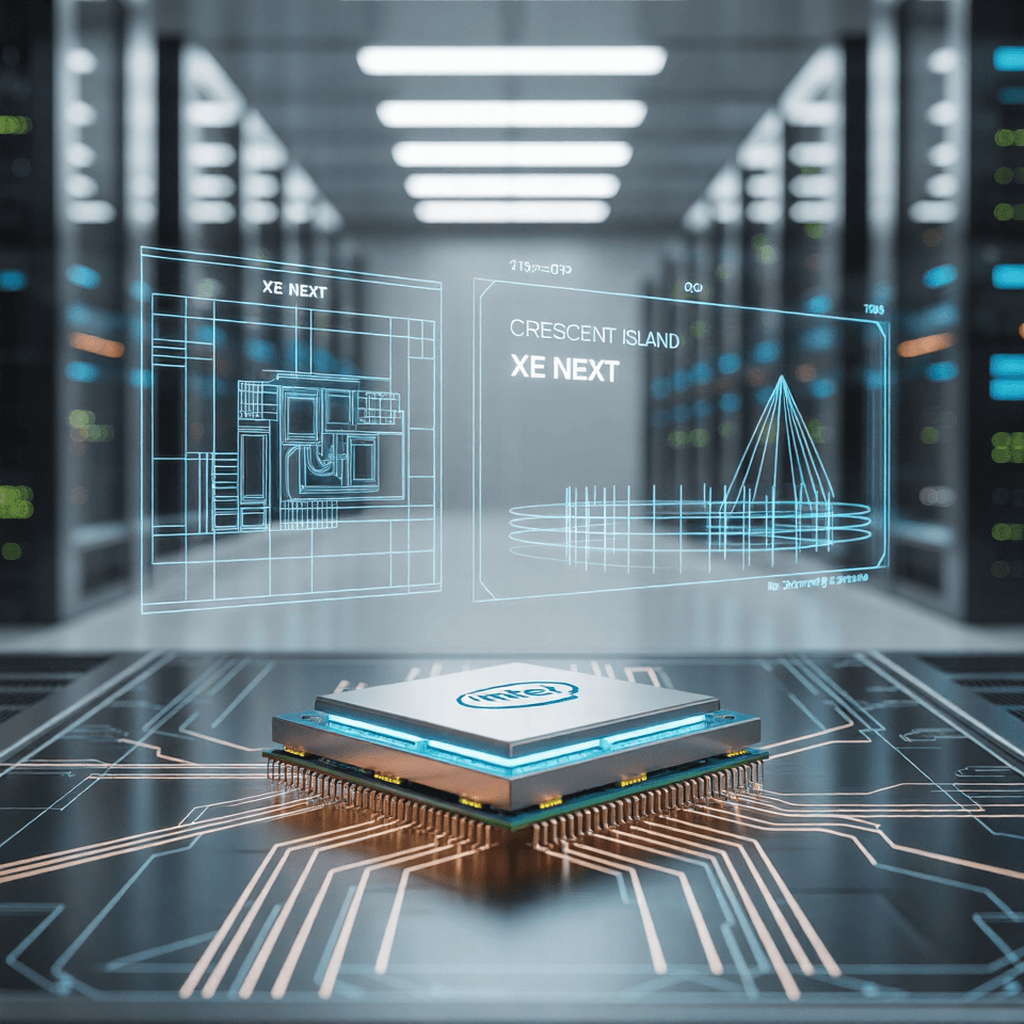
Intel is officially doubling down on graphics and AI. Following a period of uncertainty surrounding its Battlemage and Celestial GPU roadmaps, CEO Lip-Bu Tan confirmed at the Cisco AI Summit that the company has recruited industry veteran Eric Demers as its new Chief GPU Architect.
Demers, known for his leadership roles at both AMD and Qualcomm, now faces one of the most consequential challenges in modern semiconductor design: helping Intel transition from traditional graphics toward AI-centric compute infrastructure capable of competing with NVIDIA.
Confirmed: New Leadership and the “Xe Next” Direction
The appointment of Demers — who previously led development of Qualcomm’s Adreno GPU architecture — signals Intel’s shift toward energy-efficient, high-density AI compute. Working alongside Kevork Kechichian, head of Intel’s data center processor division, Demers will help guide development of Intel’s next generation GPU strategy built around the evolving Xe architecture.
At the center of that roadmap is a new family of AI-focused GPUs designed primarily for inference, training, and hyperscale deployment rather than traditional gaming workloads.
Key Technical Pillars of Intel’s New GPU Strategy
- Crescent Island: An Xe3P-based GPU optimized specifically for AI inference workloads, reportedly featuring up to 160GB of LPDDR5X memory and designed for high-density deployment.
- Jaguar Shores: Intel’s upcoming flagship platform for AI training and high-performance computing (HPC), with design reportedly finalizing by mid-2026.
- Xe Next: The official successor to Xe3P. Intel has committed to an annual architectural cadence to better align with NVIDIA’s rapid release cycles in the AI accelerator market.
This marks a notable shift from Intel’s previous GPU efforts, which struggled to balance gaming, professional visualization, and data-center workloads simultaneously. For enthusiasts tracking Intel’s consumer roadmap, that uncertainty was especially visible during the Arc Battlemage B770 developments, where questions about high-end gaming ambitions surfaced.
Why This Matters for the Entire PC Ecosystem
For readers and builders, this development is about far more than enterprise servers. The rapid rise of AI infrastructure has created what many are calling an “AI tax” across the entire hardware market, driving up prices for GPUs, memory, and advanced packaging.
Breaking NVIDIA’s AI Stronghold
NVIDIA currently controls an estimated 90%+ share of the AI accelerator market. Intel’s renewed “customer-first” approach aims to provide hyperscalers such as Microsoft, Meta, and Google with credible alternatives. Any successful competition could help ease supply constraints and stabilize pricing across the broader silicon ecosystem.
Foundry + Architecture: Intel’s Vertical Integration Play
Unlike previous GPU efforts, Intel’s upcoming AI-focused GPUs are expected to leverage the company’s internal 18A process node. By controlling both chip design and manufacturing, Intel hopes to achieve tighter vertical integration than rivals reliant on external foundries like TSMC.
If executed successfully, this could give Intel an advantage in power efficiency, packaging innovation, and long-term supply stability.
The Consumer “Trickle-Down” Effect
While the immediate focus is clearly the data center, the technologies developed under the Xe Next umbrella will likely influence future consumer products. Integrated graphics in upcoming Core Ultra processors — including platforms like Panther Lake — are expected to inherit architectural improvements driven by enterprise AI development.
That places Intel in direct competition not only with NVIDIA in AI accelerators, but also with AMD’s next-generation mobile silicon such as Strix Halo versus Panther Lake APUs, where GPU capability is becoming central to laptop performance and AI workloads.
In simple terms: success in AI infrastructure helps fund and sustain Intel’s consumer graphics ambitions — including the long-term viability of Arc GPUs.
The Skeptic’s Corner: What Remains Unclear
Despite the renewed momentum, Intel still faces significant hurdles. The company has yet to provide a concrete timeline for a next-generation discrete gaming GPU beyond its integrated Panther Lake and Nova Lake graphics roadmaps.
The reported cancellation of the high-end Battlemage B770 gaming card remains a sore point for enthusiasts, reinforcing concerns that Intel may prioritize AI and data center profitability over consumer gaming GPUs.
Perhaps the biggest unknown, however, is software.
Editorial Perspective
Eric Demers brings a strong architectural pedigree, but hardware alone will not determine success. NVIDIA’s dominance is built as much on CUDA, developer tools, and ecosystem lock-in as it is on silicon performance.
If Intel wants to truly challenge NVIDIA in AI, it must deliver not only competitive hardware but also a software platform capable of attracting developers, researchers, and enterprise customers at scale.
The hiring of Demers is a meaningful step — but the real test will be execution over the next two years.