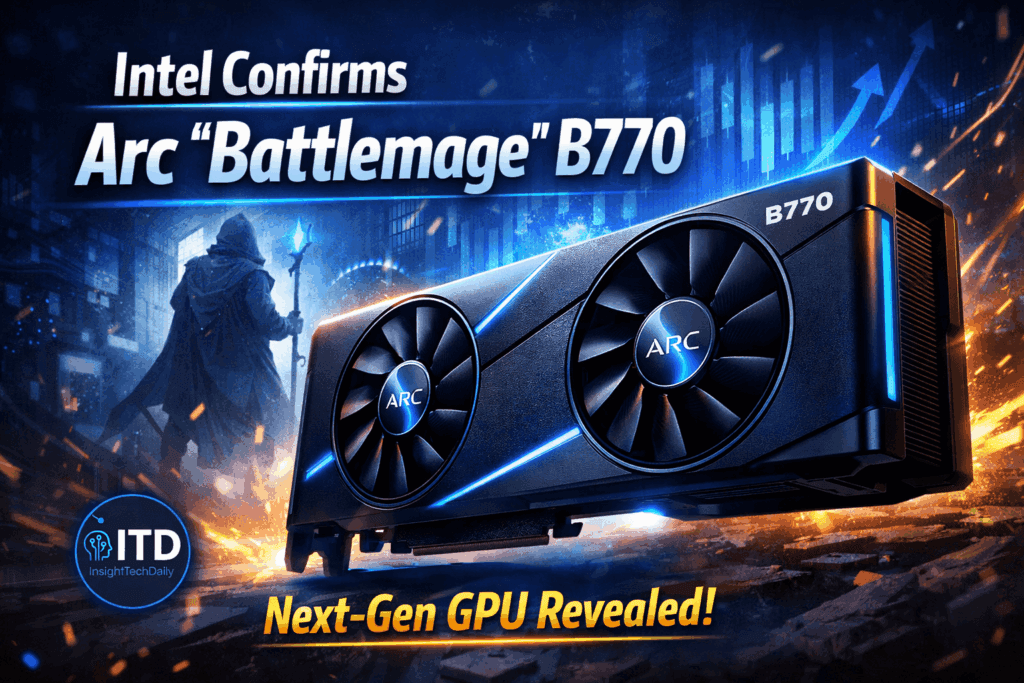
Intel Confirms Arc ‘Battlemage’ B770 as Discrete GPU Market Share Hits Milestone
By InsightTechDaily Staff — December 30, 2025

Summary: Intel has confirmed Arc “Battlemage” B770, and it comes as Intel points to a milestone in discrete GPU market share. For PC builders, that combination matters: new hardware plus growing adoption can translate into stronger competition, better value, and faster iteration—if drivers and availability keep pace.
Key takeaways
- Intel’s Battlemage B770 confirmation signals continued commitment to discrete GPUs—not a one-off experiment.
- Rising market share suggests improving consumer and OEM confidence in Arc as a third option.
- Expectations center on better efficiency, stronger ray tracing, and more mature drivers and game support.
Introduction: Why This Announcement Matters
Intel confirming Arc “Battlemage” B770 carries more weight than a routine product mention. The discrete GPU market has been dominated for years, and sustained competition typically benefits buyers through improved price-to-performance, stronger feature parity, and faster product cycles.
Just as important: Intel tying the announcement to a discrete GPU market share milestone hints that Arc adoption is trending in the right direction—especially in prebuilts and OEM systems where market share is often earned (or lost) at scale.
Overview of Intel’s Arc Graphics Journey
From Integrated Graphics to Discrete GPUs
Intel has shipped integrated graphics for decades, but discrete GPUs are a different challenge. Success requires not only solid hardware, but also sustained driver work, game-by-game optimization, and long-term platform support—areas where new entrants get tested quickly.
Lessons Learned from Arc Alchemist
The first Arc generation (“Alchemist”) showed real potential, but early driver issues and uneven performance across older APIs slowed adoption. Over time, repeated driver updates and better transparency improved the outlook—setting the stage for a second-generation push with Battlemage.
What Is Arc ‘Battlemage’ B770?
Architecture and Codename Explained
“Battlemage” is Intel’s codename for its next major Arc architecture. The B770 is widely expected to land in the upper-midrange zone—typically the sweet spot for high-volume gaming PCs—where value and efficiency matter as much as peak performance.
Expected Performance Improvements
While Intel hasn’t publicly detailed full specs in this draft, the expectations are clear: meaningful gains in real-world gaming consistency, improved performance-per-watt, and fewer “it depends on the game” outcomes compared to early Arc days.
Ray Tracing and AI Upscaling Advances
Modern GPU buyers increasingly judge cards by ray tracing and upscaling quality. Battlemage is expected to refine hardware ray tracing and continue improving XeSS (Intel’s AI upscaling), which can be a make-or-break feature for smooth 1440p gaming without cranking power draw.
Power Efficiency and Manufacturing Node
Efficiency is where Intel can win mindshare fast—especially for OEMs. Better performance-per-watt means quieter systems, simpler cooling, and more flexibility for compact desktops and laptops. If Battlemage delivers here, adoption could accelerate quickly in prebuilts.
Discrete GPU Market Share Milestone Explained
Intel’s Growing Presence in the GPU Market
Hitting a market share milestone—especially as a newer discrete GPU player—typically reflects multiple wins happening at once: more systems shipping with Arc, fewer returns/headaches for builders, and a buyer base that feels comfortable choosing Arc over the usual defaults.
Market Impact on Nvidia and AMD
A stronger third competitor usually applies pressure where consumers feel it most: pricing, bundle value, and feature pace. Even if Nvidia and AMD remain dominant, Intel’s traction can influence the “midrange value” segment that moves the most units.
Competitive Positioning of Battlemage B770
Target Audience: Gamers, Creators, and OEMs
If B770 lands where many expect, it’s positioned for:
- Mainstream gamers targeting smooth 1440p performance
- Creators who benefit from modern media engines and GPU acceleration
- OEMs seeking supply-chain flexibility and alternative GPU configs
Pricing Strategy and Value Proposition
Pricing will decide how disruptive Battlemage feels. A compelling price paired with stable drivers and strong day-one game performance could make B770 one of the most interesting “value tier” launches in its class.
Software, Drivers, and Ecosystem Improvements
XeSS and AI-Driven Features
Intel’s software story is inseparable from Arc’s success. Driver maturity, faster game profiles, and smoother performance across common APIs can determine whether a GPU is recommended—or avoided—by enthusiasts. XeSS is a key pillar here, especially as more games rely on upscaling for high settings at practical power limits.
For broader context on GPU architectures and platform competition, you can follow deep-dive coverage from established PC hardware outlets like AnandTech:
AnandTech.

Industry Reactions and Analyst Perspectives
Industry watchers tend to interpret Intel’s confirmation as a signal of long-term intent. The bigger story isn’t a single model—it’s whether Intel can sustain a predictable release cadence, keep driver momentum, and expand OEM adoption without major setbacks.
Future Outlook for Intel Arc GPUs
If Battlemage B770 delivers on consistency and efficiency, Intel’s path becomes clearer: expand market share in the midrange, then push higher over future generations. For buyers, that usually means more choice—and less “one-size-fits-all” pricing from the incumbents.
FAQs
1) What is the Arc ‘Battlemage’ B770?
It’s Intel’s confirmed next-generation Arc discrete GPU model, expected to target mainstream-to-upper-midrange performance tiers.
2) Why is the market share milestone important?
Market share growth usually indicates rising OEM adoption and improving buyer trust—two factors that can accelerate competition and improve value across the GPU market.
3) Will Battlemage B770 support ray tracing?
Battlemage is expected to continue Intel’s ray tracing support and improve performance and efficiency versus earlier Arc generations.
4) How does XeSS compare to other upscaling technologies?
XeSS is Intel’s AI upscaling approach designed to boost frame rates while preserving image quality. Support and results vary by game implementation, but it’s a major part of Intel’s competitive toolkit.
5) Who should consider buying Battlemage B770?
Gamers and creators who want strong value in the midrange—especially if pricing is competitive and driver support remains solid at launch.
6) When will Battlemage B770 be available?
Intel has confirmed the product direction in this draft, but exact launch timing and final specs are expected to be clarified closer to release.
Conclusion: What This Means for the GPU Industry
Intel’s confirmation of Arc “Battlemage” B770 alongside a discrete GPU market share milestone points to a bigger trend: Arc is no longer just “new”—it’s becoming established. If Battlemage pairs stronger performance with mature drivers and competitive pricing, the midrange GPU landscape could get more competitive in a way that actually benefits real buyers.
Disclosure: InsightTechDaily may earn commissions from qualifying purchases via affiliate links on other pages. This news article is not a product review.