For years, the AI hardware conversation has been a monologue. From CUDA acceleration to massive enterprise NVIDIA H100 clusters, one company became the center of gravity for both cloud AI and local LLM experimentation.
But the arrival of ZAYA1-8B—an open reasoning model reportedly trained on AMD Instinct MI300 hardware—points toward something larger than a single model release. It represents a significant sign that the AI ecosystem is finally expanding beyond a one-company landscape.
The future of local AI may no longer depend solely on who has the fastest GPU. Increasingly, it depends on who can build complete ecosystems around training infrastructure, inference optimization, and open accessibility. ZAYA1-8B lands directly in the middle of that transition.
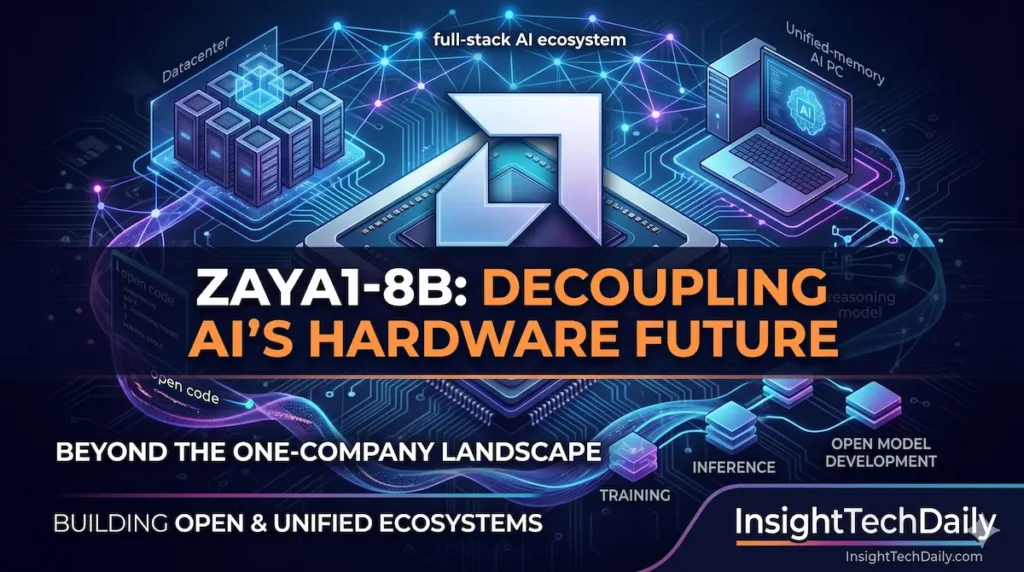
The important story here may not just be ZAYA1-8B itself. It is the growing evidence that AMD is successfully building a full-stack AI ecosystem spanning datacenter accelerators, unified-memory AI PCs, and open model development. The “NVIDIA-only” era of AI development is facing its first serious challenge.
What Is ZAYA1-8B? (The Efficiency Play)
ZAYA1-8B is an open reasoning model designed to deliver high-performance logic while maintaining efficient hardware requirements. Unlike traditional dense models, ZAYA1-8B utilizes a Mixture-of-Experts (MoE) architecture, allowing it to punch far above its weight class.
According to technical specifications, the model emphasizes:
- Efficient Reasoning: High-density intelligence with lower compute overhead.
- Compressed Convolutional Attention (CCA): Reducing the VRAM footprint during inference.
- Open Accessibility: A transparent weights model for the developer community.
- Hardware Flexibility: Optimized for the AMD ROCm software stack.
That efficiency angle is critical because AI scalability is becoming heavily constrained by power consumption, VRAM limitations, and the rising costs of cloud tokens. In the new local AI economy, “bigger” is no longer automatically “better.”
Why AMD Training Hardware Matters
The AI industry has spent years optimized for CUDA. This created a self-reinforcing loop where software, frameworks, and startups naturally targeted NVIDIA first. However, AMD’s Instinct MI300 accelerators are now appearing in “frontier-class” training conversations.
This shift matters because ecosystem momentum typically begins at the datacenter level before filtering down to consumer hardware. If major open models are increasingly trained on AMD infrastructure:
- ROCm support will improve at an accelerated pace.
- Inference frameworks will offer day-one optimization for AMD GPUs.
- Consumer AI hardware becomes more practical for non-gaming workloads.
By training on the MI300X, developers are proving that AMD’s 192GB VRAM capacity allows for the training of massive models without the complex “tensor sharding” required on memory-constrained hardware. This makes AMD a highly attractive target for the next generation of open-source research.
The Bigger Story: Memory Over Raw Power
The rise of local AI is fundamentally changing how we think about PC hardware. Historically, gaming performance (rasterization) dominated buying decisions. But AI workloads shift the priority toward memory capacity and bandwidth.
Systems with large unified memory pools are becoming the “Gold Standard” for local AI users who want to run 70B+ models without expensive multi-GPU setups. This is a trend InsightTechDaily has tracked closely:
The local AI market is beginning to resemble workstation computing more than traditional gaming. We are seeing this trend across the board, including Intel’s recent moves into high-memory AI GPUs.
The future AI PC will likely look very different from a traditional gaming rig. Local inference rewards memory-heavy architectures and power efficiency over pure clock speed. AMD’s “AI Max” platform is the first glimpse at this new hardware category.
Can AMD Actually Challenge the Dominance?
NVIDIA still maintains a massive lead in developer familiarity and enterprise deployment. However, the market may no longer require AMD to “beat” NVIDIA in every category to become highly relevant. If AMD can establish itself as the premier ecosystem for open model development and unified-memory AI PCs, it will carve out a dominant niche in the next phase of computing.
Open models like ZAYA1-8B serve as the “bridge” that allows users to move between hardware stacks without losing performance. As AI agent systems evolve, the ability to run these models locally and cheaply will become the primary driver of hardware sales.
Final Thoughts
ZAYA1-8B represents more than just another entry in the Hugging Face rankings. It is a signal that the AI ecosystem is diversifying. AMD’s growing presence across Instinct accelerators, unified-memory systems, and open model pipelines suggests they are playing a long game focused on the future of local AI.
For enthusiasts and developers, this competition is the healthiest development in the industry since the LLM boom began.
Source Context: This analysis is based on shared material regarding the ZAYA1-8B open reasoning model, the first frontier-scale foundation model trained end-to-end on the AMD Instinct MI300X platform.