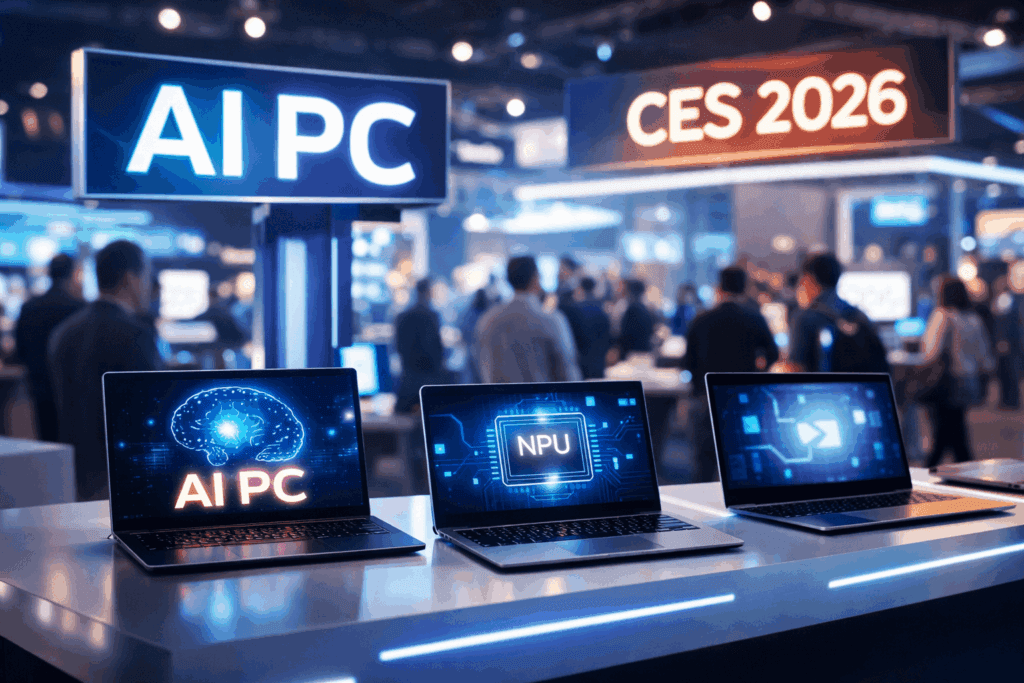

At CES 2026, artificial intelligence was everywhere — and yet, for many attendees, it barely registered as something new. Nearly every major PC manufacturer arrived in Las Vegas with some variation of an “AI PC,” typically defined by the inclusion of a neural processing unit (NPU) or other on-device AI acceleration hardware. The message from OEMs was clear: AI-ready personal computers are no longer a future concept, but the default configuration.
What was less clear was how much that message resonated with consumers.
Despite packed keynote schedules and polished demos, AI PCs did not generate the kind of breakout enthusiasm that once accompanied ultrabooks, 2-in-1s, or even early ARM-based Windows devices. Conversations across the show floor and early post-event reactions pointed to a similar theme: curiosity, but not urgency.
That disconnect raises a central question for the PC industry in 2026: Is the muted response a sign of AI saturation and branding fatigue — or does it reflect a deeper usability gap between what AI-enabled hardware can do and what everyday users actually experience?
The answer matters, not just for marketing strategies, but for the future shape of consumer computing.
The Rise of the “AI PC” as a Baseline Category
By the time CES 2026 opened its doors, AI PCs were no longer positioned as premium experiments. They were mainstream.
Systems powered by Intel, AMD, and Qualcomm all featured dedicated AI silicon alongside CPUs and GPUs. In many cases, NPUs were framed as essential for efficiency, battery life, and privacy — not optional accelerators.
From a hardware roadmap perspective, this shift was expected. Chipmakers have spent several years integrating AI acceleration directly into client processors, arguing that local inference reduces reliance on cloud services and enables real-time responsiveness. By 2026, those components were mature enough to ship at scale.
What surprised some observers wasn’t the presence of AI hardware — it was how little it changed the buying conversation.
For consumers comparing laptops in the $800–$1,500 range, “AI” often blended into the background alongside familiar factors: battery life, display quality, weight, and price. AI capability was there, but rarely the deciding factor.
AI Saturation and Messaging Fatigue
One explanation for the lukewarm reception is simple overexposure.
Over the past several years, “AI” has become an umbrella term applied to everything from photo filters to customer support chatbots. By CES 2026, the phrase “AI inside” carried far less explanatory power than it once did.
When Everything Is AI, Nothing Feels New
PC vendors face a messaging challenge similar to past technology cycles. During the early days of “multimedia PCs” or “4K-ready” devices, branding initially helped consumers understand new capabilities. Over time, those labels lost impact as features became standard.
AI PCs may be hitting that phase faster.
Many consumers struggle to articulate what differentiates an AI PC from a non-AI PC in practical terms. Is it faster? Smarter? More secure? The answers are often abstract, conditional, or dependent on specific software support. Without a clear everyday benefit, AI branding risks becoming background noise rather than a value signal.
Parallels to Past Hardware Hype Cycles
Industry veterans quietly draw comparisons to other moments where hardware advanced faster than consumer understanding:
- Early 3D TVs, which promised immersion but lacked content
- First-generation VR headsets, impressive but niche
- Touch-enabled Windows laptops before touch-first software matured
In each case, the technology itself was real — but the use cases lagged. AI PCs may be experiencing a similar transitional phase.
The Consumer Usability Gap
If saturation explains part of the reaction, usability explains the rest.
Most AI features consumers interact with daily — generative text, image creation, voice assistants — remain largely cloud-based and device-agnostic. Whether a user owns a high-end AI PC or a five-year-old laptop, many of these services behave similarly because the heavy lifting happens elsewhere.
NPUs Exist — But Their Benefits Are Often Invisible
From a technical standpoint, NPUs excel at specific tasks: image recognition, language processing, background noise removal, and real-time translation. Yet in day-to-day workflows, those advantages are often subtle or hidden.
For example:
- Video conferencing apps may use NPUs for background blur, but the user simply sees a toggle
- Photo apps may auto-enhance images without indicating where processing occurs
- System-level AI optimizations happen silently in the background
To consumers, the experience feels incremental rather than transformative. If users can’t clearly see, control, or understand the benefit of on-device AI, it becomes difficult to value.
Awareness Lags Capability
Another factor is education. Many buyers are unaware which tasks benefit from on-device AI versus cloud AI — or why that distinction matters for privacy, latency, or offline use.
At CES 2026, demos often highlighted edge cases: real-time translation without internet, local inference, or adaptive power management. These scenarios can be technically impressive, but they aren’t yet part of most consumers’ daily routines.

Software Lag Versus Hardware Readiness
The tension between hardware readiness and software adoption was a recurring undercurrent at CES.
Hardware Is Ready — Software Is Catching Up
From silicon vendors’ perspective, the infrastructure problem is largely solved. NPUs are efficient, increasingly standardized, and accessible through modern development frameworks. The bottleneck is software integration.
Many mainstream apps are still adapting to meaningful NPU usage. Developers must decide whether to invest in local inference paths, redesign workflows, or keep leaning on cloud-based models that scale more easily. For many, the business case still isn’t obvious.
CES Demos vs. Real-World Usage
Trade show demos tend to showcase ideal conditions: optimized software, curated workflows, and controlled environments. In contrast, real-world usage involves legacy apps, inconsistent updates, and diverse user behavior.
This gap reinforces consumer skepticism. If AI PCs shine primarily in demos but don’t reliably improve everyday tasks, adoption naturally slows.
Signs the Industry Knows There’s a Problem
CES 2026 didn’t feel like an industry in denial. If anything, the tone from many vendors suggested they know “AI” can’t remain a label — it has to become an experience.
That theme has shown up in other CES-era shifts as well, including brand consolidation and simpler product messaging. (For a related example of how OEMs are trying to streamline consumer-facing identities, see our coverage of HP’s gaming brand changes: HP consolidating OMEN gaming hardware under HyperX.)
OS-Level Integration May Be the Real Turning Point
Many analysts believe the inflection point for AI PCs will come not from new chips, but from operating system behavior.
When AI becomes a first-class system feature — helping manage files, summarize activity, and assist across applications — its value becomes tangible. Crucially, it also becomes consistent. Consumers are more likely to trust AI that feels native, predictable, and helpful, not experimental or fragmented.
What Would Make AI PCs “Click” for Consumers?
Based on CES 2026 discussions, several themes emerged around what could shift perception.
Fewer Features, Clearer Value
Rather than dozens of AI checkboxes, consumers may respond better to a small number of reliable, easy-to-explain benefits:
- Noticeably longer battery life from smarter power management
- Faster, better local search across files and emails
- Private, offline assistance for routine tasks
Clarity matters more than breadth.
Everyday Applications, Not Showcase Scenarios
The AI PC moment likely won’t arrive through headline demos. It will come when mundane tasks feel easier, faster, or less frustrating — consistently. That kind of progress is less visible at trade shows, but more meaningful over time.
Transitional Moment, Not a Verdict
It would be a mistake to frame CES 2026 as a failure for AI PCs. The category is still forming, and the hardware foundation is largely in place.
What CES revealed instead was a pause — a moment where industry ambition briefly outpaced consumer understanding.
If AI remains a label rather than an experience, fatigue may deepen. If it becomes quietly indispensable, adoption will follow.
For now, CES 2026 stands as a reminder that in consumer technology, capability alone is never enough. Meaning is what ultimately drives demand.
Why This Matters to Everyday Buyers
For consumers, the takeaway isn’t to avoid AI PCs — it’s to approach them with informed expectations.
The hardware you buy in 2026 is likely more capable than the software you use today. That gap may narrow quickly, or gradually. Understanding that dynamic helps buyers make calmer, more practical decisions.
AI PCs are not a punchline, nor a revolution — at least not yet. They are infrastructure waiting for its moment.