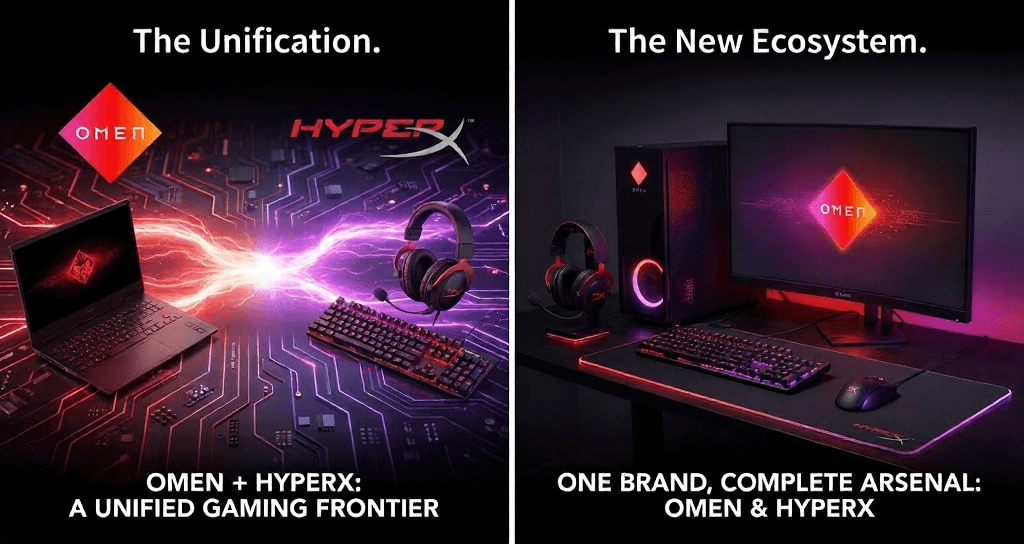

HP is moving to consolidate its consumer gaming hardware identity, folding the long-running OMEN brand more tightly under its HyperX umbrella. Going forward, gaming systems and accessories previously marketed simply as OMEN may increasingly appear as HyperX OMEN, aligning HP’s PC hardware and gaming peripheral messaging under a single banner.
This shift does not indicate an exit from gaming hardware. Instead, it changes the story HP tells in a market where gaming brands increasingly compete on ecosystems—software, peripherals, and post-purchase experience—rather than raw performance alone.
Why this matters: HyperX has long been a peripheral-first brand with strong esports credibility. Pulling OMEN closer under that name raises a bigger question: is HyperX being positioned as a full-stack gaming ecosystem brand that can stand next to ASUS ROG, Alienware, Corsair, and others—or does it remain primarily a peripherals identity with a PC label attached?
What HP Has Confirmed So Far
HP has confirmed that its gaming hardware portfolio will be consolidated under the HyperX umbrella, with OMEN transitioning from an independent brand to a sub-brand designation. In practical terms:
- OMEN-branded gaming PCs and laptops will be marketed as HyperX OMEN
- HyperX remains the primary outward-facing gaming brand for HP
- Existing OMEN products are not being discontinued
- HP will continue producing gaming desktops, laptops, displays, and accessories
HP has not announced immediate product discontinuations, nor has it indicated that current OMEN owners will lose driver or software support. This appears to be a branding and portfolio realignment rather than a product sunset.
What remains unclear
- A firm timeline for fully retiring standalone OMEN naming
- Whether future flagship systems will drop “OMEN” entirely in favor of pure HyperX branding
- Whether HP plans a full software merger (OMEN Gaming Hub + HyperX NGENUITY)
That ambiguity matters because it shapes how buyers interpret OMEN’s long-term identity—and how retailers and partners market HP’s gaming lineup over time.
A Brief History: OMEN vs. HyperX Inside HP
OMEN launched in 2014 as HP’s answer to the growing enthusiast gaming market. At the time, major OEM gaming credibility was still uneven, and OMEN was positioned as a distinct voice—separate from HP’s enterprise identity.
- Aggressive industrial design
- Focus on thermals and performance
- Dedicated gaming software (OMEN Command Center, later OMEN Gaming Hub)
- A brand voice aimed at gamers first
HyperX entered HP’s orbit differently. Originally an independent Kingston Technology brand, HyperX built credibility in memory and later became widely recognized for headsets, keyboards, and mice—particularly in competitive gaming and esports communities. After HP acquired HyperX in 2021, it inherited a brand with strong peripheral loyalty and broad retail presence.
With two gaming identities operating in parallel—OMEN for systems and HyperX for peripherals—this consolidation suggests HP wants a single center of gravity for its gaming portfolio.
Where HyperX Now Sits in the Gaming Brand Hierarchy
Brand consolidation only matters if it changes how products compete. The key lens here is not whether HP “made the right move,” but where HyperX lands relative to other gaming ecosystems.
HyperX vs. ASUS ROG: ecosystem depth vs. esports peripherals
ASUS ROG operates like a full-stack gaming platform: motherboards, GPUs, laptops, monitors, routers, peripherals, and a deeply integrated software layer. HyperX, historically, has been strongest on peripherals and esports credibility—not core PC components.
What changes with “HyperX OMEN”: HP may be attempting to pull system hardware closer to HyperX’s identity, narrowing the perception gap with ecosystem-first competitors. Whether that gap truly narrows depends less on naming and more on software cohesion and the post-purchase experience.
HyperX vs. Corsair and Razer: identity + software lock-in
Corsair leans “builder ecosystem” (components + peripherals + cases), while Razer leans lifestyle identity + unified software. HyperX’s historic positioning has been cleaner and performance-oriented—less about maximalist aesthetics, more about competitive credibility.
If HP uses HyperX as the umbrella for both peripherals and systems, HyperX could evolve from a best-in-class peripherals label into a broader identity—but only if it becomes easier to manage lighting, updates, profiles, and performance tuning across devices.
HyperX vs. Alienware, Legion, and Predator: the “system-first” test
Brands like Alienware, Lenovo Legion, and Acer Predator are system-first identities: PCs and laptops form the core, with peripherals supporting the platform story. HyperX starts from the opposite direction: peripherals first, systems second (via OMEN).
The market question: does “HyperX OMEN” make the systems feel like a natural extension of HyperX—or does it feel like a badge applied to hardware that customers still think of as OMEN?
What This Could Mean for Software and Driver Support
Brand consolidation is often a preview of where software is headed. HP currently maintains overlapping experiences:
- OMEN Gaming Hub for system tuning, lighting, and performance profiles
- HyperX NGENUITY for peripheral configuration
Maintaining two parallel gaming software platforms creates friction for users who own both OMEN systems and HyperX accessories. A “HyperX OMEN” umbrella could point toward tighter integration over time, such as:
- Shared lighting and RGB profiles
- Unified driver/firmware update pipelines
- Single account management
- Cross-device performance and macro/profile syncing
HP has not confirmed a full software merger. Still, if HyperX is being positioned as the umbrella identity, the pressure to reduce software fragmentation will likely increase—because that’s where ecosystems are won or lost.
What This Means for Existing OMEN Owners
Confirmed: no immediate loss of support
HP has not announced end-of-life plans for OMEN-branded systems. Existing devices should continue receiving:
- BIOS updates
- Driver support
- Warranty service
- Software maintenance
Likely (but not confirmed): gradual software transition
Based on how similar consolidations typically unfold across the industry, a more gradual transition is plausible:
- OMEN Gaming Hub remains supported in parallel for a period
- HyperX software becomes more central for cross-device experiences
- OMEN-specific branding may slowly fade inside software UI
HP has not published a formal roadmap, so the transition should be viewed as evolutionary rather than disruptive.
What This Does Not Mean
- HP is not exiting gaming PCs
- OMEN hardware is not being discontinued
- HyperX is not replacing OMEN as a hardware line overnight
- Existing OMEN warranties are not void
This is consolidation, not abandonment.
Looking Ahead: Signals That Will Show How Far This Goes
Several indicators will reveal whether “HyperX OMEN” is a naming tweak or a deeper ecosystem repositioning:
- Software announcements: any indication of merged OMEN and HyperX software platforms
- New product naming: whether future launches keep “OMEN” or move to pure HyperX
- Driver distribution: consolidation of update channels under HyperX branding
- Marketing language: shift from “OMEN by HP” toward “HyperX gaming systems”
Bottom Line
This consolidation is less about a logo swap and more about where HyperX is being placed in the competitive landscape. HyperX already has meaningful credibility in peripherals and esports. The open question is whether HP uses that credibility to build a more unified, ecosystem-first experience across PCs, accessories, and software—bringing it closer to the way ASUS ROG, Corsair, and other gaming platforms compete today.
For now, OMEN appears to be continuing—just as a name that increasingly lives under the HyperX umbrella.
Related CES 2026 analysis: Rising component costs are pushing premium laptop prices higher across the industry — a trend that helps explain why vendors are tightening and consolidating their product portfolios. Read more.