Microsoft’s new Surface Laptop Ultra is not just another premium laptop refresh. It represents the most serious attempt yet to turn Windows on Arm, NVIDIA graphics, unified memory, and local AI development into one flagship mobile workstation.
For years, Windows on Arm has felt like a promise waiting for the right hardware partner. Qualcomm helped prove that thin, efficient Windows laptops could last longer and run cooler, but the platform still struggled to shake the perception that it was mainly a battery-life story. NVIDIA’s newly revealed RTX Spark Superchip changes that conversation in a major way, and Microsoft’s Surface Laptop Ultra is the clearest sign yet that Windows on Arm is moving from lightweight productivity into high-performance AI computing.
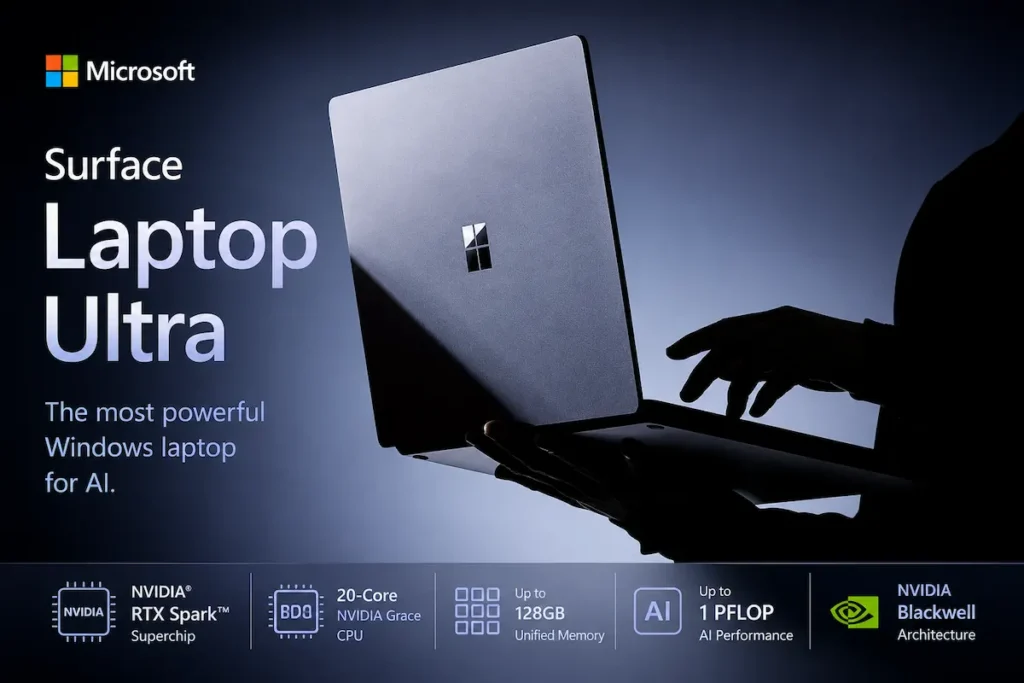
The Surface Laptop Ultra pairs Microsoft’s premium Surface design language with NVIDIA’s new RTX Spark platform, a custom Arm-based system built around a 20-core NVIDIA Grace CPU, a Blackwell RTX GPU with up to 6,144 CUDA cores, and up to 128GB of unified memory. NVIDIA is positioning RTX Spark as a new class of Windows PC hardware for local AI agents, creators, developers, and gamers. Microsoft, meanwhile, is using the system to make a much bigger statement: the Windows PC can now compete directly with Apple’s high-end unified-memory laptops in the local AI era.
That comparison matters because Apple has spent years owning the “big memory in a laptop” narrative. MacBook Pro systems became popular with developers not only because of build quality, but because Apple Silicon made massive unified memory pools feel normal. Microsoft and NVIDIA are now bringing that same architectural advantage into the Windows ecosystem, while adding something Apple cannot offer: native CUDA, RTX graphics, and the standard NVIDIA AI software stack.
Surface Laptop Ultra Is Microsoft’s Most Aggressive Surface Yet
Surface devices have traditionally balanced portability, design, and premium productivity. The Surface Laptop Ultra appears to push far beyond that comfort zone. Microsoft describes the system as less than 18mm thick and under 4.5 pounds, with a 15-inch mini-LED PixelSense Ultra touchscreen, a taller 3:2 aspect ratio, and up to 2,000 nits of peak HDR brightness. It also includes an surprisingly robust I/O array: HDMI, USB-C, USB-A, a headphone jack, and a full-size SD card reader.
That port selection alone is notable. Microsoft seems to understand that the audience for this machine is not just checking email and writing documents. Developers, video editors, 3D artists, and AI researchers still need real physical connectivity. HDMI and a full-size SD card reader are practical additions that make a workstation laptop feel like a tool instead of a fashion accessory.
The bigger story, though, is inside the chassis. RTX Spark is not a conventional laptop GPU bolted onto a standard x86 or low-power platform. As we noted in our breakdown of NVIDIA, Apple, Qualcomm, and x86 in the Next PC Fight, this is a tightly integrated architecture. NVIDIA says RTX Spark supports up to 1 petaflop of FP4 AI performance and up to 128GB of unified memory, promoting native CUDA support, TensorRT, and OptiX straight out of the gate. That gives Microsoft a flagship Windows AI workstation in a genuinely mobile frame.
Why Unified Memory Is the Real Story
The headline spec will be the 6,144-core Blackwell RTX GPU, which brings NVIDIA’s latest graphics architecture into an Arm-based Windows laptop. But the more important long-term change is the unified memory model. Recent industry shifts, like the Lenovo NVIDIA N1X ARM Laptop Leak, show that the industry is moving rapidly toward this integrated approach.
Traditional Windows laptops divide system memory and graphics memory. The CPU gets one pool of RAM, the GPU gets its own dedicated VRAM, and workloads have to continuously move data back and forth. That arrangement works well for gaming, but large AI models are different. They frequently become memory-capacity constrained long before they max out compute performance.
A 120-billion-parameter language model does not fit neatly into a conventional thin laptop memory layout. Even when quantized, large models demand significant memory capacity and bandwidth. That is why unified memory is so critical. With a large shared pool, the CPU and GPU access the same memory space flexibly, allowing developers to allocate the vast majority of available memory toward the model itself.
The Surface Laptop Ultra’s 128GB unified memory option is the key spec for local AI developers. It potentially allows the machine to run massive models locally, reduce cloud dependency, and keep sensitive data entirely on-device. For small teams, independent developers, and creators experimenting with AI tools, that structural change completely resets the economics of prototyping.
Thermals and Power: The Enterprise Silicon Reality Check
The Surface Laptop Ultra faces an obvious engineering question: can Microsoft actually cool this platform well enough inside an 18mm chassis? More importantly, can it realistically run away from a wall outlet?
Microsoft says the machine uses an all-new thermal system with up to 2.5 times the thermal capacity of the 15-inch Surface Laptop 7th Edition. Early hands-on reporting points to a thicker, more serious chassis, larger fans, and audible fan noise during sustained demo workloads. That is appropriate; a quiet workstation laptop that throttles hard is not useful to professionals.
However, the real warning shot involves power draw. While standard Windows on Arm devices built on Qualcomm silicon are celebrated for efficiency, RTX Spark transplants a 20-core CPU derived from enterprise Grace architectures alongside a high-performance Blackwell GPU. Under continuous local inference or training runs, this architecture will pull significant power. Buyers looking for the multi-day battery life of standard thin-and-light laptops will need to reset expectations. When pushing a local model hard, this machine will almost certainly require its high-wattage power brick to maintain full performance.
Sustained performance across long sessions is what matters to engineering teams and 3D artists. If Microsoft gets the internal design right, this could become the first Surface that genuinely competes in workstation territory. If it does not, the machine risks running straight into the harsh limits of mobile physics.
Windows on Arm Still Has Compatibility Questions
RTX Spark gives Windows on Arm a massive performance tier, but it does not erase platform concerns. App compatibility remains a long-running challenge. Microsoft’s Prism emulation layer has improved the experience for x86 applications, but professional buyers still need to evaluate their exact software stack.
This audience relies heavily on niche plugins, older utilities, specialized drivers, external hardware, and professional applications that may not all be native to Arm. If an enterprise security stack or legacy tool has compatibility issues, raw GPU power will not solve the problem. NVIDIA is promoting RTX Spark as a full-stack developer platform, and Adobe is working on specific optimizations, but widespread ecosystem adoption will take time.
The True Economics of Local vs. Cloud AI
The local AI argument is often presented as a technical or privacy convenience, but the real driving force is operational cost. Developers and small businesses experimenting with AI can burn through cloud credits quickly. Running continuous workloads through closed-source model APIs or renting cloud GPUs introduces recurring operating costs that scale poorly during long prototyping phases.
A local machine capable of running serious, heavily quantized open-weights models acts as a predictable, fixed-cost capital expense. It effectively caps development costs, letting a team run infinite prompts, test fine-tuning configurations, and prototype agents without checking a billing dashboard. This trend is sparking a broader industry focus on localized computing, an evolution we explored deeply in our analysis of the AMD Ryzen AI Halo Workstation and Local AI.
But the break-even math depends entirely on initial hardware pricing. While official numbers aren’t final, a premium Surface chassis packed with a 128GB unified memory Grace/Blackwell superchip will easily push this machine into the $3,500 to $5,000+ workstation tier. For a solo operator or a lean startup, that is a substantial upfront investment. The question buyers must answer is whether their projected monthly cloud compute, API tokens, and data egress fees over a two-to-three-year lifecycle outweigh the upfront cost of premium local hardware.
Gaming Is the Bonus, Not the Core Story
NVIDIA is also positioning RTX Spark as a gaming-capable platform, leveraging DLSS, Reflex, and the broader GeForce ecosystem. That matters, but it should not be the center of the narrative. The more interesting point is that NVIDIA can bring genuine gaming credibility into a workstation frame—an area where macOS still struggles with library depth and developer priority.
Still, buyers should be careful. Until independent reviews arrive, gaming performance claims should be treated as promising rather than proven. Emulation, drivers, thermals, and game-level compatibility will all matter. The Surface Laptop Ultra may be powerful, but it is not automatically a replacement for a dedicated gaming laptop running a traditional high-wattage discrete mobile GPU. Its more natural role is a hybrid: a premium AI and creator laptop that can game exceptionally well when off the clock.
Final Thoughts: The Surface That Changes the Conversation
The Surface Laptop Ultra is important because it gives Windows a new flagship narrative. For years, the premium laptop conversation has often ended with Apple Silicon. Microsoft had beautiful hardware, but its partners lacked the integrated architecture narrative. NVIDIA RTX Spark changes that balance, heating up what we’ve tracked as The 2026 Five-Way Chip War in AI PCs.
By effectively framing the AI PC as a local model-running workstation rather than an NPU-badge for background OS tasks, Microsoft and NVIDIA are raising the bar for the entire industry. If Surface can successfully ship this hybrid superchip, it will likely pressure OEMs like ASUS, Dell, and Lenovo to push their own high-memory configurations, driving real competition across the Windows ecosystem.
There are still massive questions regarding final pricing, sustained thermals, and real-world battery life under load. Not every buyer needs this much machine, and everyday users will remain far better served by standard thin-and-lights. But as a market signal, the Surface Laptop Ultra is impossible to ignore. Microsoft and NVIDIA are effectively making a definitive statement about where premium personal computing is headed: the next major fight will be won by how much heavy-duty AI work can happen directly on the machine in front of you.
Article FAQ
What is NVIDIA RTX Spark?
NVIDIA RTX Spark is a new Arm-based superchip for Windows PCs that combines a Blackwell RTX GPU, a 20-core NVIDIA Grace CPU, up to 128GB of unified memory, and NVIDIA’s AI and graphics software stack.
Why does 128GB of unified memory matter?
Unified memory allows the CPU and GPU to access a shared memory pool. For local AI workloads, that can make it easier to run large models that would otherwise be limited by smaller dedicated GPU memory pools.
Can Surface Laptop Ultra run large AI models locally?
NVIDIA says RTX Spark systems are designed to run large local AI workloads, including 120-billion-parameter language models. Real-world performance will depend on model format, quantization, thermals, power availability, software support, and final system configuration.
Is Surface Laptop Ultra a MacBook Pro competitor?
Yes, Microsoft appears to be positioning Surface Laptop Ultra as a high-end Windows workstation alternative to Apple’s MacBook Pro, specifically targeting developers and creators who want large unified memory alongside the native CUDA and RTX ecosystem.
Should most people buy this laptop?
No. Surface Laptop Ultra is a specialized tool aimed at developers, creators, AI researchers, and professional workstation users. Most everyday users will be better served by a standard laptop due to this machine’s high anticipated cost and specialized power requirements.