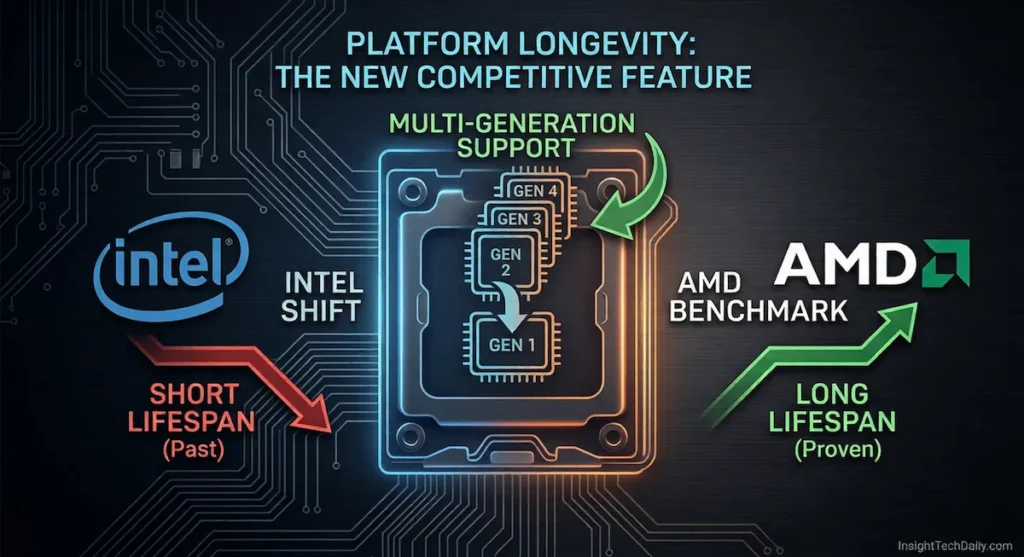
Intel appears to be shifting toward multi-generation socket longevity, a move that directly mirrors AMD’s successful AM4/AM5 strategy. This cultural shift, likely influenced by new leadership, could significantly lower the long-term cost of PC building.
A Subtle but Meaningful Shift in Intel’s Platform Strategy
For decades, Intel’s desktop CPU roadmap has followed a familiar pattern: new architecture, new socket, new motherboard. While technically justified in many cases, the approach has carried a consistent side effect of higher upgrade costs and shorter platform lifespans for consumers.
Now, early signals suggest that Intel may be reconsidering that approach. Recent commentary and roadmap hints point toward a potential shift to multi-generation socket longevity, aligning more closely with AMD’s long-standing strategy. If confirmed, this would mark one of the more consequential philosophical changes in Intel’s desktop platform design in years.
The “Robert Hallock Effect”: Cultural Change Inside Intel?
One of the more intriguing aspects of this shift is the influence of Robert Hallock, formerly AMD’s Director of Technical Marketing and now a key part of Intel’s client computing group. Hallock spent years helping AMD communicate—and arguably shape—the value of long-lived platforms like AM4.
Intel’s Historical Socket Cadence: A Quick Reality Check
Historically, Intel sockets have followed a relatively short lifecycle—typically supporting one to two CPU generations. To understand what may be changing, it helps to look at the recent track record:
| Socket | Supported Generations | Status |
|---|---|---|
| LGA 1200 | 10th & 11th Gen | Retired |
| LGA 1700 | 12th, 13th, & 14th Gen | End of Life |
| LGA 1851 | Arrow Lake (current) | Current |
| LGA 1954 | Next-gen platform (expected) | Upcoming |
While LGA 1700 stretched to three generations, it was never positioned as a long-term platform commitment. AMD, by contrast, explicitly communicates support windows (e.g., “2027 and beyond” for AM5), which helps build buyer confidence at launch. Intel is increasingly competing on this “platform value” metric.
LGA 1851 and LGA 1954: Early Signs of a New Direction
Intel’s current LGA 1851 platform, alongside the upcoming LGA 1954, serves as the clearest indicator of whether this strategy is evolving. While Intel has not made a formal multi-year support pledge, internal messaging and roadmap signals suggest a greater emphasis on platform stability and longer lifecycle planning than in previous generations.
Why This Shift Matters Now
- Rising Motherboard Prices: With high-end boards often costing as much as the CPU itself, builders are less willing to upgrade every two years.
- Sustainability: Longer platform lifespans significantly reduce electronic waste.
- Competition: AMD has used platform longevity as a primary weapon to win over the DIY enthusiast market.
The Verdict: A Strategic Recalibration
Intel’s shift is a pragmatic response to a changing market. By incorporating a more consumer-friendly longevity model, Intel can improve customer loyalty and ease the financial burden on enthusiasts. While we await a formal commitment, the groundwork is being laid for a more builder-friendly Intel, an Intel that may finally treat platform longevity as a competitive feature rather than a technical side effect.
For more on Intel’s evolving platform strategy, read our analysis of Z990 and Z970 chipsets and what they signal for Nova Lake builders.