The latest expansion of Intel’s Binary Optimization Tool, or iBOT, signals a strategic push by Intel to make software-driven performance part of its modern gaming pitch. Instead of relying only on faster silicon, Intel is trying to squeeze more real-world performance from supported games through architecture-specific optimization.
Intel’s gaming story is no longer just about clock speeds, core counts or how many watts a desktop CPU can pull under load. With the expansion of iBOT support to more games, Intel is making a different argument: some gaming performance can come from smarter software that helps existing hardware run selected workloads more efficiently.
That matters because the PC gaming market has become increasingly competitive. AMD’s Ryzen X3D processors have built a strong reputation among gamers, Nvidia continues to dominate the high-end GPU conversation, and handheld gaming PCs are pushing chipmakers to think more carefully about efficiency, scheduling and platform-level tuning. Intel still has major strengths, but it also needs more than raw hardware claims to rebuild momentum with enthusiasts.
iBOT is part of that broader strategy. It gives Intel a way to optimize selected games at the software layer, potentially improving frame rates without requiring a new GPU or a full platform upgrade. The idea is simple on the surface: use Intel-specific optimization to make supported games run better on supported Intel systems. The technical execution, however, is more interesting than a normal “game booster” label might suggest.
What Intel iBOT Actually Is
iBOT stands for Intel Binary Optimization Tool. It is not simply a background app that closes extra processes or applies generic gaming presets. Intel positions iBOT as a software optimization feature connected to Intel Application Optimization, also known as Intel APO.
Intel Application Optimization is designed to improve performance in selected games by optimizing thread scheduling and application resources in real time. Intel says APO works through Intel Dynamic Tuning Technology, or DTT, and supported titles can vary depending on processor, configuration and graphics hardware.
iBOT goes a layer deeper. Instead of only guiding how game workloads are scheduled, iBOT is intended to optimize how selected application binaries execute on Intel CPUs. In simpler terms, Intel is trying to make certain games behave more efficiently on its own processor architectures without requiring the original game developer to rewrite the source code.
That is an important distinction. This is not the same as generating extra frames with interpolation, and it is not the same as overclocking. It is closer to Intel saying, “We know how this workload behaves on our CPUs, and we can tune the execution path to better match the hardware.”
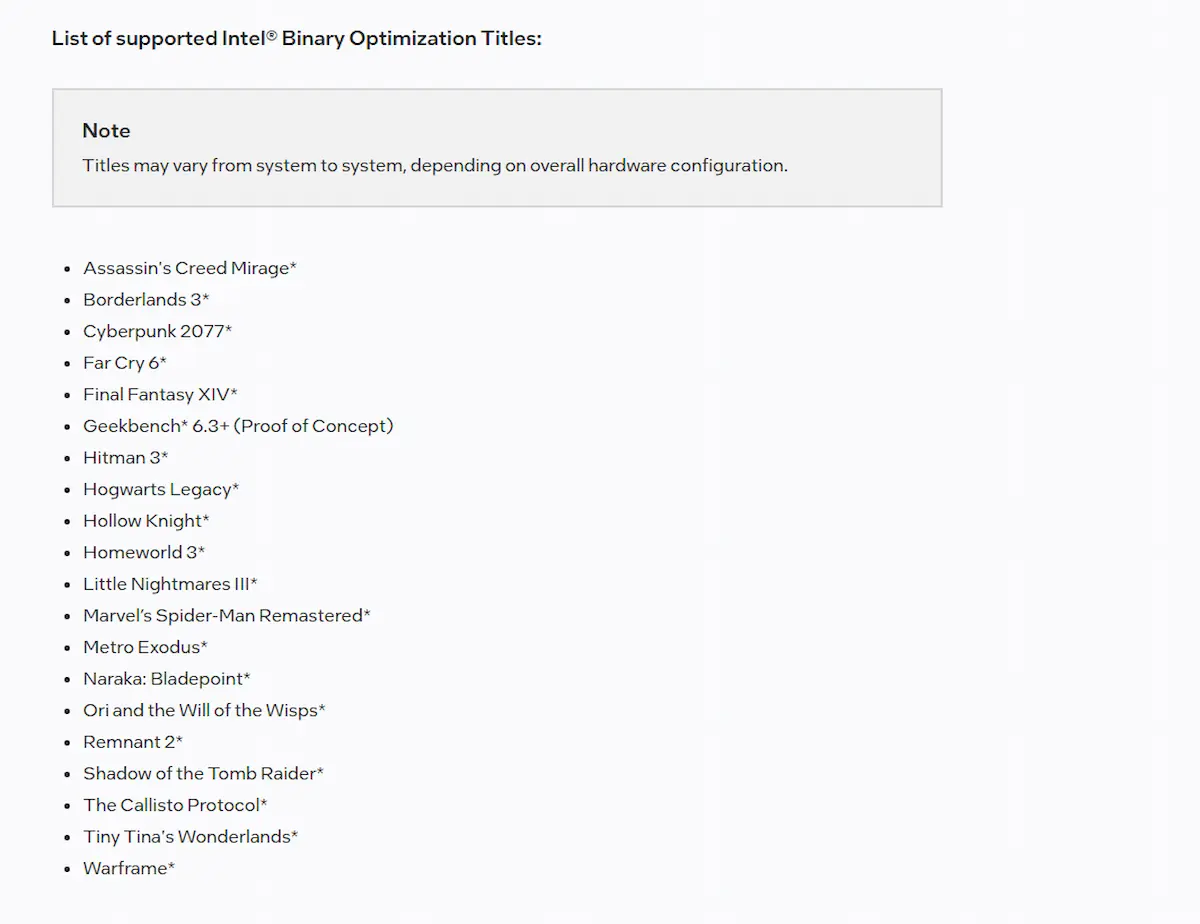
Intel’s supported iBOT title list shows the software’s game-specific approach, with performance gains depending on hardware configuration and supported titles.
InsightTechDaily Note: The supported-title list is important because it keeps iBOT in perspective. This is not a universal gaming boost switch. It is a targeted optimization layer for selected games, selected Intel hardware, and specific system configurations. That makes independent testing especially important before treating Intel’s claimed gains as a guaranteed result for every player.
Intel Adds Seven More Games to iBOT Support
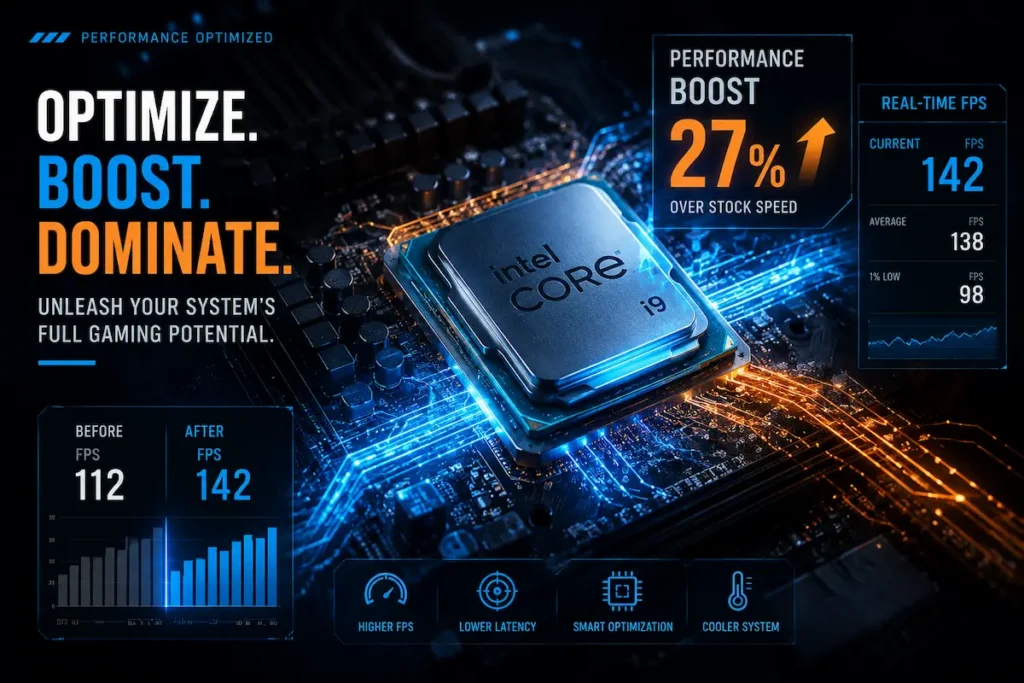
According to reporting from Tom’s Hardware, Intel has expanded iBOT support with seven additional games, claiming improvements of up to 27% in some cases and an average uplift of roughly 12% across the newly supported titles.
Those numbers are worth paying attention to, but they should be read carefully. “Up to” performance claims usually represent best-case scenarios, and the real-world result for any individual player will depend on the game, CPU, GPU, resolution, graphics settings, drivers and system configuration.
Still, even a smaller gain can matter in the right situation. A 5% to 12% improvement may not sound dramatic next to a full hardware upgrade, but in gaming performance terms, it can be meaningful if it helps smooth frame pacing, improve minimum frame rates or push a system closer to a higher refresh-rate target.
This is especially true in CPU-sensitive games. Strategy titles, simulation games, large open-world environments and competitive titles with high frame-rate targets can all expose CPU limitations. If software optimization can reduce inefficiencies in those workloads, it gives Intel another lever to pull beyond simply launching a faster chip.
Why This Matters Beyond the Seven New Games
The larger story is not just that Intel added more supported titles. It is that Intel is trying to turn software optimization into part of the platform value proposition.
For years, CPU gaming comparisons have often been reduced to benchmark charts: average FPS, 1% lows, power draw and platform cost. Those metrics still matter, but they do not tell the whole story. Modern gaming performance is shaped by the full software and hardware stack, including thread scheduling, cache behavior, memory latency, driver quality, compiler choices and game-engine design.
iBOT gives Intel a way to address some of those performance gaps after hardware has already shipped. If a game is not making ideal use of a modern Intel CPU, Intel can potentially apply a validated optimization profile instead of waiting for a game patch or relying only on future silicon improvements.
That is a useful strategy in a gaming market where platform perception matters. AMD’s Ryzen X3D chips have become the easy recommendation for many gaming-first desktop builds because their large 3D V-Cache can deliver strong results in CPU-limited games. Intel’s response cannot simply be “we have CPUs too.” It needs to show that the platform can deliver real-world gaming value through hardware, software and tuning.
InsightTechDaily Insight: Intel’s iBOT expansion is less about one batch of supported games and more about the direction of PC performance. Hardware still matters, but the next layer of competition is software efficiency. If Intel can turn optimization profiles into reliable, validated gaming gains, it gives the company another way to defend its platform against AMD’s cache-heavy gaming advantage and the broader shift toward efficiency-focused gaming hardware.
Software Optimization Is Becoming a Gaming Battleground
The iBOT expansion fits into a larger industry trend: software is becoming one of the most important ways hardware companies extend performance.
We already see this clearly on the GPU side. Nvidia uses DLSS, Reflex and driver-level optimizations to improve the user experience beyond raw raster performance. AMD has FSR and driver-level tuning. Intel has been building out XeSS, Arc driver improvements and now a more visible CPU-side optimization story through APO and iBOT.
That is why iBOT deserves more attention than a typical utility update. It represents Intel trying to make the CPU platform itself more adaptive. Instead of treating each processor as a fixed piece of hardware whose performance is locked at launch, Intel is signaling that some workloads can be improved over time through targeted optimization.
This idea also connects with Intel’s broader gaming ambitions. As we covered in our look at the Acer Predator Atlas 8, Intel Arc G3 and Panther Lake, Intel’s future gaming push is not limited to desktop CPUs. The company is also trying to become more competitive in handhelds, integrated graphics and mobile gaming platforms, where efficiency and software tuning can matter just as much as peak power.
In that environment, software optimization becomes strategic. A handheld gaming PC, for example, has strict thermal and battery limits. If Intel can improve game performance through smarter scheduling or binary optimization instead of brute-force wattage, that becomes valuable. The same applies to thin gaming laptops and compact desktops where cooling headroom is limited.
The 27% Claim Sounds Big, But Independent Testing Still Matters
Intel’s reported “up to 27%” improvement is the kind of number that gets attention, but it should not be treated as a universal promise. A best-case uplift in a specific game or scenario does not mean every supported title will see the same result.
The more useful figure may be the reported 12% average improvement across the newly supported games. That is still a meaningful claim, but it is also the kind of number that needs independent testing across different systems.
There are several reasons for caution. First, iBOT support is limited to selected games and selected Intel platforms. Second, game updates can change performance behavior over time. Third, driver versions, BIOS settings, memory configurations and graphics cards can all affect results. Fourth, some optimizations may improve average FPS but have less impact on frame pacing or 1% lows, which many gamers care about just as much.
That does not make Intel’s claim unimportant. It just means the next step is validation. If independent reviewers can reproduce meaningful gains across multiple supported titles, iBOT becomes a more credible part of Intel’s gaming value proposition. If the gains are inconsistent, it may remain a useful but narrow feature.
Why Gamers Should Care
For everyday gamers, the appeal of iBOT is straightforward: free performance is always interesting.
If a supported Intel system can gain extra frames through software, that is a win. It may help users stretch the life of a CPU, improve performance in CPU-sensitive games or reduce the need to chase every hardware upgrade. This matters even more at a time when the cost of gaming hardware remains high and consumers are more selective about where they spend.
It also comes at a moment when gaming subscriptions, storefronts and platform decisions are changing how people think about value. As we discussed in our coverage of Microsoft’s Xbox Game Pass pricing and Call of Duty strategy, gaming is increasingly shaped by ecosystem decisions as much as individual hardware purchases. Intel’s iBOT push fits that broader pattern: companies are trying to make their platforms feel more valuable after the initial purchase.
That said, gamers should keep expectations realistic. iBOT is not a magic performance button for every game. It is a supported-title feature, and the best results will likely appear in games where Intel has identified specific optimization opportunities. It may be useful, but it should not replace normal buying advice around CPU performance, GPU pairing, platform cost and independent benchmarks.
The Risk: Optimization Can Create Confusion Too
There is also a more complicated side to software-driven performance: transparency.
When hardware companies optimize specific applications, users benefit from better performance, but reviewers and benchmark databases need to understand what is being measured. If a system is running with iBOT enabled, the result may not be directly comparable to the same system without it. That does not automatically make the score invalid, but it does make disclosure important.
This is especially relevant for synthetic benchmarks and broad CPU comparisons. Game-specific optimization can be useful for players, but benchmark optimization can raise questions about fairness, repeatability and whether the result reflects general performance or a tuned path for a particular workload.
Intel will need to be careful here. The best version of iBOT is transparent, optional, clearly labeled and focused on real user benefit. If users know which games are supported, what hardware is required and when the feature is active, it becomes easier to trust the results.
What This Means for Intel’s Gaming Strategy
Intel’s iBOT expansion shows that the company is trying to compete on more than raw silicon. That is important because Intel’s gaming position has been under pressure.
AMD has a strong desktop gaming story with Ryzen X3D processors. Nvidia continues to dominate discrete GPU mindshare. Handheld gaming PCs have made efficiency and integrated graphics more important. Meanwhile, Windows gaming itself is becoming more dependent on software layers, drivers, upscalers, launchers and platform services.
Intel has pieces of that puzzle: CPUs, Arc graphics, XeSS, APO, iBOT, laptop platforms and future architectures like Panther Lake. The challenge is tying those pieces together into a gaming ecosystem that feels reliable and valuable to users.
iBOT can help if Intel keeps expanding support and proves the gains are consistent. It gives Intel a story that goes beyond “buy our next CPU.” It says the platform can continue improving through software. That is a more modern pitch, and it fits where PC gaming is going.
Bottom Line
Intel’s latest iBOT expansion is a small update with a larger message. The company is trying to make software optimization a more visible part of its gaming performance strategy.
The reported addition of seven supported games, along with claims of up to 27% improvement and roughly 12% average uplift, gives Intel a stronger talking point. But the real test will be independent benchmarks, supported hardware coverage and whether the gains show up consistently in the games people actually play.
For gamers, iBOT could become a useful bonus feature on supported Intel systems. For Intel, it could become something more important: a way to turn platform-level software into a competitive advantage.
The bigger trend is clear. PC performance is no longer only about who ships the fastest chip. It is also about who can keep optimizing the hardware after it reaches the user’s desk.