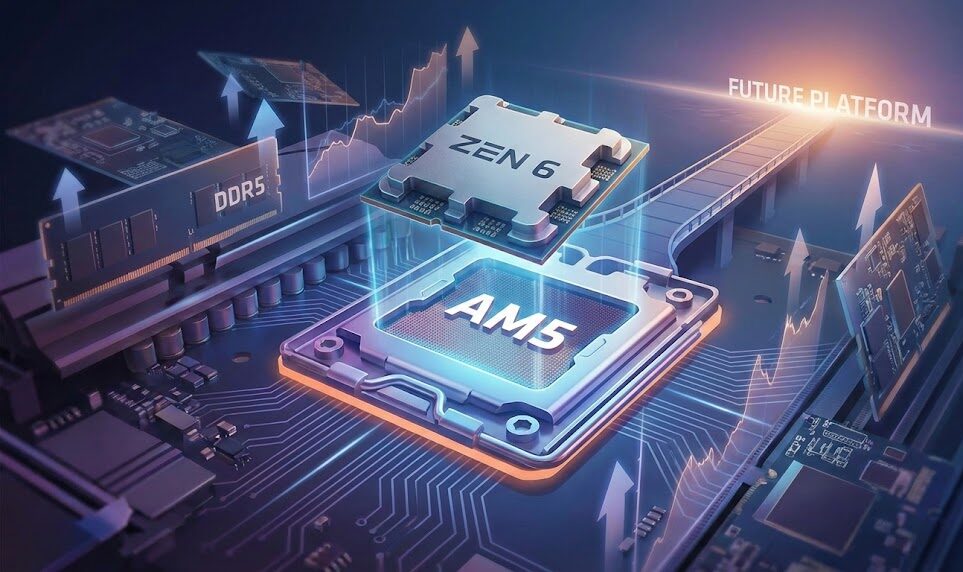
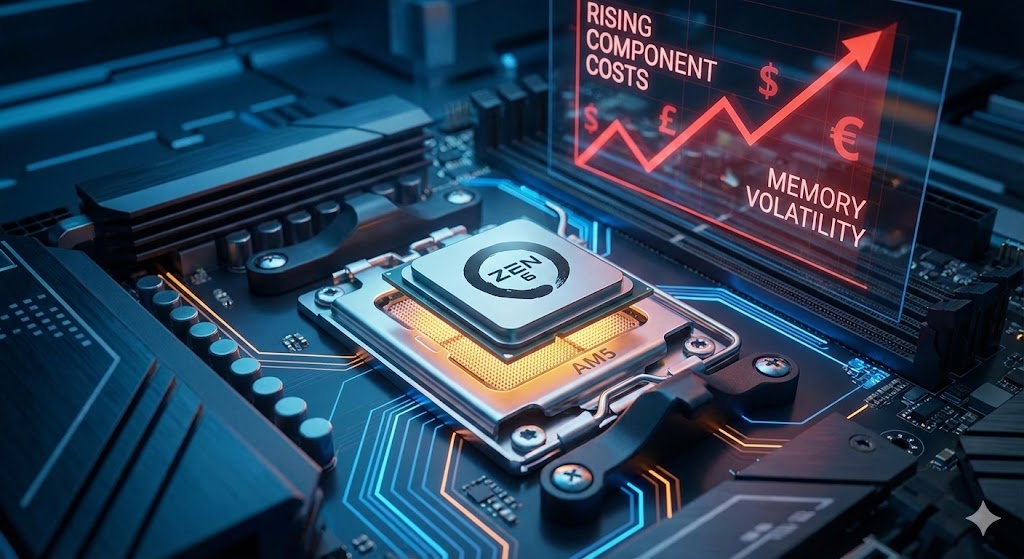
AMD has confirmed that its next-generation Zen 6 CPU architecture will continue to support the AM5 socket, extending a platform strategy that already spans multiple Ryzen generations. In an industry where frequent socket changes are the norm, the decision stands out. It matters even more as the broader PC hardware market grapples with rising component costs, volatile memory pricing, and increasingly expensive upgrades.
For existing Ryzen users, the announcement signals continuity and potential long-term value. For enthusiasts planning new builds, it reframes the cost-benefit equation of investing in AM5 today rather than waiting. At the same time, AMD’s confirmation arrives alongside indications that Zen 6’s rollout may not be uniform, with higher-end models likely prioritized while more affordable SKUs could arrive later due to market pressures.
TL;DR: If you’re already on AM5, Zen 6 could be a rare “CPU-only” upgrade. If you’re still on AM4 (or older), the biggest cost hurdle isn’t the CPU—it’s the platform jump to DDR5 + a new motherboard, and that math may not improve just by waiting.
AMD’s AM5 Commitment: What’s Confirmed vs. What Isn’t
AMD has publicly stated that Zen 6 processors will remain compatible with the AM5 socket, reinforcing earlier messaging that AM5 would be a long-lived platform rather than a short transitional step.
What is confirmed
- AMD plans to support Zen 6 CPUs on AM5 motherboards.
- Existing AM5 boards should, in principle, support Zen 6 with appropriate BIOS updates, assuming power delivery and firmware requirements are met.
- AMD continues to position AM5 as the successor to AM4’s unusually long lifespan.
What remains uncertain
- Exact launch timing for Zen 6 desktop CPUs.
- Whether all AM5 motherboards—including early, lower-end models—will receive full Zen 6 support.
- The structure of the initial lineup, particularly entry-level and midrange SKUs.
AMD has not yet published a full Zen 6 desktop roadmap, and the company has been careful not to overpromise on availability or pricing. That caution is notable given current market conditions.
From AM4 to AM5: A Rare Case of Platform Longevity
To understand why AMD’s announcement matters, it helps to look backward. The AM4 socket debuted in 2017 and supported everything from first-generation Ryzen to Zen 3-based CPUs released years later. That level of continuity allowed users to upgrade CPUs without replacing motherboards, memory, and cooling—an increasingly rare scenario in the PC industry.
AM5, launched with Ryzen 7000-series processors, initially felt more restrictive:
- Mandatory DDR5 memory
- New motherboards with higher average prices
- Early BIOS maturity challenges
At launch, some users questioned whether AM5 would deliver the same long-term value as AM4. Zen 6 compatibility now provides a partial answer—provided motherboard support and pricing don’t undermine the promise.
Why this matters today
Platform swaps are no longer “just” CPU upgrades. They often involve:
- New motherboard
- New memory standard
- Potentially new cooling and power considerations
As component prices rise, avoiding even one of those costs becomes increasingly meaningful.
Rising Component Costs Are Reshaping Upgrade Decisions
AMD’s AM5 longevity pitch arrives during a period of renewed price pressure across key PC components.
DDR5 pricing volatility
While DDR5 prices initially fell as production ramped up, recent market dynamics—ranging from supply adjustments to increased enterprise demand—have introduced fresh volatility. High-capacity and high-speed DDR5 kits, in particular, remain expensive compared to mature DDR4 alternatives.
Illustrative cost reality (not a price quote): For many builders, moving from an AM4 refresh to an AM5 platform can add roughly $200–$350+ once a new DDR5 kit and motherboard pricing are factored in—before you even account for optional upgrades like faster storage.
For builders, this creates a dilemma:
- AM5 offers a longer upgrade runway
- But the cost of entry is still meaningfully higher than legacy platforms
Storage costs aren’t helping
Solid-state storage pricing has also become less predictable. High-performance PCIe 4.0 and 5.0 SSDs, which pair naturally with AM5 systems, have seen uneven pricing trends, making “future-proof” builds more expensive upfront.
In this context, AMD’s promise that today’s AM5 investment will extend into Zen 6 becomes more than a technical detail—it becomes a financial argument.
Zen 6 Launch Strategy: Why High-End CPUs May Arrive First
Industry signals suggest that AMD may prioritize higher-end Zen 6 CPUs during the initial launch window. While AMD has not formally confirmed a staggered release, the pattern would align with market realities and recent CPU launch strategies.
Why high-end SKUs often come first
- Higher margins help offset rising production and component costs
- Enthusiasts are more willing to absorb premium pricing
- Early adopters tend to already be on AM5 or planning full platform upgrades
Potential impact on entry-level buyers
If lower-cost Zen 6 models arrive later:
- Budget-conscious users may delay upgrades
- AM5 adoption at the low end could slow
- Older Zen 4 or Zen 5 CPUs may remain the value sweet spot longer than expected
This approach wouldn’t be unprecedented, but it does complicate AMD’s value narrative—especially for users who were counting on affordable drop-in upgrades.
AM5 vs. Full Platform Swaps: The New Cost Equation
In previous CPU generations, platform upgrades were often framed as technical necessities. Today, they are increasingly financial decisions.
Staying on AM5
- Zen 6 represents a potential CPU-only upgrade
- DDR5 and motherboard investments are preserved
- Total upgrade cost is significantly lower
Switching platforms
- The jump to AM5 involves multiple expensive components
- Rising memory and SSD prices amplify the total cost
- Waiting for Zen 6 doesn’t necessarily reduce upfront spending
In this environment, AMD’s socket continuity doesn’t just reward existing users—it reduces the penalty of upgrading over time compared with frequent platform resets seen elsewhere in the CPU market.
How This Compares to the Broader CPU Market
AMD’s AM5 strategy contrasts with broader industry trends where sockets and chipsets change more frequently, often pushing users toward full rebuilds every few generations. That reality makes incremental upgrades harder—and makes platform longevity itself a tangible feature when budgets are tight.
- Platform longevity strengthens enthusiast credibility
- It reduces friction for incremental upgrades
- It positions AMD as more cost-conscious, even when component prices rise
However, platform longevity alone doesn’t guarantee value. Pricing, performance gains, and availability will ultimately determine whether Zen 6 feels like a must-have upgrade or a measured evolution.
What Enthusiasts Should Do Right Now
For readers considering their next move, the Zen 6-on-AM5 confirmation offers guidance—but not definitive answers.
If you already have an AM5 system
- Waiting for Zen 6 is a reasonable strategy
- Incremental upgrades (storage, GPU) may make more sense short-term
- BIOS support will be critical—board choice matters
If you’re on AM4 or older platforms
- Zen 4 and Zen 5 CPUs may offer better near-term value
- AM5 makes more sense as a long-term investment, not a budget build
- Timing matters: component pricing may fluctuate more than CPU pricing
If you’re building new
- AM5 offers the longest forward compatibility on paper
- Expect higher upfront costs
- Plan for a multi-year lifecycle to justify the investment
Key Takeaways
- Zen 6 staying on AM5 is strategically significant because it can preserve motherboard + DDR5 investments.
- Rising DDR5 and SSD costs make full platform swaps more painful than in prior upgrade cycles.
- A high-end-first launch (if it happens) could delay the “affordable AM5 drop-in upgrade” narrative.
- Platform stability itself becomes a feature when budgets tighten and rebuilds get expensive.
The Bigger Picture: Longevity as a Competitive Advantage
AMD’s confirmation of Zen 6 support on AM5 is not flashy news—but it is significant. In an era of expensive memory, unpredictable storage pricing, and increasingly complex upgrade paths, platform stability itself becomes a feature.
That doesn’t mean Zen 6 will be immune to market pressures, nor does it guarantee affordable CPUs across the stack at launch. What it does mean is that AMD is doubling down on a philosophy that once defined its rise during the AM4 era: respect the user’s investment.
Whether that philosophy holds under continued cost pressures will shape not just Zen 6’s reception, but the long-term perception of AM5 as one of the most consumer-friendly platforms in modern PC history.