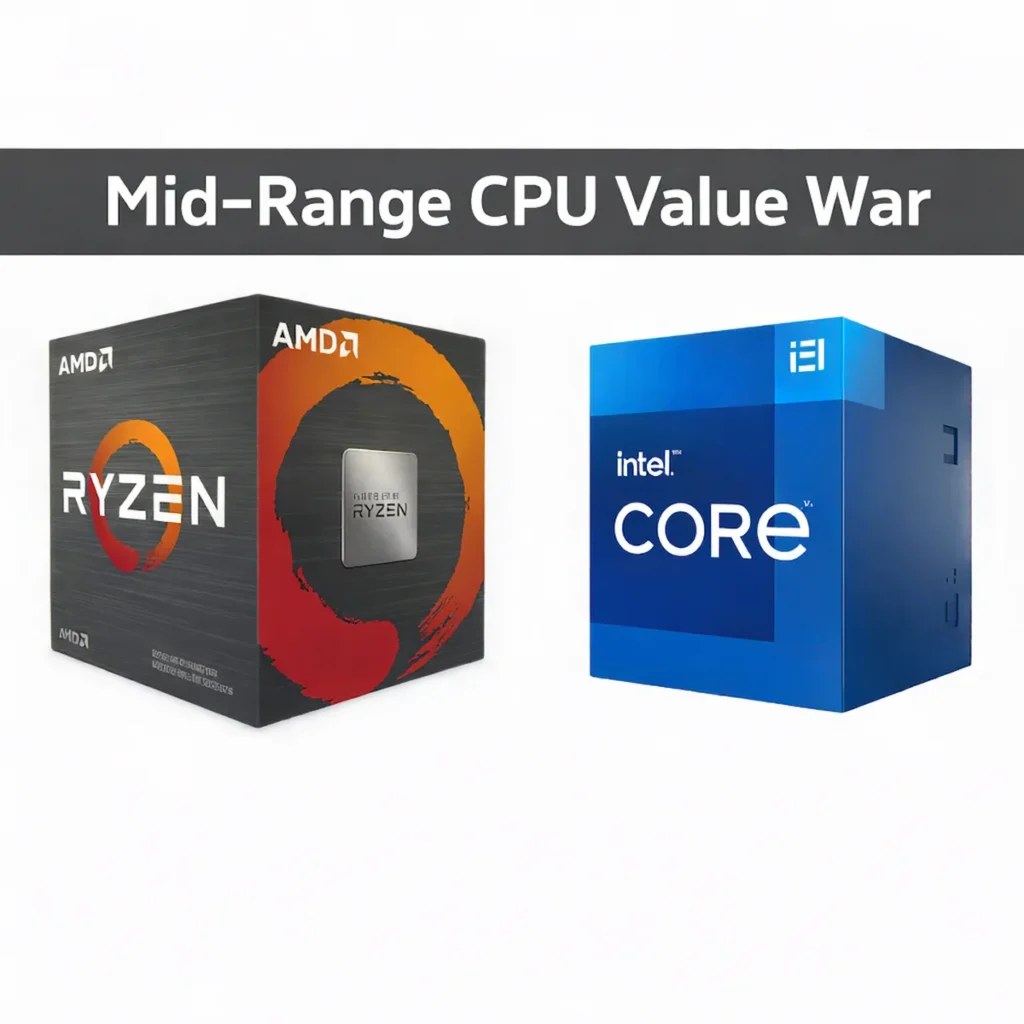
The mid-range desktop CPU market has once again remembered that competition exists, and consumers are the main beneficiaries.
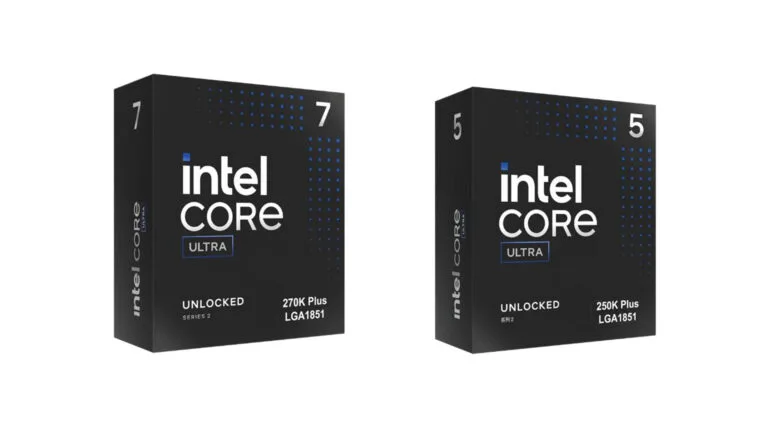
Intel has officially introduced its Core Ultra 200S Plus desktop processors, led by the Core Ultra 7 270K Plus and Core Ultra 5 250K Plus, with availability starting March 26, 2026. Intel says the new chips bring more cores, faster interconnect speeds, and higher official memory support, while starting at $299 for the Ultra 7 270K Plus and $199 for the Ultra 5 250K Plus.
AMD, meanwhile, has not announced a direct new mainstream desktop counter. Instead, it is defending the segment through pricing. On AMD’s own storefront, the Ryzen 7 9700X is currently listed at $339, down from $359, while the Ryzen 5 9600X sits at $220, down from $279.
That combination is what makes this moment worth watching. Intel is trying to improve the equation by adding more silicon at aggressive launch prices. AMD is answering with lower pricing on already-established Zen 5 parts. The result is a much clearer value war in the mid-range desktop market than PC buyers have seen in quite some time.
Intel’s move is more than a routine refresh
This is not just a minor clock-speed shuffle.
Intel says the Core Ultra 7 270K Plus moves to 24 cores in an 8P+16E configuration, while the Core Ultra 5 250K Plus moves to 18 cores with 6P+12E. That compares with the earlier Core Ultra 7 265K at 20 cores and the Core Ultra 5 245K at 14 cores. Intel also says the new Plus-series parts raise official memory support to DDR5-7200, up from DDR5-6400 on the non-Plus models.
For upper mid-range buyers, that matters because Intel is not only refreshing performance claims. It is also repositioning price bands. The older Core Ultra 5 245K launched in roughly the low-$300 range, while the Core Ultra 7 265K sat closer to the $400 class. On paper, $199 and $299 are much more aggressive entry points.
Intel is naturally presenting the new chips in the strongest possible light. The company says the Core Ultra 200S Plus lineup can deliver up to 15% faster gaming versus existing Core Ultra Series 2 desktop processors, alongside dramatically stronger multithreaded performance in segment-matched comparisons. Those are vendor numbers, not independent review conclusions, so they should be treated as directional until broader third-party testing arrives.
Still, even without taking every performance claim at face value, Intel’s strategy is obvious: it wants the conversation to shift from “Arrow Lake was underwhelming” to “that is a lot of CPU for the money.”
That is a much more useful narrative for Intel to be selling.
Intel’s push for higher core counts at lower price points is part of a broader shift, not just a product refresh. Recent changes to Arrow Lake positioning and new chipset segmentation point to a deeper strategy shift as Intel works to stay competitive in the mid-range market.
AMD’s answer is simpler: lower the price of entry
AMD’s current position looks different, but no less intentional.
The Ryzen 5 9600X remains a 6-core, 12-thread Zen 5 chip with a 65W TDP. The Ryzen 7 9700X remains an 8-core, 16-thread model, also rated at 65W. The specs have not changed. The price context has.
That matters because AMD does not necessarily need to match Intel core-for-core in this segment if its chips continue to deliver competitive gaming performance, lower power draw, and a more mature AM5 upgrade story.
Tom’s Hardware, for example, currently describes AMD as still holding a strong gaming position overall, and specifically notes that the Ryzen 7 9700X has become a much stronger contender thanks to lower-than-launch pricing and firmware and OS improvements. That reinforces AMD’s broader strategy here: lower the barrier to entry, preserve platform appeal, and make Intel work harder for every sale.
In other words, AMD’s defense of the mid-range feels less about spectacle and more about erosion. Trim the prices. Keep the platform story intact. Force the competition to win on execution, not just launch-day headlines.
AMD’s position in the mid-range market extends beyond CPU pricing. From unified memory discussions in AI PCs to competitive GPU positioning, the company is pushing a broader strategy across compute, graphics, and platform design.
This is really about performance per dollar, not just raw specs
Core counts remain useful marketing shorthand, but they are not the whole story in the mid-range desktop market.
A buyer shopping in the $200 to $350 range is usually balancing gaming performance, general productivity, motherboard cost, cooling needs, and upgrade flexibility. That is why AMD’s mainstream Ryzen 9000 chips still look appealing. The Ryzen 5 9600X and Ryzen 7 9700X were designed as efficient parts from the start, and AM5 still offers a clearer long-term platform narrative than Intel’s current position.
Intel’s pitch, by contrast, is increasingly about delivering more throughput in the same buying window. More E-cores should help in multithreaded work, and the new Plus chips also add platform-level improvements such as faster official memory support. But full build costs still matter. A CPU that looks cheaper on paper can still end up in a more expensive overall platform once motherboard pricing, power delivery, and cooling are factored in.
That does not automatically make AMD the better value for every buyer. It does mean the best deal depends more than ever on the full system bill, not just the CPU sticker price.
Could this signal a longer-term pricing shift?
Possibly, though with some caution.
Intel’s official launch pricing on the Core Ultra 200S Plus series suggests a willingness to be more aggressive than it was with the initial Core Ultra 200 desktop rollout. AMD’s current store discounts tell a similar story from the other side. The company is clearly willing to let Ryzen 9000 pricing slide lower in order to stay attractive in the mainstream market.
The Ryzen 5 9600X, in particular, moving from $279 to $220 on AMD’s own storefront is not subtle.
That does not guarantee a permanent, industry-wide reset. CPU pricing still moves with inventory, bundles, promotions, board pricing, and whatever fresh acronym the industry decides is critical this quarter. But it does suggest that the mainstream desktop segment has become far more price-sensitive than it looked at launch.
For consumers, that is excellent news. For margins, perhaps less festive.
What buyers should watch next
The next few weeks matter more than the launch slides.
Independent benchmarks will determine whether Intel’s added-core strategy meaningfully improves real-world value at $199 and $299, especially in gaming-heavy builds where AMD has remained strong. Retail pricing will matter even more than vendor starting prices, because both Intel and AMD chips can drift quickly once channel competition takes over.
There is also the question of whether AMD responds with more than pricing. Recent reporting has pointed to a possible Zen 5 desktop refresh aimed at countering Intel’s latest moves, but those plans remain unconfirmed by AMD and should be treated accordingly for now.
For the moment, the clearest conclusion is this: the mid-range CPU market is becoming a much better place to spend money. Intel is adding cores and cutting launch prices. AMD is using lower Ryzen pricing and platform continuity to hold the line. Buyers who waited out the earlier part of this generation may finally be getting rewarded for their patience, which is a polite way of saying that hesitation sometimes ages very well in PC hardware.
As of March 20, 2026, this looks less like a temporary scuffle and more like a genuine value war.