A faster graphics card cannot solve every hitch in an open-world game. When a frame stalls on engine work that the CPU has not finished, extra GPU power can leave the underlying problem intact. An AI-assisted performance mod for The Elder Scrolls IV: Oblivion Remastered offers a useful case study in tackling that kind of bottleneck.
Created by LTSharpe with Claude Code, Oblivion Remastered Performance Fix reports substantial gains in selected tests. The interesting questions are how those results were measured, what the patch changes, and how well its improvements carry over to other PCs.
About this analysis: This article examines the creator’s published results, technical documentation, and release notes reviewed on October 19, 2026. The performance figures are developer-reported measurements, not independent benchmarks by InsightTechDaily.
How LTSharpe Used Claude to Investigate the Game
In their account of the project, LTSharpe describes being disappointed that a graphics-card upgrade had left persistent performance problems. They say the work developed over roughly two and a half weeks, despite having no background as an IT developer.
The workflow involved turning troublesome locations into repeatable benchmark scenarios, letting Claude investigate and implement changes, then playing the resulting builds and providing feedback. LTSharpe describes directing the work and making decisions throughout that process.
That testing loop is an important part of the story. A patch needs a way to distinguish an improvement from an unusually smooth run. Repeatable scenes also make it easier to discover that a change helps one situation while hurting another. The useful lesson for aspiring modders is to make a performance problem measurable before trying to automate its repair.
What the Reported Performance Gains Show
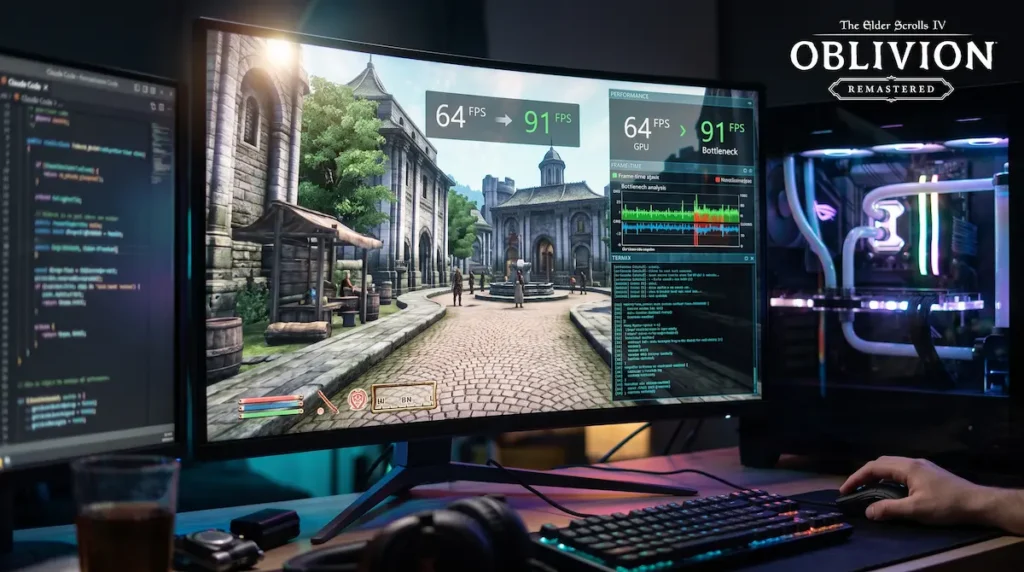
The published results come from a Ryzen 7 5800X, Radeon RX 9070 XT with 16 GB of VRAM, and 32 GB of system memory, running Windows 11 and the Steam version.
| Test | Without fixes | With fixes |
|---|---|---|
|
Cheydinhal street views 4K output Frame generation enabled |
64 FPS 1% low: 50 FPS |
91 FPS 1% low: 68 FPS |
|
Cheydinhal flight 4K output Frame generation disabled |
55 FPS 1% low: 26 FPS |
63 FPS 1% low: 43 FPS |
|
Imperial City flight 4K output Frame generation enabled |
72 FPS 1% low: 33 FPS |
102 FPS 1% low: 45 FPS |
The street comparison supplies the roughly 43% headline gain. The author also reports that hitches lasting at least 50 milliseconds fell from 19.5 to 4.8 per Imperial City flight. The README notes that these comparisons were collected at different stages of development, rather than all with one identical mod build.
The benchmark documentation adds essential context: the relevant 4K profiles use FSR Performance, and results with frame generation count generated frames. These are 4K output settings with upscaling, rather than native-resolution rendering. The Imperial City frame-generation profile also uses a 60 FPS cap before frame generation.
Consequently, the frame-generation and non-frame-generation rows should be assessed separately. A displayed frame-rate increase does not establish the same increase in game simulation speed or responsiveness. The flight without frame generation provides another useful comparison, although it is a different workload.
The benchmark guide also acknowledges run-to-run variation and recommends alternating baseline and modified runs. Small differences need repeated measurements before they can support a conclusion.
What the Patch Changes Inside the Engine
Bethesda’s overview of the remaster explains that the original game powers gameplay and world logic underneath its Unreal Engine 5 presentation. Improving performance therefore involves examining the work passing through that combined architecture.
According to the project’s technical documentation, the changes include:
- Avoiding redundant lighting updates. Some weather-system updates requested expensive scene changes even when their values had not changed. The patch filters unnecessary work and handles certain genuine changes through cheaper update paths.
- Parallelizing command translation. More of the conversion from Unreal rendering instructions into DirectX 12 commands can run across CPU cores.
- Reducing concentrated travel work. Separate fixes address memory reuse, physics preparation, distant character creation, and the unloading of old world cells.
These changes target several sources of uneven frame times. Describing them as a complete replacement for the game’s streaming system would overstate the documented work.
There are also resource tradeoffs. The documentation describes additional video-memory use from parallel command translation and an automatic setting that leaves it disabled on cards with less than 9.5 GB. A change that benefits one hardware configuration can need different behavior on another.
The Beta Already Provides a Lesson in Regression Testing
As of October 19, the latest listed release is version 1.1.0-beta. Its notes describe a lighting regression introduced by the first beta: clouds and the sky could darken or flicker after lightning. The update corrects that behavior.
This matters when evaluating the promise of preserving image quality. An optimization can aim to produce the same image while still disrupting a dependency that only becomes obvious in a particular weather condition. A faster benchmark and a convincing comparison video cannot establish that every scene remains correct.
Publishing the regression and its correction makes the project easier to assess. It also illustrates the continuing need for player reports, varied test conditions, and careful maintenance after an AI-assisted change reaches users.
What This Says About Official Game Optimization
It is reasonable to ask whether the improvements could become part of an official update. The published work gives developers and technically minded players specific behavior to investigate.
However, it does not establish why the original developers left those bottlenecks in place. Claims about staffing decisions, publisher deadlines, or management priorities would require reporting from the people involved.
There is also a difference in responsibility between offering an optional mod and shipping an official update to an entire supported player base. An official change needs evidence that its gains survive broader compatibility and regression testing. The mod’s own lighting correction shows why that work matters.
The constructive question is whether the documented improvements can be reproduced, validated across more configurations, and maintained through future updates. That is a stronger basis for accountability than assuming the speed of one project explains a studio’s internal decisions.
AI Modding and the Bigger Open-Source Question
The project makes AI-assisted game maintenance worth watching. It also starts with an enormous advantage: an existing game already supplies the world, quests, assets, mechanics, and creative direction. The optimization work has a relatively clear target, such as reducing frame time in a repeatable scene while preserving behavior.
Building an original game introduces additional decisions about scope, art, writing, design, funding, and coordination. Faster implementation can help with those projects, but a successful performance patch does not tell us how much of that broader production work an AI assistant can handle.
OpenMW offers a useful distinction. It is an open-source replacement engine that can run Morrowind using the player’s existing game data. Its editor also supports creating original games. Rebuilding an engine, supplying a commercial game’s content, and producing a new game are related but separate undertakings.
Community development deserves to be assessed on its own goals. A small original game, a replacement engine, and a performance mod can each succeed without reproducing the production model of a large commercial RPG.
What Players Should Check Before Trying the Mod
The Nexus Mods installation instructions distinguish the standard Steam package, an OBSE64 package for setups where another mod already uses version.dll, and an experimental Game Pass package. Players should choose the appropriate route rather than overwrite an existing mod’s DLL. The generated log lists the fixes applied.
For a useful personal comparison, keep resolution, upscaling, frame generation, graphics settings, and the route through the game consistent. Record the mod version as well as the game build. Changing several of those variables at once makes it difficult to identify what caused a difference.
Pay attention to pauses and visual behavior as well as average FPS. A smoother town walk may matter more than a higher peak, while a weather or stability problem can outweigh either improvement. The project’s benchmark tools provide a starting point for gathering results that other players can evaluate.
The next valuable evidence will be repeatable comparisons on more CPUs and GPUs, alongside longer play sessions that exercise conditions a short route misses. Those results will help show how broadly the reported gains apply and which changes need further refinement.
Sources and Further Reading
- Oblivion Remastered Performance Fix: source, results, and documentation
- Benchmark methods and reproduction instructions
- Explanation of individual engine changes
- Version 1.1.0-beta release notes
- LTSharpe’s account of the development process
- Nexus Mods listing and installation guidance
- Bethesda’s overview of the remaster
- OpenMW FAQ