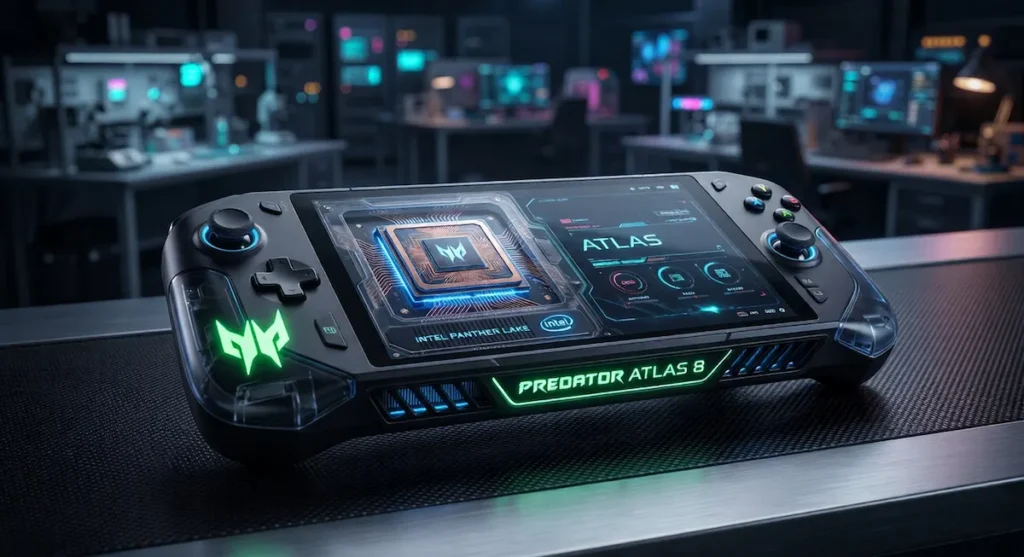
Acer may be preparing a more serious swing at the handheld gaming PC market, and the rumored Predator Atlas 8 looks less like a one-off gadget than a signal of where Intel wants portable PC gaming to go next.
According to reporting from VideoCardz, Acer is working on a new Predator-branded gaming handheld currently referred to as the
Predator Atlas 8 . The name suggests an 8-inch-class device, putting it in the same broad category as systems like the Lenovo Legion Go, ASUS ROG Ally, MSI Claw, and other Windows-based portable gaming PCs. The key detail is not just the display size or Predator branding, though. The report says the device is expected to use Intel’s upcoming
Arc G3 platform for handheld gaming systems.
Tom’s Hardware separately summarized the leak as an Acer handheld built around Intel Arc G3 chips, framing it as a potential competitor to AMD’s Ryzen Z2 handheld platform. That matters because most of the strongest handheld PC designs over the last few years have leaned heavily on AMD silicon, while Intel’s handheld presence has been more limited and uneven.
What Is Reportedly Changing With Acer’s Predator Atlas 8
The Predator Atlas 8 has not been formally announced by Acer, so the usual caution applies. There is no confirmed price, final specification sheet, battery capacity, launch date, weight, screen resolution, operating system configuration, or retail availability. At this stage, the product is best treated as an industry report rather than a finished device.
Still, the direction is notable. Acer already sells handheld gaming devices under its Nitro Blaze line, but moving a rumored device into the Predator family would suggest a more premium gaming position. Predator is Acer’s long-running enthusiast brand, usually associated with higher-performance gaming laptops, desktops, displays, and accessories. Bringing that badge to an Intel-powered handheld would signal that Acer sees room above basic portable PC gaming, not just another Steam Deck alternative with Windows installed and fingers crossed.
The reported “Atlas 8” name also points to the market’s current sweet spot. Eight-inch-class handhelds have become a practical compromise: large enough to make modern PC game interfaces readable, but still portable enough to avoid turning into a small laptop with thumbsticks. The challenge is that bigger screens, higher refresh rates, and Windows overhead all put pressure on battery life and thermals. That is where Intel’s next platform becomes the real story.
Why Intel Arc G3 And Panther Lake Matter
The rumored Acer handheld is tied to Intel’s next-generation handheld push. VideoCardz reports that Intel is expected to announce Arc G3 for gaming handhelds on May 28, with the launch covering Panther Lake-based chips designed specifically for portable gaming systems.
Panther Lake is already an important Intel platform beyond handhelds. Intel officially describes Panther Lake, branded as
Intel Core Ultra Series 3 , as its first client system-on-chip family built on Intel 18A. The company says Panther Lake uses a scalable multi-chiplet architecture and is intended for consumer PCs, commercial AI PCs, gaming devices, and edge systems. Intel has also claimed up to 180 platform TOPS for AI acceleration and a new Intel Arc GPU with up to 12 Xe cores, though real-world performance will depend heavily on final device power limits and cooling.
For handhelds the key is mostly
efficiency . A portable gaming PC can have a fast GPU on paper and still feel compromised if it burns through its battery in under an hour, gets loud under load, or throttles after a few minutes of play. Panther Lake’s appeal for a device like the Predator Atlas 8 would be the possibility of stronger integrated graphics and better performance-per-watt in a form factor where every watt matters.
ITD Insight Intel does not need Arc G3 handheld chips to beat every AMD-based device in raw performance to make this strategy work. It needs to prove that its graphics drivers, upscaling stack, and power management can deliver a predictable handheld experience across real games, not just attractive silicon specifications.
The AMD Handheld Problem Intel Is Trying To Solve
The handheld PC category has largely been shaped by AMD. Valve’s Steam Deck uses a custom AMD APU built around Zen 2 CPU cores and RDNA 2 graphics, while many newer Windows handhelds have used AMD Ryzen Z-series or Ryzen mobile chips. Valve describes the Steam Deck’s custom AMD APU as optimized for handheld gaming, which is exactly the kind of design target Intel is now trying to address more directly.
That AMD advantage has not only been about silicon. It has also been about ecosystem maturity. Game compatibility, driver cadence, performance profiles, frame pacing, suspend behavior, and vendor utilities all matter in a handheld. A device can win a benchmark and still lose the user if the fan curve is irritating, the sleep state is unreliable, or the graphics driver stumbles in popular games.
This is why the reported 2026 timing may be more strategic than slow. If Acer is building around Panther Lake and Arc G3, a later reveal gives Intel and Acer more time to optimize drivers, thermal behavior, battery profiles, and game-specific tuning. In the handheld market, “ready” is more valuable than “first,” because buyers notice rough edges quickly when a device is used on a couch, airplane tray, or commute rather than sitting permanently at a desk.
Computex 2026 Would Be The Right Stage
The timing also lines up with the industry calendar. Acer has an official Computex 2026 presence, with the company saying it will showcase its latest laptops and gaming devices at the event. That does not confirm the Predator Atlas 8, but it does make Computex a plausible venue for a broader Acer gaming hardware announcement.
Computex is especially fitting because this story is not just about Acer. It is about the supply chain and platform ecosystem around handheld PCs. Intel needs OEM partners to prove Arc G3 can scale beyond one reference design. Acer needs a differentiator in a crowded market where “Windows handheld with analog sticks” is no longer enough. A Predator-branded Intel handheld would give both companies a cleaner narrative: Acer gets a higher-end portable gaming device, while Intel gets another public proof point for Panther Lake gaming beyond laptops.
What Buyers Should Watch For
The most important unknowns are practical, not branding-related. A future Predator Atlas 8 would need competitive battery life, a balanced screen, comfortable controls, strong cooling, and a software layer that does not make Windows feel like it is constantly resisting the handheld form factor. These are not small details. They are the difference between a device people use daily and one that becomes a very expensive launcher for driver updates.
There are also several specification questions that will determine where the Atlas 8 would sit in the market
- Power limits: Handheld performance depends heavily on sustained wattage, not just peak chip capability.
- Memory bandwidth: Integrated graphics rely on shared system memory, so configuration choices could matter as much as GPU branding.
- Display target: An 8-inch screen can be excellent, but resolution and refresh rate need to match realistic handheld GPU performance.
- Software experience: Acer’s launcher, performance profiles, updates, and controller mapping will be central to the experience.
- Price: The Windows handheld market is getting crowded, and premium pricing only works if the device feels meaningfully better.
Why This Matters
The Predator Atlas 8 rumor matters because handheld PCs are moving from experimental enthusiast devices into a more mature product category. The first wave proved that people want portable PC gaming. The next wave has to prove that these devices can become refined, efficient, and reliable enough for mainstream buyers who do not want to troubleshoot every game.
For Intel, Arc G3 handheld chips could be a chance to reset expectations around its integrated graphics in gaming-focused devices. Intel’s Arc story has improved over time, but handheld gaming is a demanding test because users care about performance, battery life, compatibility, heat, noise, and quick resume behavior all at once. For Acer, the opportunity is to use Predator as more than a laptop and monitor brand, extending it into a form factor where brand trust is still being established.
The broader competitive effect could be good for buyers. If Intel becomes a serious handheld platform supplier, AMD will face more pressure on efficiency, graphics performance, driver polish, and pricing. OEMs may also gain more leverage and more design options, which could lead to better variety across screen sizes, battery capacities, and performance tiers.
What Remains Unconfirmed
At this point, Acer has not confirmed the Predator Atlas 8, and Intel has not yet publicly detailed final Arc G3 handheld product specifications. Claims around performance, ray tracing, upscaling, and efficiency should therefore be treated as potential platform direction rather than guaranteed product outcomes.
It is also worth being careful with generational labels. Panther Lake’s official Intel material points to a new Arc GPU implementation with up to 12 Xe cores, while the Arc G3 handheld branding is being discussed through reporting ahead of Intel’s expected announcement. Until Intel publishes the final handheld SKU details, the safest read is that Acer is reportedly aligning with Intel’s next handheld-focused Arc platform, not that every performance characteristic is known.
Bottom Line
The rumored Acer Predator Atlas 8 is not confirmed hardware yet, but it points to a more interesting shift: Intel appears ready to make a stronger play for handheld gaming PCs with Panther Lake and Arc G3, while Acer may be preparing to push its Predator brand into a more serious portable category.
If the reporting holds, the Atlas 8 will not succeed simply because it uses new Intel silicon. It will succeed only if Acer and Intel can turn that silicon into a quiet, efficient, well-supported handheld with strong game compatibility and sensible pricing. That is a harder challenge than announcing a chip — but it is also exactly what the next phase of handheld PC gaming needs.