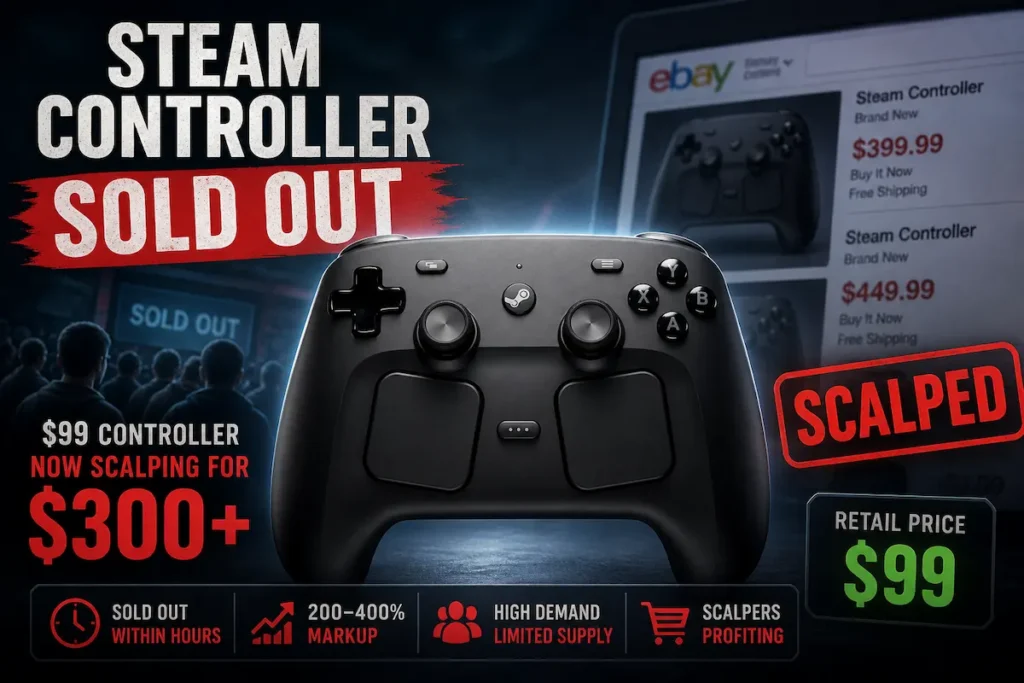
Valve’s latest Steam Controller has barely hit the market, and it’s already becoming a case study in modern gaming hardware shortages. Priced at $99, the controller reportedly sold out within hours of pre-orders opening—only to reappear on resale platforms at dramatically inflated prices.
Listings on secondary marketplaces are now reaching $300 to $500, turning what was meant to be an accessible premium controller into a high-margin opportunity for scalpers.
While early impressions of the device itself have been largely positive, the rollout is quickly shifting attention away from the hardware—and toward the ongoing problem of supply constraints in gaming peripherals.
What Happened
The new Steam Controller appears to have generated strong demand driven by a mix of Valve’s ecosystem momentum and renewed interest in PC-first gaming hardware.
Key factors behind the rapid sellout include:
- Improved hardware design: Early reports highlight upgraded ergonomics and more advanced haptic feedback compared to the original Steam Controller
- Steam ecosystem integration: Tight compatibility with Steam Input and the broader PC gaming ecosystem
- Steam Deck halo effect: Continued growth of Valve’s handheld platform has expanded interest in its accessories
Despite some retailers enforcing purchase limits, inventory was depleted almost immediately—suggesting either exceptionally strong demand, constrained supply, or a combination of both.
Secondary Market Explosion
Within hours of the sellout, resale platforms such as eBay were flooded with listings priced at 200% to 400% above retail.
This type of rapid price inflation has become increasingly common in gaming hardware launches, particularly for:
- Limited-run accessories
- High-demand GPUs and CPUs during shortage cycles
- New platform hardware with uncertain restock timelines
What stands out in this case is how quickly the pricing escalated—indicating that scalpers were prepared to act immediately, likely using automated purchasing tools or pre-positioned accounts.
The speed of this sellout suggests the problem isn’t just demand—it’s demand predictability. When a launch is clearly going to be hot and supply is limited, scalpers effectively treat it as guaranteed arbitrage.
A Familiar Pattern for Valve Hardware
This isn’t Valve’s first encounter with scalping.
The Steam Deck launch faced similar issues, though Valve attempted to mitigate them through a reservation queue system tied to Steam accounts. That approach helped reduce—but not eliminate—resale market exploitation.
Compared to the Steam Deck rollout, the controller situation appears more traditional—and more vulnerable:
- No extended reservation queue (based on early reports)
- Faster purchase cycles
- Lower price point, making bulk buying easier
In short, the same ecosystem that makes Valve hardware appealing also makes it predictable—and exploitable—during launches.
Why This Keeps Happening
The Steam Controller situation reflects broader structural issues in the gaming hardware market:
- Limited initial production runs: Companies often underestimate or deliberately cap launch supply
- Global supply chain constraints: Component sourcing, manufacturing slots, and logistics remain volatile
- Automated scalping tools: Bots can purchase inventory faster than human buyers
- Resale platform incentives: Marketplaces enable rapid flipping with minimal friction
For manufacturers, there’s a difficult balance between overproducing (risking excess inventory) and underproducing (fueling scarcity and scalping).
Ironically, scarcity can amplify brand visibility and perceived demand—but it also damages consumer trust when real buyers are consistently locked out of launches.
Community Reaction and Anti-Scalping Debate
The gaming community response has been swift, with frustration focused less on the controller itself and more on access.
Commonly proposed solutions include:
- Account-based purchase restrictions tied to play history
- Queue systems similar to the Steam Deck rollout
- Delayed shipment verification to deter bulk resellers
- Stronger retailer-level bot protection
However, each of these approaches introduces trade-offs in convenience, scalability, and global availability.
What This Means for Buyers
For now, potential buyers are left with two options:
- Wait for official restocks (likely at standard pricing)
- Pay inflated resale prices on secondary markets
Historically, Valve has replenished hardware supply over time, but the timeline can vary widely depending on production capacity and demand persistence.
Given the strong early interest, it’s likely that demand will remain elevated through the first few restock cycles.
What This Could Mean Next
The Steam Controller sellout is less about one product—and more about an ongoing shift in how gaming hardware launches behave.
As demand becomes more predictable and global audiences grow, launches increasingly resemble limited drops rather than traditional retail rollouts.
If this trend continues, companies like Valve may need to rethink launch strategies entirely, including:
- Pre-order reservation systems as standard practice
- Staggered regional releases
- Direct-to-consumer anti-bot infrastructure
Until then, the cycle is likely to repeat: high demand, limited supply, and a resale market ready to capitalize on the gap.
Source: Market listings and early retail availability data following Steam Controller pre-orders