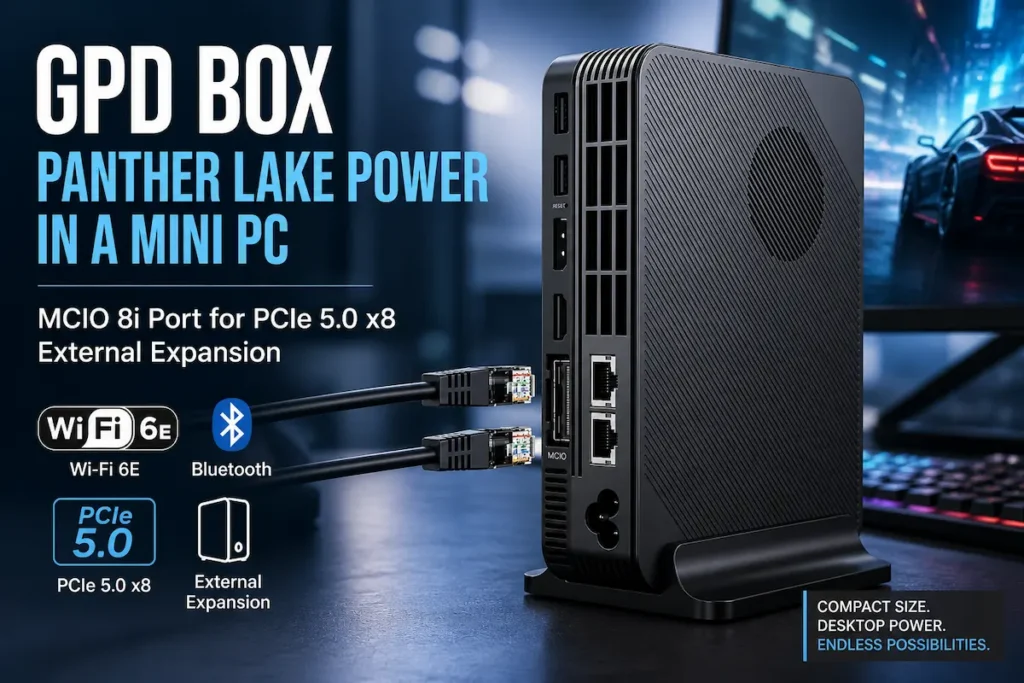
Mini PCs have long walked a fine line between size and capability. You get portability—but usually at the cost of upgradeability. With the newly unveiled GPD BOX, that tradeoff may be starting to break down.
Powered by Intel’s upcoming Panther Lake architecture, the system introduces an unusual feature for this category: an optional MCIO 8i port capable of delivering PCIe 5.0 x8 bandwidth externally. That single addition could reshape how enthusiasts and professionals think about small form factor systems.
Mini PCs have traditionally been “closed boxes.” By enabling high-bandwidth external PCIe expansion, the GPD BOX moves closer to a modular desktop model—just distributed across cables instead of inside a case.
What Happened
GPD has introduced the GPD BOX mini PC, built around Intel’s next-generation Panther Lake processors. While compact systems often prioritize efficiency over flexibility, this system takes a different approach by integrating an optional MCIO 8i interface.
This interface enables PCIe 5.0 x8 connectivity to external devices—something rarely seen outside of enterprise or workstation-class hardware. In practical terms, that means users can attach:
- External GPUs (eGPU setups)
- High-speed NVMe storage arrays
- AI accelerators or specialized PCIe cards
- Networking or capture hardware
All without needing a traditional desktop tower.
Panther Lake in a Small Form Factor
At the core of the system is Intel’s Panther Lake, expected to continue the company’s push toward more efficient hybrid architectures and improved AI capabilities.
While full specifications are still emerging, early expectations for Panther Lake center on:
- Improved performance-per-watt
- Stronger integrated AI acceleration
- Better thermals for compact systems
That combination matters for mini PCs, where thermal limits often define real-world performance more than raw specs.
The Real Story: MCIO 8i and External PCIe
The headline feature here isn’t just the CPU—it’s a shift in how expansion is handled.
The MCIO 8i port effectively externalizes high-speed PCIe lanes, allowing the system to offload demanding workloads to external hardware. Unlike Thunderbolt-based solutions, which can introduce bandwidth limitations, a direct PCIe 5.0 x8 link significantly increases available throughput.
That said, real-world performance will depend on how well external enclosures and cabling are implemented—an area where standards are still evolving.
This approach opens the door to configurations that were previously impractical for mini PCs:
- Desktop-class GPU performance via external enclosures
- Scalable storage solutions for creators and developers
- Modular AI compute setups using dedicated accelerators
If widely adopted, MCIO-style expansion could become the “new PCIe slot” for compact systems—shifting upgrades from internal slots to external modules without sacrificing performance.
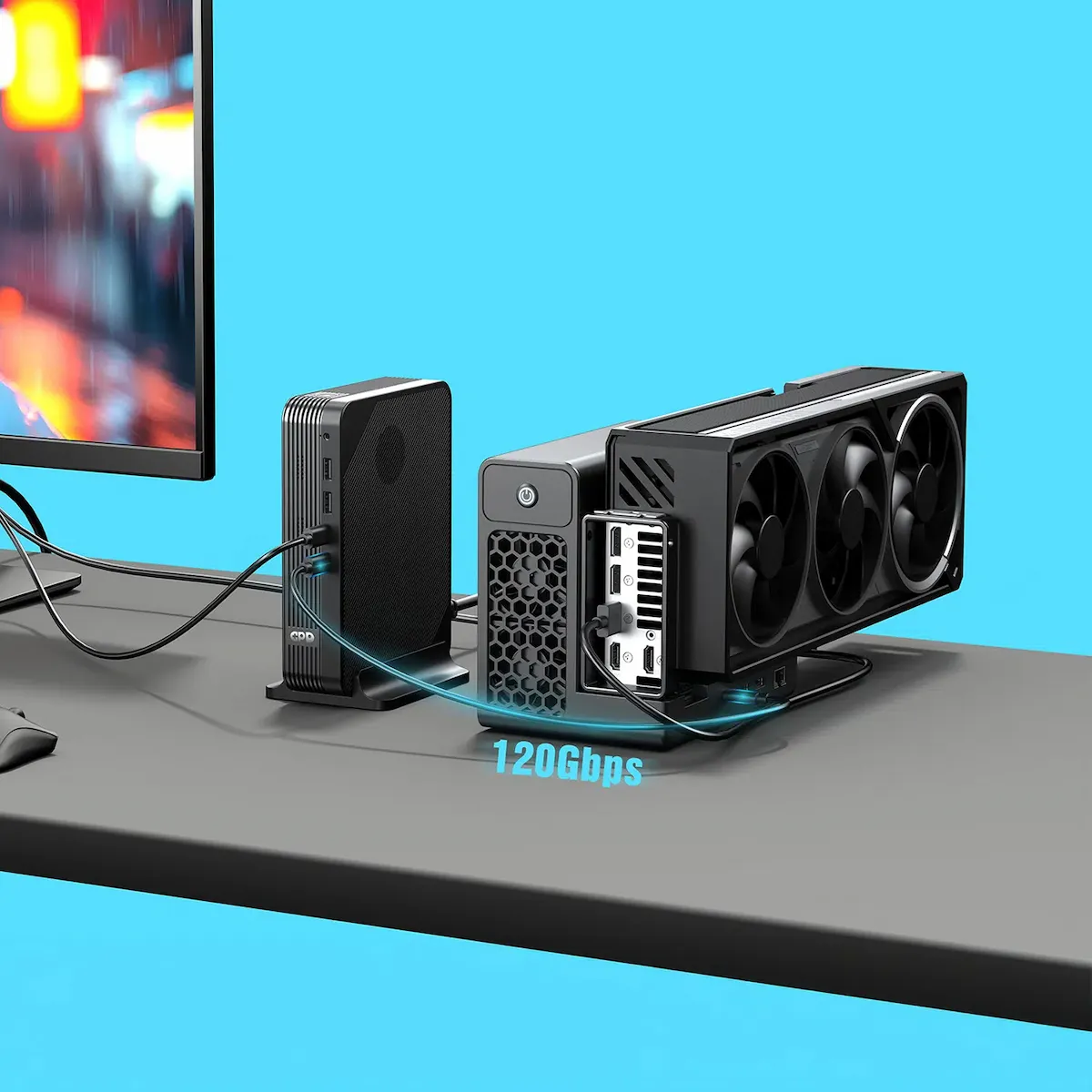
Image credit: GPD
This setup highlights the real advantage of MCIO-based expansion: instead of being locked into internal components, users can scale GPU, storage, or AI acceleration externally—bringing desktop-level flexibility to a mini PC form factor.
Why This Matters for Readers
The GPD BOX isn’t just another mini PC—it’s part of a broader shift in how computing hardware is being designed.
We’re already seeing similar trends across the industry:
- AI workloads pushing demand for flexible compute setups
- Rising memory and component costs changing build strategies
- Growing interest in compact, power-efficient systems
For context, we’ve already explored how hardware constraints are shaping buying decisions in Raspberry Pi vs Mini PC in 2026, and how compact systems are increasingly being used for local AI workloads in local AI system builds.
The GPD BOX sits right at the intersection of those trends—offering:
- Portability of a mini PC
- Scalability closer to a desktop
- Flexibility through external expansion
Cooling and Design Challenges
Fitting next-gen silicon into a compact chassis is never simple. While GPD hasn’t fully detailed its thermal solution, systems like this typically rely on:
- Vapor chamber cooling
- High-efficiency heat pipes
- Optimized airflow in tight enclosures
The success of the GPD BOX may ultimately come down to how well it balances performance with sustained thermal output—especially under workloads like gaming or AI inference.
What This Could Mean Next
The GPD BOX hints at a future where the line between mini PCs and desktops becomes increasingly blurred.
If the concept gains traction, we could see:
- Standardized external PCIe ecosystems
- More modular computing setups
- Mini PCs replacing traditional desktops in more use cases
It also aligns with a larger industry shift toward distributed computing setups—where processing, storage, and acceleration are no longer confined to a single box.
The real innovation isn’t just smaller hardware—it’s breaking the assumption that all performance has to live inside one machine. The GPD BOX is an early example of that shift.
Pricing and Availability
GPD has not yet confirmed pricing or release timing for the GPD BOX. Given the optional nature of the MCIO 8i port and the use of next-generation silicon, multiple configurations are likely.
As Panther Lake approaches launch, more concrete details around performance, thermals, and real-world use cases should emerge.
Bottom Line
The GPD BOX isn’t just another mini PC—it’s a concept that challenges how compact systems are built and expanded.
If external PCIe expansion becomes more mainstream, systems like this could redefine what “small form factor” really means—shifting from fixed hardware to flexible, modular computing.
For now, it’s an early look at a direction the industry may be heading.
Source: GPD product announcement and early specifications