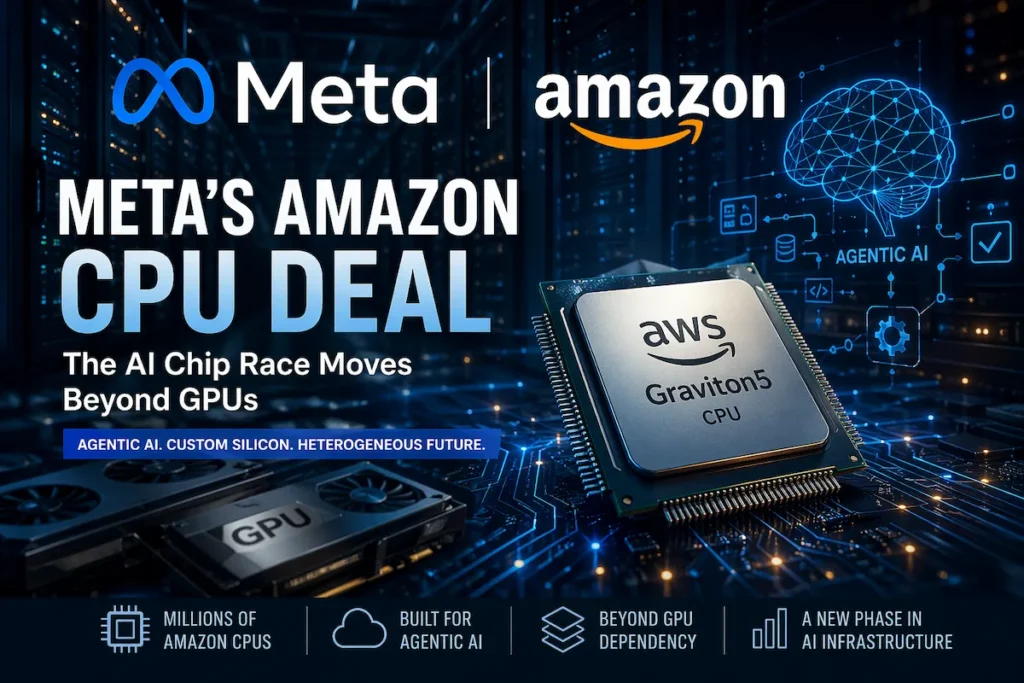
Meta’s reported deal to use Amazon-designed CPUs for AI workloads is a useful reminder that the AI hardware race is getting more complicated than the usual “who has the most GPUs?” conversation.
According to reporting from Reuters, Meta has entered a multiyear agreement with Amazon Web Services to use AWS Graviton5 central processing unit chips, with the deal expected to be worth billions of dollars. Axios separately reports that the arrangement involves tens of millions of Graviton cores for Meta’s next-generation AI systems.
The important part is not just that Meta is buying more compute. It is that the compute is CPU-based. For the past several years, the AI infrastructure story has mostly revolved around GPUs, especially Nvidia accelerators. But agentic AI workloads may require a broader hardware mix, where CPUs, GPUs, memory systems, networking, and custom accelerators all matter.
Meta’s reported Amazon CPU deal does not mean GPUs are suddenly less important. It means large AI systems are starting to look less like one giant accelerator cluster and more like a layered compute stack built around different kinds of work.
What Happened
Meta has reportedly signed a major deal with Amazon Web Services to use Amazon’s custom Graviton CPUs for AI infrastructure. Reuters describes the agreement as a multiyear deal involving AWS Graviton5 chips, while Axios reports that Meta will use tens of millions of Graviton cores.
That makes this different from the usual AI chip headline. This is not primarily about GPUs for training giant models. It appears to be about CPU-heavy AI workloads, including the kind of orchestration, decision-making, and service coordination needed for agentic AI systems.
Agentic AI generally refers to systems that do more than generate a single response. These systems may plan steps, call tools, manage context, retrieve information, write code, check results, and continue working through a task. That kind of workload can still involve GPUs, but it also creates heavy demand for CPUs and surrounding infrastructure.
What Is Confirmed vs. What Is Still Reported
Confirmed through available reporting: Meta has entered into a major AWS chip agreement involving Amazon-designed CPUs. Reuters identifies the chips as AWS Graviton5 CPUs and says the deal is expected to be worth billions of dollars.
Reported but not fully detailed: The exact number of chips, the final deployment scale, the performance characteristics, and the precise mix of workloads have not been fully disclosed. Axios reports the deal involves tens of millions of Graviton cores, which points to a very large CPU deployment.
Still unclear: We do not yet know how much of this will support inference, orchestration, coding agents, internal Meta systems, or broader AI services across Facebook, Instagram, WhatsApp, and Meta’s AI products.
Why CPUs Matter for Agentic AI
GPUs are excellent at massively parallel math, which is why they became the default hardware symbol of the AI boom. Training large models and running heavy inference workloads can require huge amounts of parallel compute.
But not every part of an AI system looks like that.
Agentic systems often involve branching logic, tool calls, memory lookups, scheduling, retrieval, code execution, safety checks, and state management. Those jobs can be more CPU-heavy because they depend on coordination, latency, memory access, and general-purpose execution rather than pure matrix math.
That is why this deal matters. It suggests Meta is not simply trying to add more raw accelerator power. It may be preparing for AI systems that behave more like distributed software platforms than single-shot chatbot engines.
This Does Not Replace GPUs
The easy mistake would be to frame this as “CPUs versus GPUs.” That is not really the story.
GPUs will remain central for training large models and handling many demanding inference jobs. Nvidia’s role in AI infrastructure is not disappearing because Meta is buying or renting a large number of Amazon CPU cores.
The better read is that AI infrastructure is becoming heterogeneous. A large AI platform may use GPUs for heavy model execution, CPUs for orchestration and agent workflows, specialized accelerators for inference, high-bandwidth memory for feeding models, and fast networking to keep the entire system moving.
In other words, the chip race is expanding. It is no longer only about who can secure the most GPUs. It is also about who can build the most efficient full-stack AI infrastructure.
Why Amazon Benefits
For Amazon, the Meta deal is a major validation of AWS custom silicon. Amazon has spent years building its own chip portfolio, including Graviton CPUs, Trainium AI training chips, and Inferentia inference chips.
If one of the world’s largest AI companies is willing to use AWS Graviton CPUs at this scale, it strengthens Amazon’s argument that cloud providers can offer more than rented Nvidia GPU capacity.
It also helps AWS compete against Microsoft Azure, Google Cloud, Oracle, and other infrastructure providers trying to win AI workloads. The long-term cloud fight is not just about who has available GPUs. It is about who can offer the best mix of chips, pricing, software integration, and scale.
Why Meta Benefits
For Meta, the deal gives it another path to scale AI infrastructure without depending entirely on one hardware supplier or one internal chip strategy.
Meta already has major AI ambitions across consumer products, advertising, recommendation systems, generative AI, coding tools, and future agentic assistants. Running those systems at Meta scale requires a huge amount of compute, and not all of it needs to sit on premium GPUs.
Using AWS Graviton CPUs could help Meta shift some workloads onto infrastructure that is better matched to CPU-heavy tasks. That could improve efficiency, reduce bottlenecks, and give Meta more flexibility as AI demand grows.
What It Means for Developers
For developers, this is another sign that AI deployment may become less GPU-centric over time.
Training frontier models will still require specialized accelerators. But the software wrapped around those models may increasingly run across CPU fleets, distributed services, databases, memory systems, and orchestration layers.
That could influence how agent frameworks, inference stacks, retrieval systems, and cloud tools are designed. Developers may need to think less in terms of “run everything on a GPU” and more in terms of matching each part of an AI workflow to the right hardware.
What It Means for Consumers
For everyday users, the impact will be indirect. Nobody is going to buy a Meta-branded Amazon Graviton chip for a gaming PC.
But this kind of infrastructure shift could affect the AI products people actually use. If companies can run agentic workloads more efficiently, AI assistants may become faster, cheaper to operate, and better at handling multi-step tasks.
That could matter for future assistants that book appointments, summarize ongoing work, manage files, write code, analyze documents, or coordinate across multiple apps in the background.
The consumer-facing result may not be a new device. It may be AI services that feel less like chat windows and more like active software helpers.
The Bigger Picture
Meta’s reported Amazon CPU deal is not just about experimenting with new types of AI hardware. It is about securing long-term access to compute in a market where supply, pricing, and availability have become strategic risks.
The early AI boom was defined by GPU scarcity. Demand for high-end accelerators surged faster than manufacturing capacity, driving up prices and forcing companies into long waitlists and aggressive procurement strategies. That environment has not disappeared—it has simply evolved.
What we are now seeing is a second phase of the AI infrastructure race, where major players are quietly diversifying their compute stacks to reduce dependence on any single chip category or supplier.
This shift is part of a broader competitive landscape that InsightTechDaily has previously described as a
five-way chip war shaping the future of AI PCs,
as well as a wider platform battle between
Nvidia, Apple, Qualcomm, and x86 players
competing to control different layers of the AI stack.
Deals like this allow companies such as Meta to:
- Lock in large volumes of compute capacity ahead of future demand
- Hedge against GPU shortages and pricing volatility
- Shift certain workloads onto more available and cost-efficient hardware
- Build infrastructure that can scale without being bottlenecked by one component
At the same time, companies like Amazon are using custom silicon such as Graviton to move further up the value chain, offering not just cloud capacity but tightly integrated hardware ecosystems.
This is why the AI chip race is becoming harder to define. It is no longer just about who has the fastest GPU or the largest cluster. It is about who can secure supply, control costs, and orchestrate an entire compute platform across CPUs, GPUs, accelerators, memory, and software.
The companies that win the next phase of AI will not just build better models. They will be the ones that quietly secure the hardware needed to run them at scale before shortages and pricing pressures hit the rest of the market.
In that context, Meta’s move looks less like a technical experiment and more like a strategic hedge—one that reflects how competitive and resource-constrained the AI infrastructure landscape has become.
What to Watch Next
The next question is whether other large AI companies follow Meta’s path and start talking more openly about CPU-heavy agentic infrastructure.
It will also be worth watching whether AWS turns this into a broader selling point for enterprise AI customers. If Graviton CPUs become part of the standard pitch for agentic AI, Amazon could use this deal as proof that its custom silicon strategy is paying off.
For now, the takeaway is simple: GPUs are still the star of AI hardware, but they are no longer the whole story.
Source: Reporting from Reuters, Axios, and TechCrunch-style story notes reviewed by InsightTechDaily.