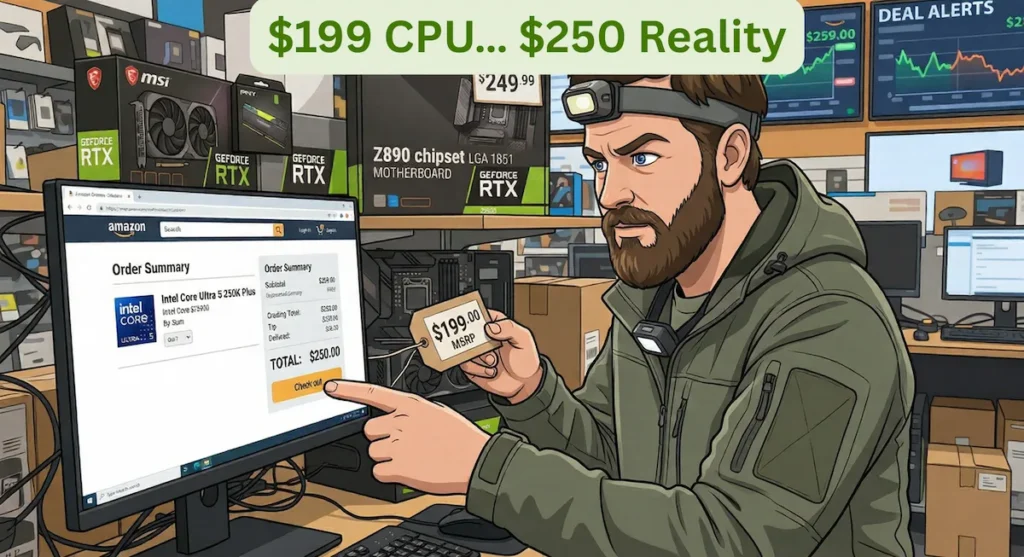
Intel’s $199 “Budget King” Isn’t So Cheap: Core Ultra 5 250K Plus Prices Climb Well Above MSRP
Intel’s push to reclaim the mid-range CPU market has officially arrived with the Core Ultra 5 250K Plus, part of the “Arrow Lake Refresh.” On paper, this chip is a value disruptor, launching with an aggressive $199 MSRP aimed directly at AMD’s Ryzen 5 lineup.
In reality, however, early retail pricing tells a different story—…and it’s one Deal Hunter Dan has seen before. The same pricing pressures are already showing up across Intel’s broader lineup, including systems featured in our best Panther Lake laptops of 2026, where next-gen performance is arriving alongside higher real-world costs.
The $199 MSRP vs. Real-World Pricing
Within days of launch, the gap between Intel’s suggested price and actual checkout pricing has widened significantly. As of late March 2026, listings across major retailers show consistent markups:
- Newegg: Around $219.99 (~10% above MSRP)
- Amazon: First-party inventory depleted, third-party listings reaching $250–$257
- Micro Center: In-store pricing near $249.99 depending on region
This isn’t unusual for a high-demand launch—but it does undermine Intel’s “sub-$200 budget king” positioning, at least in the short term.
Why Prices Are Climbing
This surge isn’t just early adopter hype. Initial independent benchmarks suggest the 250K Plus is delivering exceptional multi-threaded performance for its class, thanks to its 18-core (6P + 12E) configuration.
In productivity workloads, the chip is reportedly competing with CPUs that launched at nearly double the price just one generation ago. Combined with support for DDR5-7200, it’s quickly becoming a go-to option for budget workstation builds—not just gaming rigs.
Dan’s Note: When a “budget” CPU starts replacing last year’s $350–$400 chips in real workloads, MSRP becomes more of a suggestion than a reality. The market corrects fast—and usually upward.
The Real Cost: Platform Matters More Than the CPU
The bigger issue for buyers isn’t just CPU pricing—it’s platform cost.
The 250K Plus requires Intel’s LGA 1851 ecosystem, meaning new Z890 or B860 motherboards. Right now, even entry-level boards are hovering around $170+, with higher-end options climbing well beyond that.
To fully leverage the chip’s performance advantages, builders are also pushed toward high-speed DDR5-7200 memory, further increasing total system cost.
In practice, this means the “budget” CPU often sits inside a non-budget platform, reinforcing a trend we’ve been tracking in the broader AMD vs Intel mid-range CPU value war, where total system cost—not just chip pricing—is defining real value.
AMD Responds With Aggressive Pricing
AMD has already moved to defend its position. The Ryzen 5 9600X is now widely available in the $185–$195 range, undercutting Intel’s real-world pricing.
More importantly, AMD’s mature AM5 platform offers significantly cheaper motherboard options, particularly with B650 boards frequently dropping below Intel’s entry pricing.
For gaming-focused builds, this keeps AMD firmly in the lead for performance-per-dollar, even as Intel’s new chip pushes ahead in multi-threaded workloads.
Verdict: Great CPU, Bad Timing (For Buyers)
The Core Ultra 5 250K Plus is, without question, one of the most compelling mid-range CPUs Intel has released in years.
But pricing reality matters:
- Under $215: Strong buy, especially for productivity workloads
- $220–$240: Competitive, but platform costs become a factor
- $250+: Hard to justify for gaming builds
For now, Deal Hunter Dan’s advice is simple: wait if you can.
Supply is likely to stabilize in the coming weeks, and early-launch premiums tend to fade quickly. Paying a 20–25% markup on a “budget” CPU defeats the entire point of the product.
Stay tuned to InsightTechDaily for ongoing coverage of CPU pricing trends, platform costs, and real-world value analysis as the 2026 Spring hardware cycle unfolds.