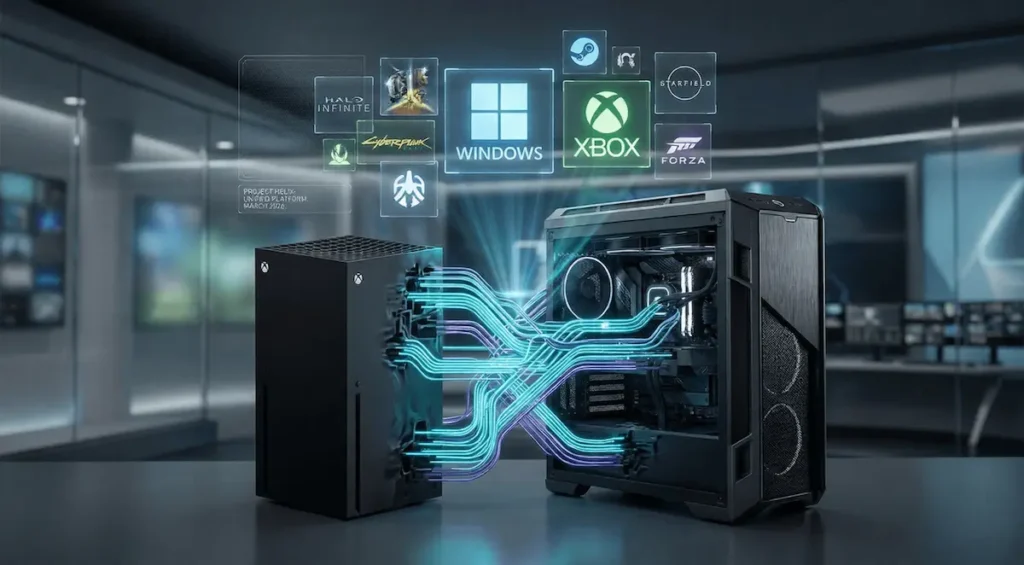
Concept illustration of Microsoft’s rumored Project Helix architecture bridging Xbox and Windows PC gaming.
For decades, the gaming industry has operated with a clear divide: consoles and PCs. Each platform had its own architecture, operating system, and software ecosystem. But Microsoft may be preparing to erase that distinction.
According to discussions emerging around GDC 2026, Microsoft’s next-generation Xbox — internally known as Project Helix — is reportedly designed to run both Xbox games and native PC titles. If accurate, the move represents one of the most significant architectural shifts in console history.
Instead of treating the Xbox as a closed gaming platform, Helix could transform it into something closer to a Windows-based gaming appliance designed for the living room.
From Console Hardware to a Unified Gaming Platform
Since the Xbox One generation, Microsoft has steadily moved toward aligning the Xbox ecosystem with Windows.
Examples include:
- Xbox titles launching simultaneously on PC
- Xbox Play Anywhere cross-platform purchases
- Game Pass operating across console and PC
- Shared DirectX graphics technologies
Project Helix appears to push that strategy much further by potentially allowing native PC binaries to run directly on Xbox hardware.
In practical terms, that could mean a future where the Xbox functions less like a traditional console and more like a specialized gaming PC with a console interface.
What Running Native PC Games Actually Means
Running native PC titles would represent a major departure from the traditional console model.
Historically, console games are compiled specifically for fixed hardware environments. PC games, on the other hand, must support a wide range of GPUs, CPUs, and memory configurations.
If Project Helix supports native PC binaries, Microsoft likely achieves this through:
- A Windows-based system architecture
- Standardized GPU driver layers
- A console-optimized compatibility environment
- DirectX feature parity with Windows PCs
The result could be a system where developers build primarily for PC while maintaining seamless compatibility with Xbox hardware.
The Unified Memory Trade-Off
One of the most interesting engineering questions surrounding Project Helix involves memory architecture.
Consoles typically use unified memory, allowing the CPU and GPU to share the same memory pool. This approach simplifies development and allows hardware to allocate resources dynamically.
PC gaming systems, by contrast, use separate pools:
- System RAM
- Dedicated VRAM on the GPU
If Helix blends console-style unified memory with PC software compatibility, developers may need to account for both memory models when optimizing games.
This could create interesting trade-offs between:
- Console-level efficiency
- PC-level flexibility
This architectural direction also aligns with the broader trajectory of Xbox hardware. Microsoft has already been signaling a heavier focus on AI-enabled gaming hardware for the next generation, including the AMD-powered silicon expected for the 2027 Xbox platform.
What This Means for Gaming PCs
If the next Xbox effectively becomes a standardized gaming PC, it could reshape the broader gaming hardware market.
For many players, the appeal of consoles has always been simplicity:
- No hardware compatibility concerns
- No driver management
- Predictable performance targets
A Windows-based Xbox capable of running PC games would deliver many of those benefits while expanding the available library dramatically.
That could place pressure on the entry-level gaming PC market, particularly for users who primarily play mainstream PC titles available through storefronts like Steam.
Project Helix vs Steam Machines vs Traditional Consoles
Microsoft’s rumored Project Helix platform also arrives at a moment when the boundaries between consoles and PCs are already beginning to blur.
Valve’s Steam Deck and the growing ecosystem of handheld gaming PCs have demonstrated that many players are comfortable running PC games on hardware that behaves more like a console.
If Project Helix allows native PC titles to run on Xbox hardware, the next console generation could represent a new category of gaming device: a standardized living-room gaming PC.
| Platform | Operating System | Game Compatibility | Hardware Model | Primary Advantage |
|---|---|---|---|---|
| Traditional Consoles | Custom console OS | Console-specific builds | Fixed hardware | Developer optimization and simplicity |
| Steam Machines / SteamOS | Linux (SteamOS) | PC games via Proton compatibility layer | PC-style hardware | Large PC game library in a console-style interface |
| Microsoft Project Helix | Windows-based architecture | Native Xbox and PC binaries | Standardized console hardware | Unified ecosystem across console and PC |
If Microsoft succeeds in bridging these ecosystems, the next generation of gaming hardware may look less like competing console platforms and more like different form factors for the same underlying PC gaming environment.
The Handheld Gaming Factor
Another emerging factor is the rapid growth of Windows-based gaming handhelds.
Devices such as handheld PCs have demonstrated that players are increasingly comfortable with PC games running on console-style hardware.
If Microsoft unifies the Xbox and Windows gaming ecosystems more tightly, it could create a consistent experience across:
- Living-room consoles
- Desktop gaming PCs
- Portable gaming handhelds
That strategy would mirror Microsoft’s broader vision of making Windows the central platform for gaming regardless of device type.
A Strategic Shift in the Console War
Microsoft’s approach also contrasts with how other platform holders appear to be navigating the next generation of hardware.
Sony continues to lean heavily into its blockbuster exclusive strategy and remake-driven catalog expansion, as seen in its evolving PlayStation roadmap heading into 2026. Nintendo, meanwhile, is facing rising manufacturing pressures as memory and component prices increase ahead of the Switch successor, which could influence how aggressively the company prices its next console generation.
Rising component costs — particularly memory — are already creating pricing challenges for hardware makers, a factor highlighted in recent reporting on how Nintendo is navigating growing cost pressure ahead of the Switch 2.
If Project Helix delivers on its rumored capabilities, Microsoft could differentiate itself not just through hardware performance, but through ecosystem flexibility.
Instead of competing purely on console hardware power, the next phase of the console war may increasingly revolve around:
- Game libraries
- subscription services
- storefront ecosystems
- cross-device compatibility
The Bigger Picture
The long-standing divide between consoles and PCs has already been narrowing for years. Project Helix suggests Microsoft may be ready to remove that boundary entirely.
If successful, the next Xbox generation could mark the moment when consoles stop being separate computing platforms and instead become purpose-built gaming PCs designed for the living room.
For developers and players alike, that would represent one of the most significant shifts in gaming hardware design in decades.