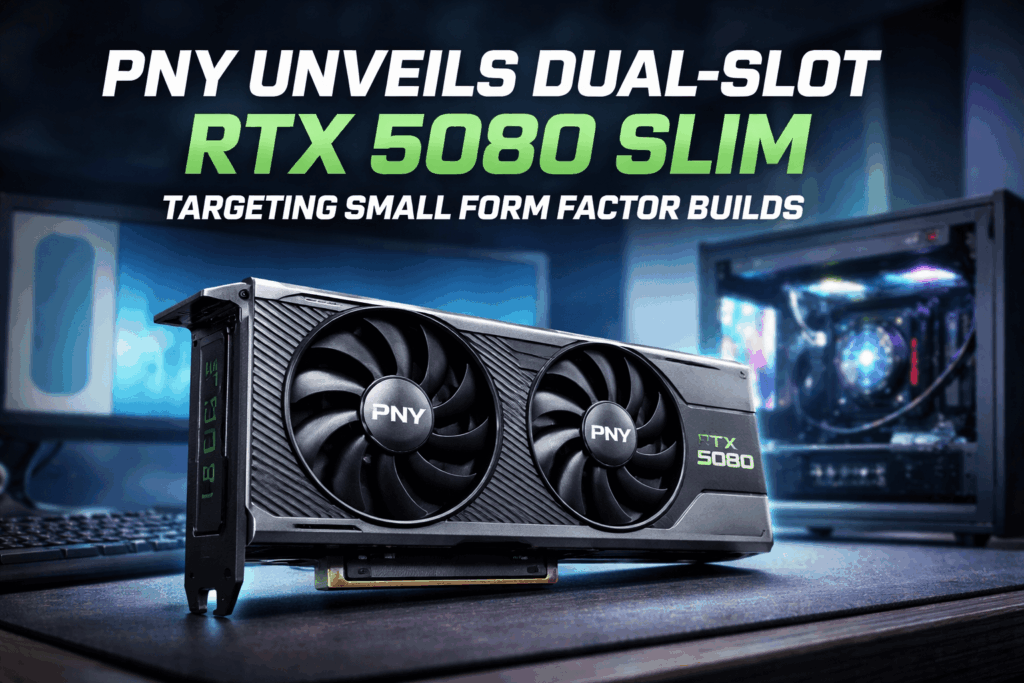

When flagship graphics cards routinely approach the size and weight of small appliances, any move in the opposite direction tends to attract immediate attention. That’s precisely what happened when PNY revealed new dual-slot, dual-fan RTX 5080 “Slim” models designed explicitly for compact PC builds.
At a glance, the pitch sounds simple: a high-end Blackwell-generation GPU that fits into a traditional two-slot footprint. In practice, it puts a spotlight on a real engineering tension across PC hardware—escalating performance demands versus the physical constraints of Small Form Factor (SFF) systems.
This breakdown covers what PNY has actually announced, what remains unconfirmed, and why a slim RTX 5080 could matter beyond one product cycle.
Quick Take: Why This Matters
- Two-slot GPUs are still a hard limit for a large portion of popular ITX/SFF cases.
- “Slim” at the high end typically means trade-offs: thermals, noise, and sustained clocks—not necessarily peak FPS.
- If it sells, others follow: successful slim high-end designs tend to force the rest of the market to respond.
The Context: GPUs Keep Growing, Cases Don’t
Over the past several generations, graphics cards have expanded in almost every dimension. Triple-slot coolers, extended PCB lengths, and towering heatsinks are now common at the high end, driven by three overlapping forces:
- Rising power draw, which requires larger cooling solutions
- Higher sustained boost behavior, which depends on thermal headroom
- More consumer tolerance for size in mid-tower and full-tower cases
For builders using Mini-ITX or compact micro-ATX enclosures, those trade-offs are far less forgiving. Many SFF cases simply can’t accommodate GPUs thicker than two slots (or longer than ~300 mm) without significant compromises elsewhere.
PNY’s RTX 5080 Slim models are aimed directly at that constraint.
What PNY Announced — and What It Didn’t
Confirmed Details
Based on PNY’s initial product briefing and spec sheets, these elements are presented as established:
- Dual-slot thickness (roughly 40–42 mm)
- Dual-fan cooling design
- NVIDIA Blackwell architecture base
- Standard RTX 5080 silicon (not positioned as a cut-down SKU)
- Explicit SFF positioning for compact builds
Importantly, these appear positioned as alternatives to oversized triple-fan partner models—not as budget or “eco” variants.
Still Unconfirmed or Early-Stage
Several details that matter to real-world builders remain unclear or only partially disclosed:
- Final boost clock behavior
- Power limit (TBP) relative to reference RTX 5080
- Whether factory OC trims will be offered
- Noise profile under sustained gaming load
- MSRP and region-by-region availability
- Launch window timing and first-wave inventory
Notably, PNY has avoided making sweeping thermal or acoustic claims. That restraint is worth paying attention to—slim high-end designs usually win on fit first, and everything else second.
Engineering a Slim RTX 5080: The Real Trade-Offs
Fitting a flagship-class GPU into a dual-slot form factor is less about a miracle breakthrough and more about disciplined compromise.
Cooling Density vs. Heat Output
Even with an efficiency-focused generation, the RTX 5080 still lives in a power envelope that challenges compact coolers. To make a dual-slot design viable, PNY’s approach appears to lean on:
- High-density fin stacks
- Shorter vapor chamber layouts or flattened heat pipes
- Airflow tuning over raw surface area
In plain terms: expect fan speed to do more of the work than it would on a triple-slot cooler. That doesn’t automatically mean “loud,” but it often means more audible under sustained load.
Clock Behavior Over Peak Performance
Slim cards typically trade sustained boost behavior for form factor compatibility. Peak performance may look close to larger cards in short bursts, but longer sessions can reveal:
- Slightly lower average clocks
- Earlier thermal saturation
- More conservative power limits
For SFF builders, that trade is often acceptable—because the alternative is “it doesn’t fit,” or “it fits but breaks the rest of the build plan.”
Why Dual-Slot Still Matters in 2026
It’s tempting to treat two-slot as a legacy target in an era of bigger GPUs, but it remains a critical threshold for several practical reasons.
Case Compatibility
A large portion of popular ITX cases (including sandwich-style and console-inspired layouts) are designed around strict two-slot clearances. Once a card exceeds that, builders run into cascading limitations:
- Reduced CPU cooler height
- Incompatible side panels
- Restricted airflow paths
- Harder cable routing and tighter bends
Motherboard and PCIe Layouts
Dual-slot cards reduce conflicts with adjacent PCIe slots, M.2 placement, riser routing, and front-panel cable paths—issues that scale disproportionately in small enclosures.
Weight and Structural Stress
Slimmer cards can also place less mechanical strain on PCIe slots and riser cables, which matters more in vertical mounts and travel-oriented builds.
SFF Gaming Isn’t a Niche Anymore
One of the biggest signals here isn’t just the product itself—it’s the acknowledgment of demand. Small Form Factor gaming has evolved from a hobbyist subculture into a meaningful segment driven by:
- Urban living spaces and smaller desks
- Desk-first setups (minimal footprint)
- Console-replacement PCs
- LAN-friendly portability
Case makers, PSU vendors, and cooling specialists have already adapted. GPUs have been slower to follow, largely due to thermal realities. PNY’s move suggests that balance may be shifting.
How This Fits Into NVIDIA’s Broader Ecosystem
Even as a board-partner design, this reflects broader platform realities around Blackwell.
Efficiency Enables New Form Factors
Architectural emphasis on efficiency doesn’t just benefit laptops and data centers—it also gives partners more freedom to explore compact designs without catastrophic performance loss.
Partner Differentiation Is Back
When demand spikes, differentiation collapses and availability becomes the product. Slim RTX 5080 cards represent a return to segmentation based on use case—not just factory overclocks or cosmetic shrouds.
Practical Implications for Builders
Build Flexibility
- Easier integration into sub-20-liter cases
- Fewer compromises on CPU cooling
- Reduced need for case mods
Thermal Planning Still Matters
A slim GPU doesn’t eliminate heat—it redistributes it. Case airflow, fan curves, intake/exhaust balance, and component placement remain critical.
Noise Expectations Should Be Realistic
Compact coolers tend to be more audible under load. If “near silent” is the priority, a larger cooler in a bigger case will still have the advantage.
Market Impact: Will Others Follow?
Historically, slim high-end GPUs influence competitors only if they sell. If PNY’s RTX 5080 Slim cards deliver:
- Acceptable thermals
- Competitive real-world performance
- Manageable acoustics
…then similar designs from other board partners are likely to follow. If not, the market may drift back toward oversized coolers as the “safe default.” Either way, the experiment itself is notable.
What This Means for the Future of SFF PCs
PNY’s announcement doesn’t end the “bigger GPUs” trend—but it complicates it. The bigger takeaway is that efficiency increasingly offers alternatives: physical scaling may become a choice rather than a necessity.
For SFF builders, that’s a meaningful shift.
Bottom Line
PNY’s dual-slot RTX 5080 Slim models won’t appeal to everyone—and they aren’t trying to. They target a long-standing gap in the high-end GPU market: strong performance options for genuinely compact systems.
The trade-offs are real, and expectations should be calibrated accordingly. But in a landscape dominated by ever-larger cards, simply offering a high-end alternative that fits where others won’t is a statement in itself.
Sometimes, smaller really is the point.