Apple’s next Mac mini may be less about a new look and more about what is happening inside the box.
Following the major redesign that arrived in late 2024, the expected 2026 Mac mini refresh appears aimed at boosting AI capability, memory headroom, and bandwidth for heavier desktop workloads. If the current reporting holds, Apple’s next compact desktop could further position itself as a serious option for creators, developers, and power users who want more performance without stepping all the way up to a Mac Studio.
Here is what to expect from Apple’s 2026 Mac mini refresh, and why it could matter more than a routine chip update.
The M5 and M5 Pro Are Expected to Lead the Refresh
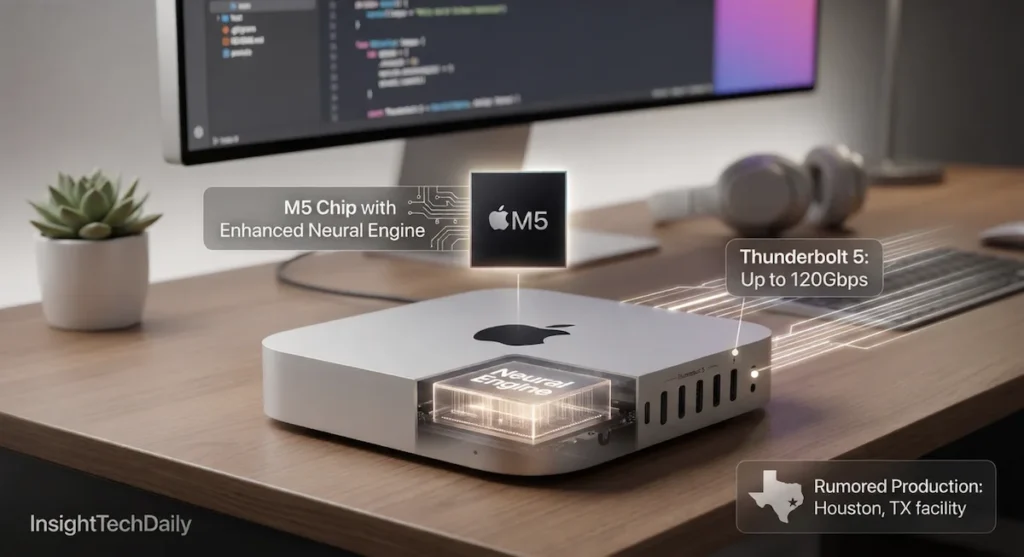
The headline feature of the 2026 Mac mini will likely be Apple’s move to the M5 chip family. While the M4 generation helped bring the Mac mini deeper into Apple’s AI era, the next step is expected to focus on stronger performance-per-watt, more capable on-device AI handling, and better graphics throughput.
That matters because the Mac mini is no longer just a small office desktop. For a growing number of buyers, it is becoming a compact machine for photo and video work, coding, music production, and increasingly, local AI-assisted tasks. A stronger Neural Engine and GPU would make that positioning more credible.
The M5 Pro variant is also expected to remain important for users who need more memory and sustained performance. Rumors suggest Apple could continue pushing higher unified memory ceilings, which would help narrow the gap between the Mac mini and more expensive workstation-class systems.
Why AI Performance Matters More in 2026
One of the bigger shifts around this refresh is timing. In 2026, “AI-ready” hardware is no longer just marketing language. Buyers are beginning to judge systems based on how well they handle local assistants, creative AI tools, transcription, image generation, and automation features without leaning entirely on the cloud.
That does not mean the Mac mini suddenly becomes an enterprise AI box. But it does mean Apple has a clear incentive to make the M5 generation better at handling these workloads efficiently. For many users, especially those already deep in the Apple ecosystem, a more AI-capable Mac mini could be more appealing than a larger, louder desktop tower.
Could Apple Finally Move Beyond 256GB at the Entry Level?
One of the most practical rumored changes for the 2026 model is a possible shift in base storage. Analysts and supply-chain chatter have pointed to the chance that Apple could finally move the Mac mini’s entry tier from 256GB to 512GB.
If that happens, it would be a meaningful quality-of-life improvement. Modern apps are larger, media libraries keep growing, and AI-related assets can consume storage quickly. A 512GB starting point would make the base system feel more reasonable in 2026, even if it comes with a modest price increase.
For buyers, that would be easier to justify than another year of paying Apple’s premium upgrade pricing almost immediately after purchase.
Thunderbolt 5 Could Be a Bigger Deal Than It Sounds
Another expected upgrade is Thunderbolt 5, particularly on higher-end Mac mini configurations. On paper, it is a connectivity improvement. In practice, it could be one of the most useful real-world upgrades in the entire refresh.
More bandwidth means better support for fast external storage, more demanding docks, and high-resolution multi-display setups. For video editors, photographers, developers, and anyone building a compact desk setup around external gear, this is the kind of feature that can noticeably improve day-to-day use.
It also helps Apple continue pushing the Mac mini as a desktop that can scale up through accessories rather than through internal expandability, which has never really been its design philosophy.
The Houston Manufacturing Angle Could Matter Too
Another interesting part of the 2026 Mac mini story is the possibility of expanded U.S.-linked production. Recent reporting has pointed to Houston, Texas, as a meaningful location in Apple’s manufacturing and assembly plans for some Mac mini output.
If that becomes more central to the 2026 rollout, it would reflect a broader supply-chain strategy rather than just a PR talking point. Apple, like much of the tech industry, has been under pressure to diversify production and reduce some of the risks tied to concentrated overseas manufacturing.
For U.S. buyers, that may not dramatically change the buying experience overnight, but it could help with fulfillment, customization turnaround times, and supply resilience if Apple scales the effort meaningfully.
Why the 2026 Refresh Arrives at an Important Moment
The broader PC and component market also gives this Mac mini update extra relevance. Memory and storage markets remain sensitive, and AI infrastructure demand continues to put pressure on supply chains. High-memory systems and premium configurations across the industry have not always been as easy to find or as stable in price as buyers would like.
That makes the 2026 Mac mini refresh more than just another annual chip bump. For Apple, it is a chance to reset the product with stronger specs, cleaner positioning, and potentially better alignment with what desktop buyers actually need now.
In other words, this refresh could help define whether the Mac mini remains a “small Mac for basic users” or evolves further into a compact performance desktop with real prosumer appeal.
Expected Release Window
Apple has not officially announced the 2026 Mac mini, but the most likely windows remain a spring launch or a reveal around WWDC. A spring release would fit Apple’s tendency to update Macs outside of its fall iPhone cycle, while a WWDC appearance would make sense if Apple wants to tie the hardware more directly to its software and AI roadmap.
Until Apple says otherwise, buyers should treat the timing as informed expectation rather than confirmation.
The InsightTechDaily Take
For Intel Mac mini owners or users still running an early Apple silicon model like the M1, the 2026 Mac mini is shaping up to be a very compelling upgrade point. Better AI capability, likely stronger graphics performance, improved connectivity, and the possibility of a more sensible storage baseline all add up to a machine that could feel much more modern without losing the Mac mini’s compact appeal.
For people who already bought into the redesigned M4 generation, the story is different. This looks more like a refinement than a revolution. The chassis is already modern. The likely gains are inside the system: efficiency, performance tuning, bandwidth, and AI readiness.
That may still be enough to matter. In 2026, the Mac mini is no longer interesting just because it is small. It is interesting because Apple appears determined to make that small box do a lot more.