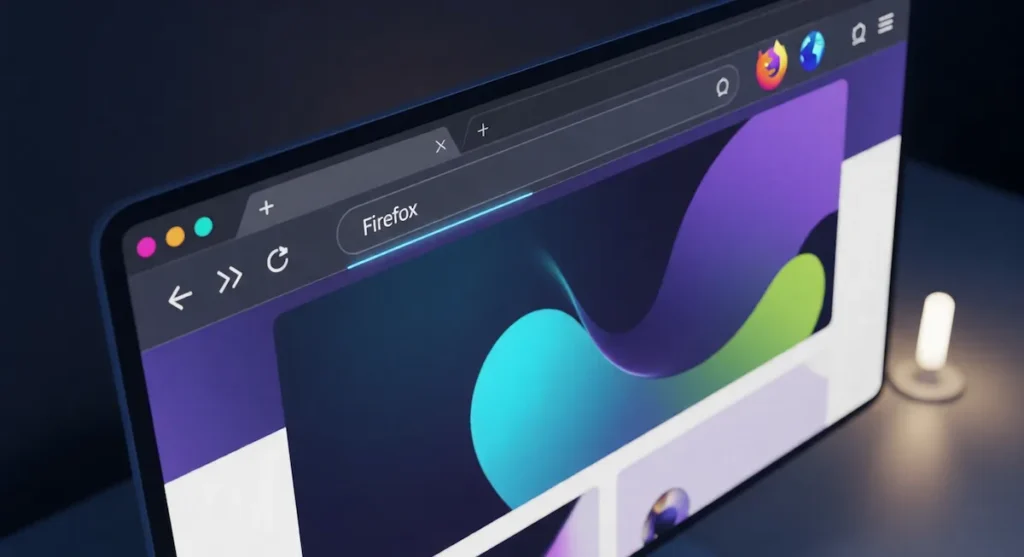
Firefox’s Project Nova May Signal a Bigger Browser Shift — But Mozilla Still Has to Prove It
Mozilla is preparing one of the biggest Firefox redesigns in years, but the real story may not be the interface—it may be the strategy behind it.
According to reporting from PCWorld, Project Nova represents a significant refresh of Firefox’s design, with early indications pointing toward deeper customization, tighter integration of Mozilla services, and potential AI-driven features. On the surface, it sounds like a long-overdue UI update. But step back, and this starts to look like something bigger: a test of what the modern web browser is supposed to be in 2026.
What Happened
Mozilla is reportedly working on Project Nova, a major redesign of Firefox—the first of this scale in roughly six years. The update is expected to modernize the browser’s interface while introducing more personalization options and potentially integrating AI-powered features directly into the experience.
At the same time, Mozilla continues to emphasize its privacy-focused ecosystem, including services like Firefox Monitor and Relay, suggesting that Nova may not just be about visuals, but about how the browser connects to a broader set of tools.
In short, this is not just a coat of paint—it’s a repositioning effort.
Why This Matters for Readers
For most users, web browsers have felt “finished” for years. Chrome, Edge, and Safari all deliver similar performance, similar features, and increasingly similar experiences. The battleground shifted away from innovation and toward defaults, ecosystems, and convenience.
Project Nova suggests that may be changing.
Instead of competing purely on speed or compatibility, Mozilla appears to be leaning into a different idea: the browser as a personalized computing layer. That includes:
- More control over layout and appearance
- Built-in privacy tools as core features, not add-ons
- Potential AI-assisted browsing experiences
- Deeper integration with services beyond just syncing tabs
If that sounds familiar, it should. The industry is already moving toward AI-powered assistants, local inference, and more context-aware software. The browser—where most users actually spend their time—may be the most logical place for that transformation to happen.
Firefox’s redesign isn’t happening in a vacuum. It reflects a broader shift where the browser could evolve from a passive tool into an active layer for AI, privacy, and user control. The question is whether users actually want that—or if they’re comfortable with the status quo.
The Real Story: Who Can Afford to Take Risks?
This is where Firefox’s smaller market share becomes an advantage—not a weakness.
Browsers like Chrome, Safari, and Edge are deeply tied to massive ecosystems. Chrome is a gateway to Google’s services and advertising engine. Safari is tightly integrated into Apple’s hardware strategy. Edge is part of Microsoft’s broader Windows and AI push.
That scale brings power—but also constraints.
When you dominate the market, radical change becomes risky. Even small interface shifts can frustrate millions of users, disrupt workflows, or impact revenue-critical behaviors.
Mozilla operates under a different set of incentives.
With a much smaller share of the browser market, Firefox has more room to experiment. It can take bigger swings, test new ideas, and rethink what a browser should be—because it has less to lose if those changes don’t immediately land.
But there’s another layer here that often gets overlooked.
Mozilla is not just competing for users—it’s competing for the direction of the web itself.
As an open-source, non-profit-backed organization, Mozilla has long positioned Firefox as part of a broader mission to support an open and accessible internet, emphasizing privacy, interoperability, and user control over platform lock-in.
That changes how you interpret Project Nova.
This isn’t just a company trying to regain market share. It’s a player trying to prove that the browser can evolve without becoming a closed, AI-driven platform controlled by a single ecosystem.
In that sense, Firefox’s willingness to take risks may not just be about survival—it may be about preserving an alternative path forward.
If the browser becomes the front-end for AI assistants and digital identity, the question isn’t just which browser wins—it’s whether that future is controlled by a few platforms or remains part of the open web. Firefox’s strategy suggests Mozilla sees that risk coming early.
This ties directly into a broader trend we’re already seeing across the industry.
As explored in The Future of Agentic Operating Systems, software is increasingly shifting toward AI-driven, context-aware systems that act on behalf of the user.
At the same time, the idea of “peak hardware” suggests that differentiation is moving away from devices and toward software layers that sit on top of them.
The browser sits directly in the middle of both trends.
If Mozilla is right, the next browser war won’t be about speed or extensions—it will be about who controls the layer where AI, identity, and everyday computing converge.
Is This the Beginning of a Browser Shift?
It’s tempting to call Project Nova the start of a fundamental change in web browsers—but that would be premature.
Right now, what we have is a signal, not a confirmed shift.
For Nova to matter beyond Firefox itself, one of two things needs to happen:
- Users respond strongly, forcing competitors to react
- Other browsers independently move in the same direction
Until then, Chrome, Edge, and Safari are likely to remain relatively conservative—iterating on AI features and services, but without dramatically rethinking the browser experience.
That’s the paradox: the biggest players have the most influence, but often the least flexibility.
What This Could Mean Next
If Mozilla executes well, Project Nova could reintroduce the idea that browsers are still worth competing over—not just maintaining.
That could lead to:
- More aggressive differentiation between browsers
- Faster integration of AI into everyday browsing
- A renewed focus on privacy as a core feature, not a setting
- A shift toward more customizable, user-controlled experiences
If it doesn’t land, however, it may reinforce a different reality: that the browser market is largely settled, and most users are unlikely to switch platforms for interface or feature changes alone.
Either way, Project Nova is worth watching—not because it guarantees a revolution, but because it highlights a moment where one company is willing to try.
And in a market that has felt increasingly static, that alone makes it interesting.